A custom performance powerboat can contain remarkable materials, sophisticated electronics, powerful propulsion, complex paint, and an extensive list of options and still fail to feel truly bespoke. The missing element is often not equipment. It is direction.
The strongest commissions begin with a point of view: a clear sense of how the boat should look, how it should be used, what should matter most from the helm, and what kind of experience the owner wants the machine to create. That point of view does not need to be theatrical. In fact, it is often most convincing when it is disciplined enough to exclude ideas that do not belong.
This is what separates a private commission from a highly optioned purchase. One starts with a product and adds features. The other starts with intent and asks every major decision to support it.
A Point of View Comes Before an Options List
Option sheets are useful because they organize decisions. They make complex products easier to configure and give owners a clear way to compare available equipment. But they are not a substitute for vision.
Without an underlying point of view, customization can become additive. One attractive feature leads to another. A dramatic paint idea is combined with a highly detailed interior, multiple contrasting finishes, extra technology, and additional visual accents simply because each one is appealing on its own. The finished boat may contain excellent components while lacking a clear identity.
A stronger commission reverses the sequence. Before asking which upgrades are available, the owner decides what the boat should feel like. Technical and restrained? Bold but clean? Focused primarily on long days at the helm? Designed around social weekends and destination runs? Visually connected to another machine in a collection, or intentionally unlike anything else the owner already has?
Those questions create a filter. Once the direction is clear, options become easier to judge because every choice can be measured against the larger idea.
Taste Is Revealed by What Is Left Out
Luxury is often associated with abundance, but sophisticated specification depends just as much on omission.
A boat does not become more personal because every available surface is customized. It becomes more personal when the selected details reflect a coherent taste. Restraint allows the strongest decisions to carry more weight.
This is familiar in architecture, automotive design, watches, and tailored interiors. The most memorable objects are rarely those in which every possible gesture has been used at once. They are the ones where proportion, color, material, and detail appear to belong to the same idea.
Performance powerboats benefit from the same discipline. A large hull offers enormous visual opportunity, which makes editing especially important. Paint can either clarify the form or compete with it. Interior materials can establish atmosphere or fragment it. Technology can support the helm or overwhelm it.
The point of view determines when enough is enough.
Intended Use Gives the Commission Its Structure
A private commission should also reflect how the owner expects to spend time aboard.
Two owners may admire the same underlying platform but imagine completely different days on the water. One may care most about the operating experience and spend much of the day at the helm. Another may organize weekends around friends, waterfront dining, and destination runs. Another may want the boat to complement a larger yacht or sit naturally alongside a collection of performance automobiles.
Those differences should influence the specification.
The importance of intended use is not that every preference requires a structural change. A proven platform still has its own engineering logic and boundaries. The value lies in prioritization. Seating, storage, helm equipment, materials, visual treatment, and other configurable details can be approached with a clearer hierarchy when the owner knows what kind of ownership experience matters most.
The result feels deliberate because practical decisions and aesthetic decisions are responding to the same brief.
Personal References Can Create a More Original Boat
Experienced owners rarely develop taste in one category alone. Their preferences are often shaped by years around automobiles, architecture, aviation, watches, furniture, art, and other designed objects.
Those references can be useful when commissioning a boat, but the best results come from interpretation rather than imitation.
A favorite automotive color may inspire a hull finish, but the scale and reflections of a boat are completely different from those of a car. An aircraft cabin may suggest a disciplined material palette without requiring the boat to mimic aviation literally. Architectural minimalism may influence the treatment of surfaces and contrast while still respecting the demands of a marine environment.
The point is not to collect recognizable motifs from other luxury categories. It is to understand what the owner responds to in those objects and translate that sensibility into marine form.
That process creates originality because the finished boat emerges from a personal combination of references rather than from a generic idea of what a luxury performance boat is supposed to look like.
The Builder’s Point of View Matters Too
A successful private commission is not created by the owner alone.
The builder needs a strong identity of its own. Without one, customization can become an exercise in saying yes to everything. That may produce difference, but it does not necessarily produce quality.
The best relationships occur when an owner with clear preferences works with a builder that has equally clear standards about design, engineering, materials, execution, and the integrity of the platform. The owner contributes taste and intent. The builder contributes technical judgment and the ability to translate that intent into a coherent machine.
This is where collaboration becomes more valuable than unlimited choice.
Adrenaline Powerboats describes its philosophy as “Art in Motion” and says its designs are developed in-house from 3D CAD through CNC work and the finished product. The company also states that it uses custom paint on every boat and that each boat is rigged in-house to the specification of the individual build. Those practices create a natural framework for a commission in which owner preferences can enter a process that still has a distinct design philosophy of its own.
A Strong Commission Should Still Look Like the Machine It Is
Personalization is most convincing when it strengthens rather than erases the identity of the underlying boat.
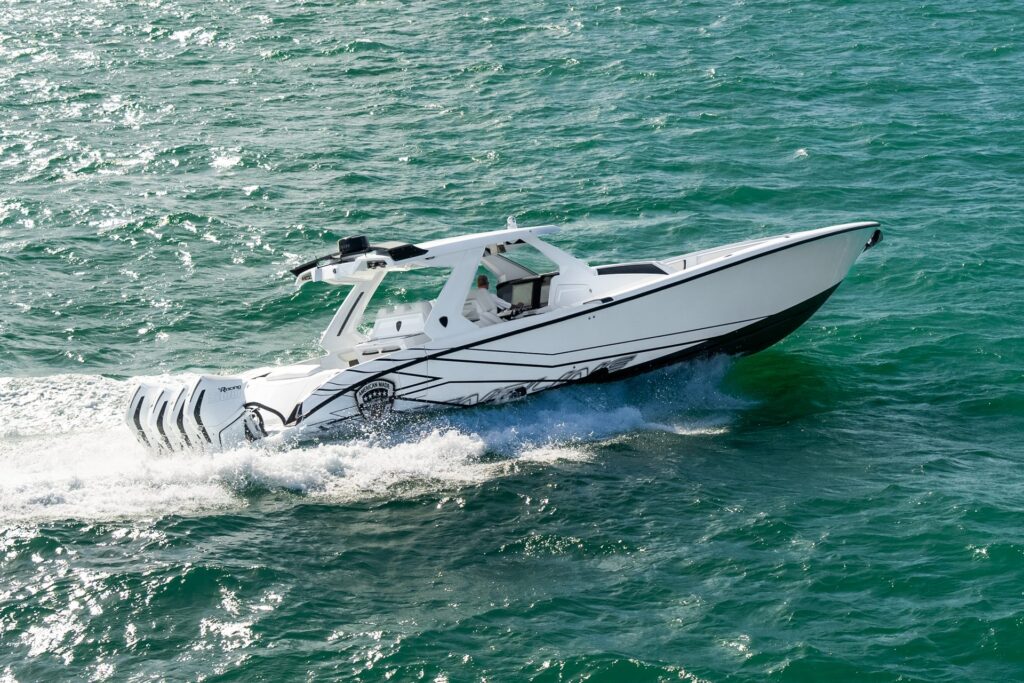
A Reaper should not need to become visually unrecognizable in order to feel personal. Its platform, proportions, and performance-oriented character provide the foundation. The commission then determines how one particular example will express that foundation.
This is similar to commissioning a significant automobile in an unusual but carefully judged specification. The model’s identity remains intact, yet color, interior, and detail can make the individual example memorable. The tension between recognizable design and personal interpretation is part of what gives the object depth.
When customization overwhelms the original architecture, the owner may gain novelty at the expense of coherence. When it works with the architecture, the machine feels more specific without feeling less authentic.
That balance is one of the clearest signs that the commission began with a point of view rather than a desire to make every component different.
Paint Is Often the Clearest Expression of Intent
Few decisions reveal a commission’s point of view as quickly as paint.
A performance boat presents a vast visual surface. Color can emphasize length, sharpen the relationship between upper and lower surfaces, reveal curvature, or alter the apparent weight of the hull. Graphics can reinforce motion or create unnecessary complexity. A finish can feel technical, understated, dramatic, classic, or deliberately unconventional depending on how it is handled.
Because paint has such immediate visual power, it needs to belong to the larger brief.
Adrenaline states that custom paint is used on every boat and that its design team works closely with customers to tailor the process to their specifications. That approach is particularly relevant to a private commission because paint can become the visible expression of decisions established much earlier: how bold the boat should feel, what other machines or environments it should relate to, and how the owner wants the design to age over time.
The best paint concept is not simply the one that attracts the most attention at delivery. It is the one that still feels inevitable after the owner has seen the boat hundreds of times.
The Helm Should Reflect the Owner’s Priorities
The point of view behind a commission is not only visual.
The helm is where the owner will repeatedly encounter the machine’s functional priorities. Technology, information hierarchy, seating, controls, and the surrounding cockpit environment should support the way the boat is expected to be used.
An owner who values technical clarity may prefer a clean interface with only the equipment that contributes meaningfully to operation. Another may place greater importance on expanded navigation, communications, or other configurable systems. The right answer depends less on how much technology can be installed than on what technology deserves to occupy the operator’s attention.
This is another area where experienced ownership becomes valuable. People who have spent substantial time around serious machinery tend to become more selective. They learn that one well-integrated feature can be more satisfying than several additions that create complexity without improving the experience.
A clear point of view helps technology remain part of the boat rather than becoming the subject of the boat.
Coherence Is More Difficult Than Individuality
Making a boat different is relatively easy. Making it coherent is much harder.
Difference can be achieved through an unusual color, a rare material, or a surprising combination. Coherence requires all of those decisions to make sense together and to support the boat’s intended use.
That is why the best private commissions often appear simpler than the amount of thought behind them. The finished machine may not advertise every decision because many of the choices exist to reinforce one another quietly. A material may repeat a tone already present in the paint. A cockpit treatment may deliberately step back so the exterior can carry more visual drama. Functional equipment may be integrated so cleanly that its importance becomes apparent only in use.
This kind of coherence is difficult to produce by accident.
It comes from returning repeatedly to the same question: does this belong to the boat we are trying to create?
A Point of View Gives the Boat Longevity
Fashion changes quickly in every luxury category. Certain colors become fashionable, technology changes, graphics evolve, and visual trends move from rare to common with surprising speed.
A boat specified only around what feels current is vulnerable to that cycle. A boat built around a personal point of view has a better chance of remaining satisfying because its decisions were not made primarily to follow the market.
That does not guarantee timelessness. No owner or designer can know exactly how taste will evolve. But authenticity tends to age better than imitation.
When an owner can explain why the major decisions were made, those decisions retain meaning even after the broader market has moved elsewhere. The boat remains connected to a specific vision rather than a passing collection of desirable features.
This is particularly valuable for owners who expect to keep meaningful machines rather than replace them simply because a newer model has arrived.
The Private Commission Is Really an Exercise in Clarity
The greatest luxury in a bespoke project may not be the number of choices available. It may be the opportunity to become precise about what matters.
A private commission asks the owner to move beyond broad preferences such as “luxurious,” “aggressive,” or “custom.” Those words are too general to guide a serious machine. The process becomes more interesting when the owner can articulate a deeper direction: how the boat should feel from a distance, what atmosphere the cockpit should have, which experiences matter most, which details deserve emphasis, and which ideas should be excluded.
That clarity gives the builder something meaningful to interpret.
For Adrenaline, an in-house design process, custom paint, and build-specific rigging provide practical ways for that interpretation to carry into the finished product. Its current site continues to present the Reaper 42 and Reaper 47 as distinct performance platforms while supporting individualized builds through the company’s broader custom approach.
The best performance boats therefore do not begin with the longest option list. They begin with a reason for every major choice.
A point of view makes customization more disciplined, collaboration more productive, and the finished boat more difficult to confuse with something assembled from fashionable parts. It turns the commission into an expression of judgment rather than abundance.
That is what gives a bespoke machine conviction.
For owners ready to define the idea behind their next Reaper before choosing the details, explore the custom Reaper inquiry process.