A custom performance powerboat can be assembled from excellent ingredients and still feel unresolved. The paint may be dramatic, the upholstery expensive, the electronics extensive, and the hardware carefully selected, yet the finished boat can lack the sense that every decision belongs to the same object. That is the difference between customization and cohesion.
Cohesion is what happens when individual choices stop competing for attention and begin reinforcing one another. Exterior color supports the shape of the hull. Interior materials continue the same visual attitude instead of introducing an unrelated one. Technology is integrated around how the owner uses the boat rather than installed simply because it is available. Functional priorities, visual decisions, and performance goals all point in the same direction.
This kind of specification is harder than choosing premium options. It requires editing, hierarchy, and an understanding that the strongest custom boats are not necessarily the ones with the most visible customization. They are the ones in which every important choice feels intentional.
A Specification Should Read as One Idea
The first test of a cohesive specification is whether the boat can be described with a clear idea rather than a list of features. A boat may be technical and restrained, bold and graphic, understated and architectural, or deeply performance-focused with luxury expressed through precision rather than decoration. Any of those directions can work if the details support the same concept.
Problems appear when the specification contains several competing personalities. A highly complex exterior graphic may fight with an interior built around quiet minimalism. Bright accent colors can become distracting when they appear across too many unrelated surfaces. Technology can overwhelm a cockpit whose visual strength depends on simplicity.
A cohesive boat does not require every element to match literally. In fact, exact repetition can become predictable. The goal is relationship. Colors, textures, materials, finishes, and equipment should feel as though they were selected by the same person for the same reason.
Paint Sets the Visual Hierarchy
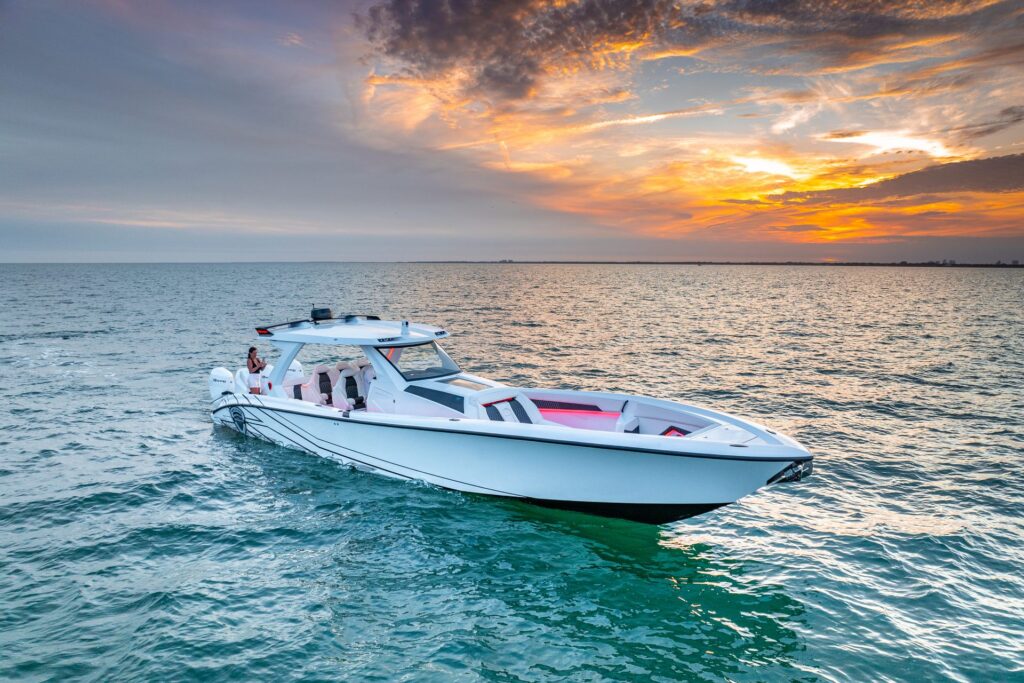
Exterior paint often establishes the first and strongest layer of identity because the hull provides such a large canvas. It can make the boat feel lower, longer, more technical, more formal, or more expressive before anyone sees the cockpit.
That means paint should establish hierarchy rather than consume it.
If the hull carries a complex visual concept, the interior may benefit from greater restraint. If the exterior is monochromatic or deliberately minimal, the cockpit can carry more texture or contrast without making the complete object feel busy. The strongest specifications understand where the visual emphasis belongs.
Adrenaline Powerboats states that custom paint is used on every boat and that its design team works closely with customers to tailor each result to their specifications. That matters because paint is not simply a final color choice in a bespoke build. It can become the visual framework around which the rest of the specification is organized.
Interior Materials Should Continue the Story
The cockpit should not feel like a separate design project that happened after the exterior was finished.
Upholstery color, stitching, flooring, visible carbon, hardware finishes, painted components, and helm surfaces all affect how the owner experiences the transition from viewing the boat at a distance to stepping aboard. The most resolved builds preserve continuity between those two perspectives.
That does not mean copying exterior colors directly into every interior surface. A better approach may be to echo one tone, repeat a material character, or preserve the same level of visual restraint. A dramatic exterior can be balanced by a calmer cockpit. A dark technical exterior may be softened with materials that still feel purposeful but make long days aboard more inviting.
The key is avoiding arbitrary contrast. Every material should have a reason to be there beyond the fact that it was available.
Technology Needs to Belong to the Helm
Modern performance boats can carry substantial electronics, but technological abundance can easily undermine visual cohesion if the helm becomes a collection of screens, controls, mounts, and devices that appear independently added.
A better specification begins with information hierarchy.
The owner should understand which data and controls matter most while operating the boat. Display size, placement, switching, navigation equipment, communications, and secondary functions can then be organized around those priorities. The objective is not to minimize technology. It is to prevent technology from becoming visual and functional clutter.
The current Reaper 42 specification, for example, lists dual 19-inch Garmin helm screens, a single 27-inch Garmin helm screen, digital switching, digital shift and throttle control, and autopilot among its published equipment. The significance of these features in a cohesive specification is not the number of systems involved, but the need to integrate them into a helm that still feels deliberate and understandable.
Performance Priorities Should Shape the Specification
A cohesive powerboat is not created through aesthetics alone. The boat’s intended performance role should influence the rest of the specification.
An owner focused on long destination runs may prioritize visibility, seating support, navigation, storage, and a cockpit environment that remains comfortable after hours underway. Another owner may care more deeply about the driver experience and want the specification to emphasize helm clarity, technical materials, and a more focused atmosphere. A boat intended to complement a yacht may be configured around a different mix of usability, visual distinction, and day-trip capability.
These are not merely functional choices. They change how the boat should look and feel.
A performance-focused specification should not carry decorative ideas that undermine its sense of purpose. Likewise, a boat designed around social weekends should not feel unnecessarily austere simply because the platform is capable of serious performance. Cohesion means allowing the intended use to influence both the practical and visual character of the build.
Hardware and Small Details Matter More Than They Seem
Large decisions establish the direction, but small details determine whether that direction survives close inspection.
Cleats, hinges, grab points, trim, fasteners, switch panels, door hardware, and visible structural elements can either support the boat’s broader design language or quietly interrupt it. These components do not need to become decorative features, but their finish and integration matter because the owner encounters them repeatedly.
A blacked-out technical theme may be weakened by several unrelated bright finishes. A more traditional stainless treatment may feel inconsistent if the surrounding design is intentionally minimal and monochromatic. The best approach depends on the boat, but consistency creates credibility.
This is where careful specification begins to resemble industrial design. The owner may not consciously identify every successful detail, yet the complete object feels more resolved because fewer elements appear accidental.
Restraint Is a Design Tool
Customization creates the temptation to keep adding.
Once a builder offers custom paint, engine paint, electronics upgrades, material choices, visual carbon, lighting, and other options, it becomes easy to believe that selecting more will make the boat feel more bespoke. Often the opposite is true.
Restraint gives important elements room to work.
A single distinctive exterior color can have more impact than several competing graphics. One carefully used accent can feel more deliberate than accents repeated across every available surface. A clean helm can appear more sophisticated than one filled simply because equipment could be added.
This does not mean the best specifications are always minimal. A highly expressive boat can still be cohesive. The requirement is discipline. Complexity needs structure just as much as simplicity does.
Customization should create identity, not noise.
The Exterior and Interior Should Meet at the Helm
The helm is one of the most important transition points in the entire boat because it connects exterior identity, cockpit architecture, technology, materials, and the owner’s direct operating experience.
A cohesive specification treats the helm as part of the complete visual language.
If the exterior is technical and purposeful, the helm should not suddenly feel ornamental. If the boat uses a more refined and understated palette, the displays and controls should be integrated in a way that preserves that calm. Steering, throttles, seating, and visible materials should feel as though they belong to the same machine seen from outside.
Adrenaline’s current Reaper 42 and Reaper 47 both publish dual-row helm seating for six, wraparound coaming bolsters, multiple storage spaces, and marine-grade upholstery among their cockpit features. The Reaper 47 also lists carbon-fiber hardtop legs and windshield frame as part of its construction. These details show how cockpit function, structural expression, and material character can intersect within one design environment.
A Cohesive Specification Ages Better
One of the best reasons to prioritize cohesion is longevity.
Trends change quickly. A finish that feels current today may become strongly associated with a particular period. Electronics evolve. Color preferences move. Graphics styles cycle between minimal and elaborate. A specification built mainly around fashion may therefore age faster than one built around a clear internal logic.
Cohesion helps because the owner can still understand why the choices belong together even after the market moves elsewhere.
A boat with disciplined relationships between paint, materials, hardware, helm design, and intended use has a stronger chance of remaining satisfying because its identity was not assembled from unrelated trends. It was built around a consistent idea.
This is similar to the way well-specified collector automobiles can remain attractive long after newer models arrive. The appeal comes from the completeness of the individual example. Nothing needs to be the most fashionable choice if everything feels correct together.
Build-Specific Rigging Supports the Same Principle
Cohesion extends beneath the visible surfaces.
A custom boat can look highly resolved while feeling less convincing if systems, rigging, electronics, and equipment have been added without a clear plan. Functional organization is part of the same discipline that governs paint and materials.
Adrenaline says every boat it builds is rigged in-house and that rigging is entirely specified for each build. Combined with in-house design and custom paint, that creates a process in which visible and technical decisions can remain connected rather than being treated as unrelated stages.
This matters because a cohesive specification is ultimately about integration. The owner should not feel that one part of the boat was customized while another was simply filled with whatever fit. The technical environment should reflect the same level of intent as the visual one.
A Great Specification Creates Hierarchy
The strongest custom builds usually contain a clear hierarchy of importance.
Perhaps the exterior paint is the hero and the cockpit intentionally supports it. Perhaps the helm is the focal point, with materials and technology organized around the owner-driver experience. Perhaps the specification is intentionally restrained so that proportions and craftsmanship carry more of the visual weight.
Hierarchy prevents every element from demanding equal attention.
That principle is common across architecture, automotive design, interiors, and product design because the eye needs somewhere to rest. When every surface is treated as a statement, no statement remains particularly strong. When certain elements lead and others support, the complete object feels more sophisticated.
A performance powerboat benefits enormously from this approach because its scale offers so many opportunities for expression. The builder and owner do not need to use all of them.
The most confident choice is sometimes knowing which areas should remain quiet.
The Options List Is Only the Raw Material
A custom specification ultimately succeeds or fails after the options list has done its job.
Paint, upholstery, electronics, engines, hardware, carbon details, storage, seating, and other equipment are raw materials. They create possibilities, but they do not create coherence automatically. That requires judgment.
The owner needs a clear sense of what the boat is supposed to be. The builder needs the ability to translate that intent across design, materials, systems, and execution. Decisions have to be evaluated in relation to one another rather than approved independently.
This is where a custom Reaper can become more than a recognizable platform with unusual options. Adrenaline’s in-house design, custom-paint approach, and build-specific rigging provide a framework in which the individual specification can be treated as one integrated project rather than a sequence of disconnected selections.
The result should not make the owner think about how many options were chosen. It should make the owner feel that nothing important could be changed without disturbing the balance of the whole.
That is what makes a powerboat specification truly cohesive.
For owners ready to move beyond individual options and shape a Reaper as one complete idea, explore the custom Reaper build process.