Some machines are easy to replace. They may be impressive, capable, beautifully made, and exciting to own, yet when the next generation arrives the decision feels straightforward. The newer machine is faster, more advanced, more comfortable, or simply more current, and the old one moves on without much hesitation.
Others are different. Their value grows less dependent on specifications as time passes. The owner becomes familiar with the way they sound, the way the controls fall to hand, the particular color seen in changing light, and the memories attached to specific trips, people, and places. Eventually the question is no longer whether something newer exists. The question is whether something newer could replace what this particular machine has become.
Collectors understand this instinct immediately. A car may remain in a garage long after objectively superior alternatives appear. A watch may become more important because of the years it has spent on a wrist. A motorcycle may stay because its quirks are part of its appeal. An aircraft can acquire a familiarity that transforms it from equipment into a trusted companion. Performance boats can develop the same gravity.
Collecting Is Not Always About Acquisition
The popular image of collecting emphasizes accumulation: more cars, more watches, more art, more machines. Serious collectors often discover that the harder skill is deciding what deserves to remain.
A collection becomes more coherent when every object has a reason to be there. One car may represent a specific era of engineering. Another may have an exceptional specification. A watch may stay because it was present for an important period of life. A motorcycle may survive because no later model has reproduced the same mechanical character.
The same principle applies to a performance boat.
At first, the boat may enter the collection because of design, capability, rarity, or the simple desire to experience something different. Years later, its reason for staying may be entirely different. The original appeal becomes layered with familiarity, memory, and the knowledge that replacing the machine would mean losing a combination of qualities that cannot be ordered again in precisely the same form.
That is when ownership moves beyond acquisition.
Familiarity Can Become More Valuable Than Novelty
New machines have an obvious advantage: novelty. Everything demands attention. Paint appears more dramatic because it has not yet become familiar. The cockpit feels like a new environment. Controls, sound, acceleration, and even routine tasks carry a sense of discovery.
Novelty is powerful, but it is temporary.
Familiarity develops more slowly. The owner learns how the boat behaves in different conditions, how it feels with a familiar group aboard, which details matter most after a long day, and what routines make ownership easier. The helm becomes instinctive. Storage locations become automatic. The owner knows how the boat looks at dawn, at midday, and under marina lighting at the end of the evening.
That familiarity can create a form of attachment that a new specification sheet cannot compete with.
This is one reason collectors sometimes keep machines that no longer represent the technical peak of their category. The relationship has become experiential rather than comparative. The object is valued not simply for what it can do, but for how well the owner knows it.
Specification Can Make a Boat Difficult to Duplicate
Customization adds another layer to this attachment because a highly specific machine can become difficult to reproduce.
Two boats from the same model line may share the same basic architecture while feeling completely different in person. Paint, upholstery, materials, electronics, rigging, and other choices can create a distinct identity. When those decisions were made thoughtfully, the individual boat may feel less like an example of a model and more like a singular object.
This matters when replacement is considered.
A newer boat may offer updated technology or different capabilities, but will it carry the same balance of color, materials, restraint, and personality? Will the helm feel as natural? Will the visual identity be as satisfying? Will the next specification accidentally chase novelty instead of reproducing the qualities that made the existing boat worth keeping?
Collectors of automobiles know this problem well. A rare color combination or unusually coherent factory specification can make one example far harder to replace than its model designation suggests. A performance powerboat can create the same challenge on a larger scale.
The more personal the boat becomes, the less meaningful simple model-to-model comparison becomes.
Memories Attach Themselves to Physical Details
Machines become emotionally durable because memory needs somewhere to live.
A certain seat becomes associated with the friend who always chooses it. A section of deck recalls a particular trip. A paint color becomes inseparable from photographs taken over several seasons. The helm carries the memory of early departures, long runs, difficult conditions handled well, and quiet returns when the day seemed to end too quickly.
These associations are rarely planned. They accumulate.
Over time, the boat becomes the physical setting for a private archive of experiences. Replacing it means more than trading one machine for another. It means changing the object through which many of those memories are recalled.
This is not sentimental in a shallow sense. Enthusiast culture has always been built partly on emotional memory. People remember the sound of a parent’s car, the first motorcycle they learned to ride, the watch received for a milestone, or the aircraft that marked a particular period in their career. Mechanical objects become important because human experience collects around them.
A performance boat is especially suited to this because ownership is social as well as mechanical. The machine is experienced with other people and in places that can carry strong associations of their own.
Mechanical Character Creates Attachment
Not every machine feels replaceable even when newer alternatives are objectively better.
Collectors often talk about character because it describes qualities that resist measurement. Throttle response, sound, steering feel, vibration, seating position, control weight, and the way a machine delivers its performance can create a personality that is immediately recognizable to the owner.
Performance boats have their own version of this.
The relationship between hull, propulsion, steering, sound, cockpit, and water produces a dynamic signature. An owner who has spent hundreds of hours aboard begins to recognize that signature intuitively. The boat does not simply travel across the water; it moves in a way the owner understands.
This familiarity can become one of the strongest arguments for keeping a machine.
Technical progress may improve many things, but progress does not guarantee that every subjective quality will be preserved. Sometimes what disappears is precisely what made an earlier machine interesting.
Condition and Care Become Part of the Relationship
Collectors tend to care differently for machines they expect to keep.
Maintenance stops being merely a requirement for continued operation and becomes part of preservation. Records matter more. Paint and materials are cared for with a longer time horizon. Repairs are approached with greater attention to maintaining the integrity of the original specification.
That attitude can change the boat itself.
A performance boat that is carefully maintained over years acquires continuity. The original design remains legible. Custom details remain intentional rather than buried under a succession of unrelated modifications. The machine ages, but it does not lose its identity.
This is where provenance becomes personal. The owner may not be preserving the boat for a future auction catalog or public history. The records matter because they tell the story of stewardship.
There is satisfaction in knowing where the boat has been, what has been done to it, and why certain decisions were made. The longer the ownership continues, the more complete that record becomes.
Some Machines Earn a Permanent Role
A mature collection does not need every machine to serve the same purpose.
A yacht may remain because it offers extended comfort and entertaining space. A collector car may stay because of design or driving character. A motorcycle may provide a more elemental experience. An aircraft may exist because it transforms distance. A performance boat occupies yet another role: direct engagement with the water, a strong mechanical experience, and the ability to share that experience with several people at once.
Once a machine has established a clear role, replacement becomes less urgent.
The owner no longer asks whether the newest alternative is superior in every measurable way. Instead, the question becomes whether the existing machine still delivers something distinctive within the collection.
If it does, keeping it can make more sense than replacing it simply because time has passed.
This is one of the differences between collecting and consumption. Consumption assumes that newer should displace older. Collecting allows different eras, technologies, and experiences to coexist because their differences are the point.
The Boat Can Become a Reference Point
Certain machines eventually become benchmarks against which later purchases are judged.
A collector may describe a new car in relation to a favorite older one. A watch may be evaluated against the proportions of a piece that has remained in the collection for years. The same thing happens with boats.
An owner who has spent substantial time with a well-specified performance boat develops a clearer understanding of what matters. Seating preferences become more precise. Helm expectations rise. Material choices are judged against real experience. The owner knows which visual decisions still feel correct after years and which trends have aged poorly.
The existing boat becomes a reference point.
Even if another machine is eventually commissioned, the one that stayed longest may influence the next specification more than any brochure or showroom display. Its strengths become requirements. Its weaknesses become lessons.
That influence is another form of permanence.
Adrenaline and the Value of an Individual Build
For a custom builder, this possibility begins with creating enough individuality for a boat to develop an identity of its own.
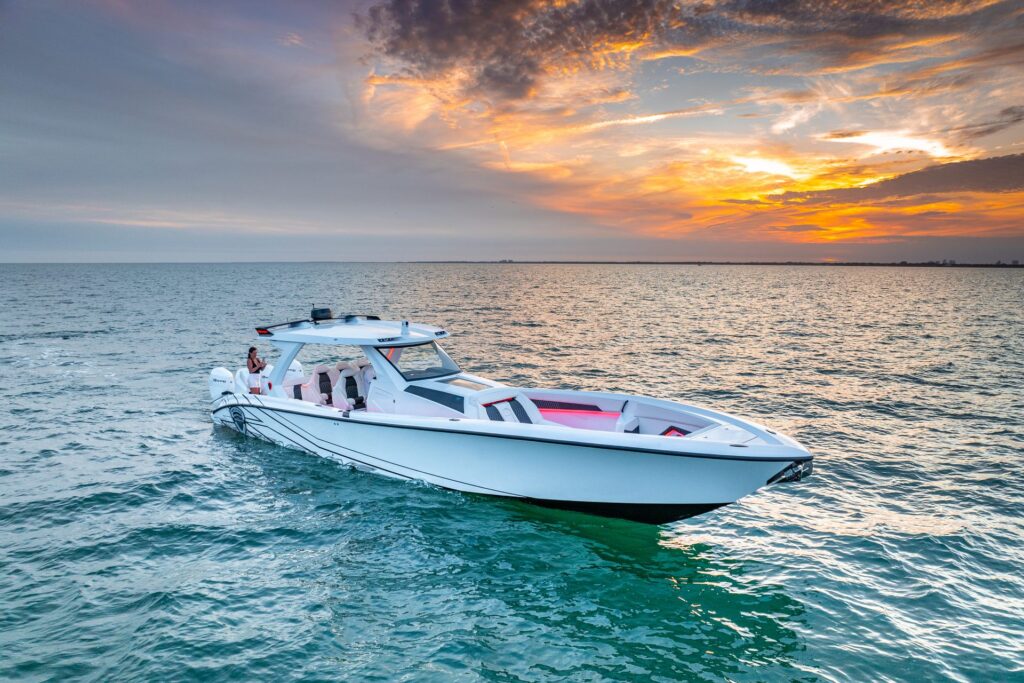
Adrenaline Powerboats says its designs are developed in-house, every boat receives custom paint, and each build is rigged in-house to its own specification. The company also describes its custom-paint process as a way to make its builds unique rather than simply repeating identical finishes.
That approach is relevant to long-term attachment because personal specification gives the owner more to recognize as uniquely connected to one boat. The underlying Reaper platform provides the model identity, while the individual build can carry a visual and functional character that becomes increasingly familiar over time.
Adrenaline currently lists the Reaper 42 and Reaper 47 as active models, each with published construction and equipment specifications that establish a clear technical foundation for the individual build.
The point is not that customization guarantees collectibility. It does not. But a carefully considered build has a better opportunity to become emotionally difficult to replace because the owner is attached not only to the model, but to that particular example.
Keeping a Machine Is a Form of Judgment
There is always another new product coming.
Technology advances. Displays improve. Engines evolve. Materials change. Styling moves in new directions. The luxury market is built partly on the promise that the next thing will be more capable, more sophisticated, or more desirable than what came before.
Collectors eventually learn to resist that rhythm when necessary.
Keeping a machine can be as deliberate a decision as buying one. It means recognizing that improvement on paper does not always equal improvement in the context of a personal collection. It means understanding which qualities are replaceable and which are not.
A boat may stay because its design has aged beautifully. It may stay because the specification still feels exactly right. It may stay because the owner has learned every part of its personality. It may stay because important memories are attached to it. More often, it stays because all of those reasons have become impossible to separate.
That is why some performance boats become part of the collection rather than simply passing through it.
The machines we keep are rarely the ones that remain objectively best forever. They are the ones that become specific enough, familiar enough, and meaningful enough that the idea of replacing them begins to feel like losing something that cannot simply be ordered again.
For owners who want to create a Reaper with the individuality to become that kind of machine, explore a custom Reaper build.