
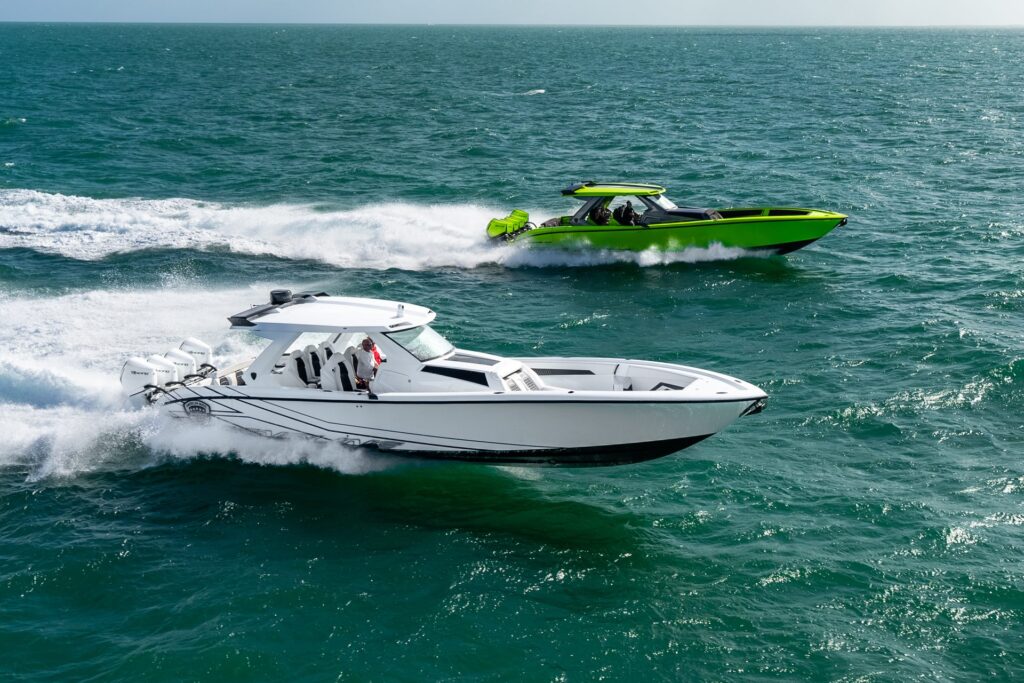
Some machines make an immediate impression and then slowly disappear into the background. Others become more distinctive with time. Their proportions remain recognizable years after newer designs arrive, their details continue to reward close inspection, and their identity grows stronger as they accumulate history. They do not depend entirely on novelty because the qualities that made them compelling in the first place were deeper than novelty.
Performance powerboats are particularly exposed to the passage of time. They exist in a category that prizes innovation, where propulsion, electronics, materials, construction techniques, and styling continue to advance. A boat that attracts attention simply because it is new will eventually surrender that advantage to the next generation. Lasting presence therefore requires something more durable than being the latest machine at the dock.
The boats people remember tend to combine proportion, visual identity, craftsmanship, mechanical character, and reputation into something coherent. They possess a recognizable point of view. Years later, even when individual specifications are no longer remarkable, the complete machine can still feel significant.
Memorable Design Begins With Proportion
The most durable designs are usually convincing before the observer begins examining individual details. Their proportions establish identity from a distance.
Length, beam, freeboard, bow profile, cockpit placement, windshield geometry, hardtop scale, and the relationship between the hull and propulsion create the basic composition. When these elements are balanced well, the boat can remain visually relevant even as smaller styling conventions change.
This is why proportion tends to age more gracefully than ornament.
Graphics can date. A fashionable color can become closely associated with a particular period. Decorative elements that once seemed progressive can eventually reveal themselves as trends. Strong proportions are more resistant to that process because they are connected to the fundamental architecture of the machine.
The same principle can be seen in automobiles, aircraft, architecture, and industrial design. Objects remembered decades later often possess silhouettes that remain legible even after technical details have evolved. Remove the badges and much of the decoration, and the form still communicates identity.
A performance powerboat with that quality does not need to explain itself every time a newer model arrives.
Identity Requires More Than Looking Aggressive
Performance design often uses the visual language of speed: long horizontal lines, low profiles, sharp transitions, technical surfaces, and purposeful cockpits. These elements can be effective, but aggression alone does not create identity.
If every performance machine pursues the same visual vocabulary, individual designs begin to become interchangeable.
Lasting presence requires recognizability.
That may come from the relationship between the bow and deck, the way the windshield meets the cockpit, the treatment of large hull surfaces, or the stance the boat carries on the water. Ideally, several elements work together so that the machine can be identified through silhouette and proportion before a logo becomes necessary.
This is where design maturity becomes important. A memorable boat should belong clearly to its category without disappearing into the category.
The strongest machines look purposeful because their forms have conviction. They do not feel as though every fashionable design cue available at the time was added simply to ensure visual impact.
Details Matter Most When They Support the Whole
Memorable design does not require simplicity in every circumstance. A highly detailed machine can still age beautifully when those details share a common logic.
The problem begins when detail competes with architecture.
A graphic that ignores the hull geometry, an oversized feature added primarily for drama, or a material introduced without connection to anything around it can attract attention briefly while weakening the overall design. By contrast, subtle details can become surprisingly memorable when they reinforce the boat’s larger identity.
A paint break might emphasize length. A hardtop may continue the visual direction established by the deck. Upholstery can echo exterior colors without reproducing them literally. Visible technical elements can support the performance character of the boat without turning the cockpit into visual noise.
Over time, coherence becomes more valuable than spectacle.
Owners often discover this after living with a machine for years. The details that remain satisfying are rarely those that shouted the loudest on delivery day. They are the ones that continue to make sense every time the boat is seen.
Craftsmanship Becomes More Visible With Time
A new boat can make almost any finish look impressive for a moment. Long-term ownership is more revealing.
Surfaces are exposed to sunlight. Hardware is handled repeatedly. Upholstery experiences heat, moisture, passengers, movement, and cleaning. Compartments are opened hundreds of times. Paint is seen under changing conditions instead of controlled lighting. The boat eventually reveals whether attention was concentrated on the first impression or carried throughout the build.
This is where craftsmanship contributes to lasting presence.
Quality work develops credibility through use. The owner begins noticing consistency: a well-resolved transition, clean integration, thoughtful finishing, or a component that still operates with the same sense of precision after substantial time aboard.
Craftsmanship also influences how a boat ages visually. When materials, paint, hardware, and structural details are selected and executed with longevity in mind, the machine has a better opportunity to mature instead of merely becoming old.
That distinction matters in any collector-oriented category. Patina can be attractive when it develops on an object that was worth preserving in the first place. Wear is less romantic when it exposes compromises that were present from the beginning.
Sound Can Become Part of a Boat’s Signature
Memory is not exclusively visual.
Enthusiasts often remember machines through sound long after individual technical details have faded. A particular engine note, the character of acceleration, or the way a machine sounds approaching and then settling back to idle can become inseparable from its identity.
Performance powerboats have an unusual advantage in this respect because sound carries across water. An approaching boat can become recognizable before its silhouette is fully clear.
Yet lasting mechanical character should not be confused with unnecessary noise. Sound becomes memorable when it feels authentic to the machine. It should seem connected to propulsion, scale, and purpose rather than created merely to attract attention.
There is a parallel here with collector automobiles. Some of the most remembered cars are not simply those that produced the highest output of their era. They are remembered because the mechanical experience was distinctive. The sound was one component of a larger personality.
A memorable performance boat can develop the same quality. Sight, sound, acceleration, and movement become connected in the owner’s mind until remembering one recalls the others.
Reputation Is Earned Beyond the Design Studio
A boat can leave the factory with visual presence. Reputation takes longer.
Reputation develops through what owners experience, what enthusiasts observe, how particular examples are used, and whether the design retains credibility after the excitement of launch has passed. It grows through accumulated encounters rather than advertising alone.
This is particularly important in specialized performance markets, where enthusiasts tend to pay attention to machines beyond the current model year. They notice which designs continue appearing at events, which boats owners keep, which examples remain visually distinctive, and which names maintain meaning as technology evolves.
A strong reputation adds another layer to physical presence.
The boat is no longer being judged in isolation. It arrives with context. People recognize the model, remember previous examples, or associate the design with a particular philosophy. The machine becomes part of a lineage rather than simply another expensive object on the water.
That process cannot be manufactured instantly. It requires consistency.
Individual Specification Can Strengthen Memory
Customization has the ability to make a particular boat more memorable, but only when it supports the design rather than overwhelms it.
A strong custom specification gives an individual example its own identity while preserving the qualities that made the underlying platform compelling. Color is especially powerful in this respect because people often remember a particular machine through its visual combination rather than its exact technical configuration.
The same can be true of upholstery, material selection, exposed technical elements, and other details. When these choices form a coherent composition, the individual boat becomes identifiable even among others of the same model.
Adrenaline Powerboats explicitly connects its identity with the idea of “Art in Motion,” describing an in-house design philosophy centered on form, function, technology, and handcrafted construction. The company also emphasizes individually tailored custom paint, giving specific builds room to develop their own visual character within the broader Adrenaline identity.
That balance is important. A memorable custom boat should still communicate what it is, but it should also become difficult to confuse with another example.
Timeless Does Not Mean Conservative
There is a tendency to equate timeless design with restraint so severe that the result avoids taking risks. That interpretation misses the point.
Some enduring machines were radical when they appeared. What made them last was not conservatism, but clarity. Their designers committed to an idea strongly enough that the finished object established a recognizable identity of its own.
Performance boats can work the same way.
A dramatic hull, unconventional surface treatment, or distinctive cockpit structure may age extremely well if it emerges from a coherent philosophy. Conversely, a safer design may become forgettable if it lacks character.
Timelessness is therefore less about avoiding bold decisions than avoiding arbitrary ones.
A machine can be visually aggressive, technically ambitious, and immediately recognizable without becoming trapped by the fashion of a single season. The question is whether its defining features belong to the boat or merely belong to the moment in which the boat was launched.
Lasting Presence Develops Through Ownership
The owner experiences a boat differently from everyone else.
Other people may remember the silhouette entering a marina or a striking paint scheme seen across the water. The owner accumulates a much deeper record. He remembers the view from the helm, the places reached aboard it, the people who occupied familiar seats, and the particular combination of sensations that accompanied hundreds of hours underway.
This changes what presence means.
A boat can become more important to its owner even as its market novelty decreases. The first season may have been dominated by discovery, but later seasons carry familiarity. Certain controls become instinctive. The cockpit acquires routines. The owner knows how the boat looks in morning light, how it feels at the end of a long day, and which details continue to provide satisfaction long after they stopped being new.
For this reason, the machines that stay in collections are not always the newest or the most extreme. Sometimes they are simply the ones that have developed too much identity to replace casually.
Lasting presence is partly designed and partly accumulated.
The Most Memorable Machines Have a Point of View
A performance powerboat becomes difficult to forget when its major qualities appear to come from the same idea.
The proportions support the performance character. The cockpit belongs visually to the hull. The materials suit the environment. Paint reveals rather than disguises the form. Mechanical character feels appropriate to the machine. Craftsmanship remains convincing after repeated use. The individual specification creates personality without obscuring the underlying design.
None of those qualities needs to dominate.
Their strength comes from combination.
Adrenaline’s current Reaper 42 and Reaper 47 continue the company’s emphasis on distinctive performance design, while its broader brand philosophy explicitly describes the boats as handcrafted works intended to combine form and function. The relevance to lasting presence is not that any design can declare itself timeless. Time makes that judgment. The important part is beginning with enough identity, craftsmanship, and conviction to make longevity possible.
That is what separates a machine that was exciting when new from one people continue to remember.
Technology will advance. Horsepower will increase. Electronics will change. New materials and construction methods will appear. Styling conventions will move forward, disappear, and eventually return in altered forms. None of that diminishes a boat whose fundamental identity was strong enough from the beginning.
A memorable performance boat does not need to remain technically unmatched forever. It needs to remain unmistakably itself.
When proportion, craftsmanship, mechanical character, individuality, and experience come together, the boat begins to occupy a place beyond its specifications. It becomes something owners photograph years later, enthusiasts recognize at a distance, and collectors hesitate to replace even when newer alternatives become available.
That is lasting presence.
For owners interested in creating a Reaper with an identity intended to endure beyond the first impression, explore a custom Reaper build.