
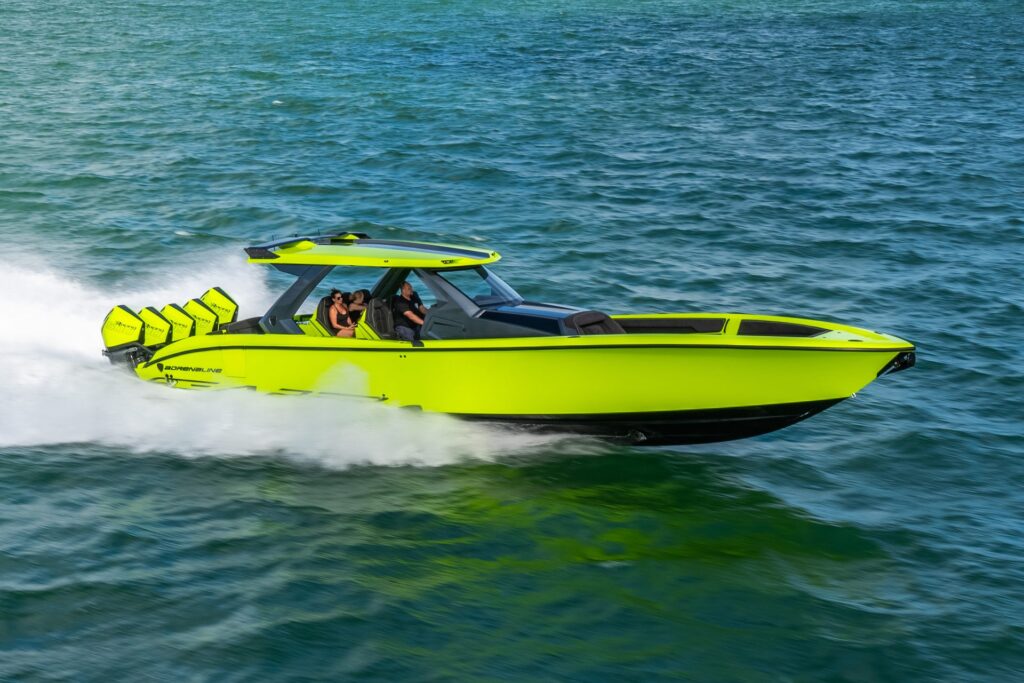
Collectors rarely describe their most meaningful possessions in purely practical terms. A watch tells time, a car provides transportation, an aircraft moves people between places, and a powerboat carries its occupants across the water. Yet none of those basic functions explains why certain examples are studied, carefully specified, preserved, photographed, discussed, and kept long after replacing them would be easy.
The collector sees another layer. Engineering matters. Design matters. Rarity matters. Specification matters. History can matter. Most of all, there is fascination in possessing a mechanical object whose character cannot be reduced to utility or price.
A serious performance powerboat fits naturally into this world. It combines large-scale industrial design with substantial mechanical capability, specialized construction, individual specification, and an ownership experience built around direct interaction. Unlike an object collected primarily to be observed, a boat can accumulate meaning through use. The hours at the helm, destinations reached, people aboard, and decisions that shaped the original specification all become part of the identity of one particular machine.
That is when a performance boat begins to function as something more than recreational equipment. It becomes part of a collection.
Collectors Look Beyond the Category
The collector mentality tends to move easily between different kinds of objects.
Someone fascinated by automobiles may also understand watches because both reward attention to engineering, materials, specification, and history. An interest in aviation may overlap with motorcycles because both expose mechanical solutions to problems involving weight, power, control, and performance. Art may appear to occupy a different world, yet collectors often approach it through many of the same questions: Who created it? Why does it look the way it does? How uncommon is it? What separates an important example from an ordinary one?
Performance boats can inspire the same curiosity.
The scale changes, and the engineering problems are distinctly marine, but the attraction is familiar. Hull architecture replaces chassis geometry. Helm design replaces a driver’s cockpit. Paint extends across enormous surfaces. Propulsion, construction, rigging, controls, seating, and hydrodynamics become subjects of interest.
For a collector, learning those distinctions is part of the pleasure. Ownership becomes richer as the ability to recognize meaningful differences becomes more developed.
Rarity Matters More When There Is Something Worth Rarity
Collectors value scarcity, but scarcity alone does not create collectibility.
An object can be rare because demand was weak, production failed, or almost nobody cared about it. Meaningful rarity is different. It exists when limited availability intersects with design, engineering, craftsmanship, cultural significance, unusual specification, or some other quality that makes people want to preserve the object.
That distinction is particularly important in performance boating.
A low-production boat may naturally be uncommon, but what makes a particular example interesting is the reason it deserves attention within that already specialized group. Perhaps the design is unusually recognizable. Perhaps the construction represents a particular philosophy. Perhaps the specification is exceptionally well judged. Perhaps the boat reflects an era of performance engineering that enthusiasts later view as significant.
Rarity amplifies those qualities. It does not replace them.
The most compelling collector objects tend to give their scarcity substance.
Specification Can Separate One Example From Another
Anyone familiar with collector automobiles knows that model designation is often only the beginning of the conversation.
Two cars from the same production run can have very different appeal because of color, interior, factory equipment, unusual options, ownership history, or condition. The underlying automobile may be identical, but collectors evaluate the particular example.
A custom performance powerboat can take that principle even further.
Paint alone can create an enormous difference in personality because the hull provides such a large visual canvas. Upholstery, materials, electronics, helm treatment, rigging, engine presentation, and other details can further distinguish one boat from another. When those choices are considered as a complete composition, the specification itself becomes part of what makes the boat interesting.
This does not mean unusual is automatically desirable. Collectors often become more selective as their knowledge increases. A specification that is rare but incoherent may be less appealing than one that demonstrates restraint and judgment.
The most desirable individual examples frequently feel inevitable. Their colors, materials, and details belong together so convincingly that changing one element would weaken the whole.
Provenance Matters When It Adds Meaning
Provenance is one of the defining ideas in collecting, but its importance varies by object.
In art, documented ownership can influence cultural and financial significance. In automobiles, factory history, competition use, notable ownership, original documentation, and important events may affect how a vehicle is understood. Watches, aircraft, motorcycles, and other collectible objects can develop similar narratives.
Performance boats can also acquire histories, although provenance should never be exaggerated simply to make a machine appear more important.
The meaningful questions are straightforward. Is the original specification documented? Has the boat been maintained carefully? Are significant modifications understood? Does the individual example have a history worth preserving? Has its configuration remained coherent over time?
For a custom boat, documentation of the original build can be particularly interesting because it preserves the thinking behind the specification. Paint concepts, build photographs, equipment selections, and other records help explain how the boat became the object it is today.
Not every performance boat needs a celebrated history to be collectible. Sometimes the most compelling provenance is simply a clear, well-documented life.
Mechanical Fascination Is Central to the Appeal
Collectors of performance machinery generally want to know what lies beneath the surface.
The fascination may begin with appearance, but it rarely ends there. Enthusiasts study engines, structures, materials, manufacturing techniques, suspension systems, aerodynamics, movement design, complications, and the mechanical decisions that separate one object from another.
A performance powerboat provides enormous depth for this kind of interest.
The hull itself is an engineering object. Construction methods affect structure and weight. Propulsion changes the character of the boat. Controls create the operator’s physical relationship with the machinery. Rigging reveals how complex systems have been organized. Even visual surfaces can carry technical meaning because many of the boat’s proportions are dictated by function.
This gives the performance boat an advantage as a collector’s object: there is always more to understand.
A person can admire the boat from across the marina, examine the craftsmanship up close, discuss the engineering at length, and then experience those decisions dynamically from the helm. The machine can be appreciated visually, intellectually, and physically.
Few collectible objects operate across all three levels so naturally.
Use Can Add Meaning Rather Than Diminish It
Traditional collecting sometimes creates tension between preservation and use.
A rare automobile accumulates mileage. A mechanical watch develops marks. An aircraft logs hours. An object preserved perfectly may retain condition, but an object used as intended can accumulate experiences that make it more meaningful to its owner.
Performance boats exist decisively on the side of experience.
They are designed to move. Their proportions make full sense underway. Their mechanical character emerges through operation. Their cockpits reveal their logic after hours of use rather than minutes of inspection.
That does not mean condition becomes irrelevant. A collector-minded owner may be especially attentive to maintenance, finish quality, records, and preservation precisely because the machine is being used. The objective is not to freeze the boat in time. It is to use it without allowing neglect to erase what makes it special.
This balance is familiar throughout enthusiast culture. The most rewarding machines are often those maintained with the care of collection pieces but exercised with an understanding of why they were created.
Craftsmanship Creates Reasons to Look Closer
Collector objects usually become more interesting under scrutiny.
The first impression may come from silhouette or reputation, but lasting fascination depends on details. A beautifully machined watch movement, a hand-finished automotive interior, a carefully constructed aircraft cabin, or a piece of furniture with exceptional joinery rewards the owner for paying attention.
A performance boat can do the same.
Paint transitions, integrated hardware, upholstery, control placement, compartment finishing, rigging, visible structural work, and the relationship between materials can all reveal the quality of the thinking behind the machine.
Adrenaline Powerboats provides a relevant example because its current company materials describe an unusually integrated approach to these disciplines. Adrenaline says its designs are developed in-house from 3D CAD through CNC milling, that every boat is handcrafted, that custom paint is used on every boat, and that individual builds are rigged in-house to their own specification.
For a collector, that kind of process matters because it gives the finished object more layers to examine. The boat is not interesting only because of how it performs. The way it was conceived and executed becomes part of the fascination.
Customization Can Create a One-Boat Collection
Not every collector wants dozens of examples from the same category.
Sometimes a collection becomes more interesting through contrast. A garage may contain vehicles from different eras and engineering philosophies. A watch collection may combine entirely different complications and styles. A hangar may hold aircraft designed for unrelated purposes.
Within that environment, a single performance powerboat can occupy its own position.
Because the boat is physically substantial and deeply configurable, one carefully specified example may satisfy an enthusiast differently from owning several standardized ones. The owner can put considerable thought into making that boat represent exactly what is wanted from the category.
This is where customization intersects with collecting in an important way.
The objective is no longer to accumulate for the sake of quantity. It is to curate.
A collector who already owns several significant machines may not need another object that feels broadly familiar. A boat with a specific combination of design, engineering, materials, paint, and character can add something genuinely different to the collection.
Collectibility Often Reveals Itself Over Time
Nobody can declare with certainty which current machines will become important collector objects decades later.
Markets change. Technology changes. Taste changes. Some products once considered ordinary become fascinating because they represent an era that disappeared. Others that were marketed as instant collectibles never develop lasting enthusiasm.
This uncertainty is part of collecting.
The better approach is often to focus on qualities that remain meaningful regardless of future market value: distinctive design, quality engineering, strong craftsmanship, thoughtful specification, limited production, documentation, and an ownership experience substantial enough to create emotional attachment.
These qualities do not guarantee financial appreciation, nor should a performance powerboat be purchased on that assumption. What they can do is make a machine worth caring about.
Collectibility in its most satisfying form is not merely a prediction about resale value. It is the recognition that an object deserves preservation because replacing its particular combination of qualities would be difficult.
The Collection Is Ultimately Personal
The best collections rarely make complete sense to everyone else.
One person values historical significance. Another pursues technical innovation. Another cares about design. Someone else builds a collection around memories, childhood obsessions, racing history, specific manufacturers, or machines that simply produce a particular feeling.
That subjectivity is not a flaw. It is the reason collecting becomes personal.
A performance boat fits naturally into such a collection because it can represent several interests simultaneously. It is industrial design on a large scale. It is a mechanical object. It is a custom product. It is a vehicle for travel and shared experiences. It can carry an individual specification and, over time, develop a history unique to its owner.
Adrenaline’s Reaper models occupy that intersection particularly well because the recognizable platform can serve as the starting point while the company’s custom-paint and build-specific approach gives individual examples room to establish their own identities. Its current Reaper 42 and Reaper 47 remain part of the company’s center-console performance range.
The collector’s question is therefore not simply whether a performance boat belongs beside automobiles, watches, motorcycles, aircraft, or art.
It is why it would not.
The same qualities that make those objects fascinating—design, engineering, rarity, specification, craftsmanship, provenance, personality, and emotional attachment—can all exist in a serious performance boat. The difference is that the boat brings those qualities into an environment where the owner can actively experience them with other people, across changing water, and over years of use.
Eventually, the best machines become difficult to describe as possessions alone. They become reference points within a collection: the car that sounds unlike anything newer, the watch whose proportions are exactly right, the motorcycle that was never replaced, or the boat whose specification and history have become too personal to duplicate.
That is when a performance powerboat becomes a collector’s object.
For enthusiasts looking to create an individual Reaper rather than simply select one from a standard template, explore the process of commissioning a custom build.