
Luxury has become easier to manufacture, package, and distribute than at any other point in modern consumer culture. Materials that once signaled rarity now appear across broad product ranges. Advanced technology moves quickly from flagship products into mainstream ones. Design languages are copied, refined, and scaled until ideas that once felt exceptional become familiar.
That does not mean luxury has disappeared. It means exclusivity is changing. At the upper end of the market, distinction is increasingly found in qualities that resist scale: human judgment, low-volume production, the freedom to respond to an individual owner, and the sense that the people building an object remain close enough to influence how it turns out.
A performance powerboat is an especially revealing example because it combines engineering, aesthetics, materials, and handwork in one machine. The difference between expensive and genuinely special often becomes visible in the parts of the process that are hardest to industrialize.
When Premium Features Become Common
For much of the twentieth century, luxury was strongly associated with scarcity. Premium materials were harder to source, specialist manufacturing was concentrated among relatively few companies, and access to certain products was limited by production capacity or distribution.
Today, global manufacturing can deliver extraordinary consistency at enormous volume. Sophisticated electronics, advanced composites, premium upholstery, precision-machined components, and polished finishes are no longer confined to tiny circles of production. Consumers benefit from that progress, but it also creates a paradox: once a premium feature becomes repeatable, it becomes less useful as evidence of exclusivity.
A product can be beautifully made, technologically advanced, and expensive while still being designed for large-scale replication. The experience may be excellent, but the system behind it is optimized for consistency rather than individuality.
This is why sophisticated buyers increasingly look beyond specification sheets. The more meaningful question becomes not simply what a product contains, but how much of the finished object could exist only because someone chose to make it that way.
Craftsmanship Contains Judgment
Craftsmanship is often used as a synonym for quality, but the two are not identical. Quality can be standardized through tolerances, procedures, inspection points, and repeatable processes. Craftsmanship includes something additional: judgment.
A craftsman responds to the object in front of him. A surface may need another step. A transition may require refinement. A paint treatment that worked in a rendering may need to be reconsidered at full scale. A component may technically fit and still need adjustment before it feels resolved.
Those decisions are difficult to capture completely in a production manual because they depend on experience. The person doing the work has to recognize the difference between acceptable and finished.
On a custom performance boat, that kind of judgment can influence everything from visual balance to rigging and finish work. The value is not in romanticizing hand labor. It is in recognizing when skilled human attention improves the result.
Scale Rewards Repeatability
Mass production depends on repeatability for good reason. Components must fit predictably, suppliers must deliver at volume, workers need standardized procedures, and products have to move efficiently through production.
That system is excellent at creating consistency. What it is less suited to is interruption.
A customer who wants a unique paint concept, an unusual material combination, or a configuration that requires several departments to coordinate around one build introduces friction into a high-volume process. As volume increases, personalization naturally tends to become modular. Choices are organized into packages that appear highly configurable to the buyer but remain repeatable behind the scenes.
Limited production can preserve more room for interpretation. With fewer builds moving through the system, a builder can remain disciplined without becoming inflexible. Individual choices can be considered in the context of the whole boat rather than forced into a predetermined menu.
That difference is central to modern exclusivity. The scarce resource is no longer always the material. Increasingly, it is organizational attention.
Time Has Become a Luxury Material
Some of the most valuable inputs in a bespoke object never appear on a materials list.
Time spent developing a design, preparing a surface, checking a transition, refining paint, fitting components, or resolving a technical detail may be almost invisible once the work is complete. Yet those hours often determine whether the finished object feels coherent.
Industrial production is constantly under pressure to remove time from the process. Efficiency comes from shortening cycle times, standardizing parts, and eliminating unnecessary variation. Craftsmanship works differently. It preserves time where time improves the outcome.
Adrenaline Powerboats describes a process that combines advanced technology with this kind of hands-on attention. The company says it spends thousands of hours conceptualizing, designing, and creating before parts reach the build floor, and that its designs are developed in-house. It also states that every boat is handcrafted, while custom paint and rigging are handled within its own operation.
The point is not that every hour of labor is automatically valuable. It is that some forms of refinement cannot be compressed without changing the result.
In-House Capability Preserves Intent
One of the challenges of building a complex premium product is maintaining design intent from the first concept to the finished object. Every time work passes between disconnected suppliers, subcontractors, departments, or manufacturing systems, information has to be translated.
In-house capability can shorten that distance.
Adrenaline states that its designs are developed completely in-house, from 3D CAD work through CNC milling and the finished product. The company also uses in-house 5-axis CNC machining for prototyping and tooling, while custom paint is tailored with the customer and every boat is rigged in-house to a build-specific specification.
The significance is not simply that several tasks happen under one roof. It is that design, manufacturing, paint, and rigging can remain connected to the same overall intent. When a builder wants individual boats to have their own identity, that continuity matters.
A custom object feels more convincing when personalization is not isolated to a decorative layer applied at the end. The strongest bespoke products carry their philosophy through the entire process.
The Human Signature Can Be Quiet
Craftsmanship does not need to announce itself through obvious handwork. In a modern performance boat, the human signature may appear in the alignment of a graphic with the geometry of the hull, the cleanliness of a rigging installation, the consistency of a painted surface, or the way several materials meet without drawing attention to the transition.
This is particularly appropriate for a machine whose aesthetic is technical rather than ornamental. The boat does not need to look handmade in a traditional sense to benefit from skilled hands and judgment.
In fact, the best work often disappears into the finished object. The owner may never know which technician reconsidered a detail or spent extra time resolving a surface, but the cumulative effect is still present. The machine simply feels more complete.
That subtlety is one reason craftsmanship remains relevant even as manufacturing becomes more technologically advanced. Human involvement is not valuable because it is visible. It is valuable when it produces a result that would be difficult to achieve through repetition alone.
Technology and Craftsmanship Are Not Opposites
Limited production should not be confused with old-fashioned production. Some of the most compelling bespoke machines are created with sophisticated digital tools.
Computer-aided design, simulation, CNC machining, advanced composites, and digital control systems can all coexist with hands-on craftsmanship. The important question is how the technology is used.
Technology can increase volume, but it can also give a small team greater precision and creative control. A CNC machine can manufacture thousands of identical parts, or it can help a builder develop specialized tooling and execute complex forms for a comparatively small number of highly individualized products.
Adrenaline’s published approach reflects this combination. Its company material pairs in-house 3D design and 5-axis CNC capability with handcrafted boats, custom paint, and build-specific rigging.
Modern craftsmanship is often strongest when technology handles precision while skilled people retain judgment. One does not diminish the other. Together, they can create an object that has both technical consistency and individual character.
What Cannot Be Scaled Becomes More Meaningful
As luxury markets expand, visible signals of premium positioning become easier to reproduce. Materials can be sourced. Technology spreads. Styling influences travel quickly. Features that once existed only at the top of a category eventually appear farther down the market.
What remains difficult to scale is attention.
It is difficult to scale the conversation that uncovers what one owner actually wants. It is difficult to scale the designer who revisits a detail because it is not yet right. It is difficult to scale the painter adapting a concept to the surfaces of a particular hull or the technician whose rigging decisions belong to one build rather than a generic configuration.
Those forms of attention consume time, expertise, coordination, and production capacity. That is precisely why they matter.
Exclusivity in this sense is not merely about restricting supply. It is about preserving the conditions required to make something specific. A limited-production builder has the opportunity to protect those conditions by refusing to treat every efficiency gain as an unquestioned improvement.
Exclusivity Is Moving Back Toward Creation
The most meaningful form of exclusivity may ultimately be less about possession than creation.
A mass-produced luxury object can still be exceptional, but the buyer enters the story near the end. Most of the decisions were made for an idealized customer long before the transaction occurred.
A bespoke object allows the owner to enter earlier. The finished result reflects not only the builder’s capability but also the ability of the process to absorb individual intent. That is where craftsmanship and limited production become more than marketing language. They preserve room for decisions that do not have to make sense across thousands of units.
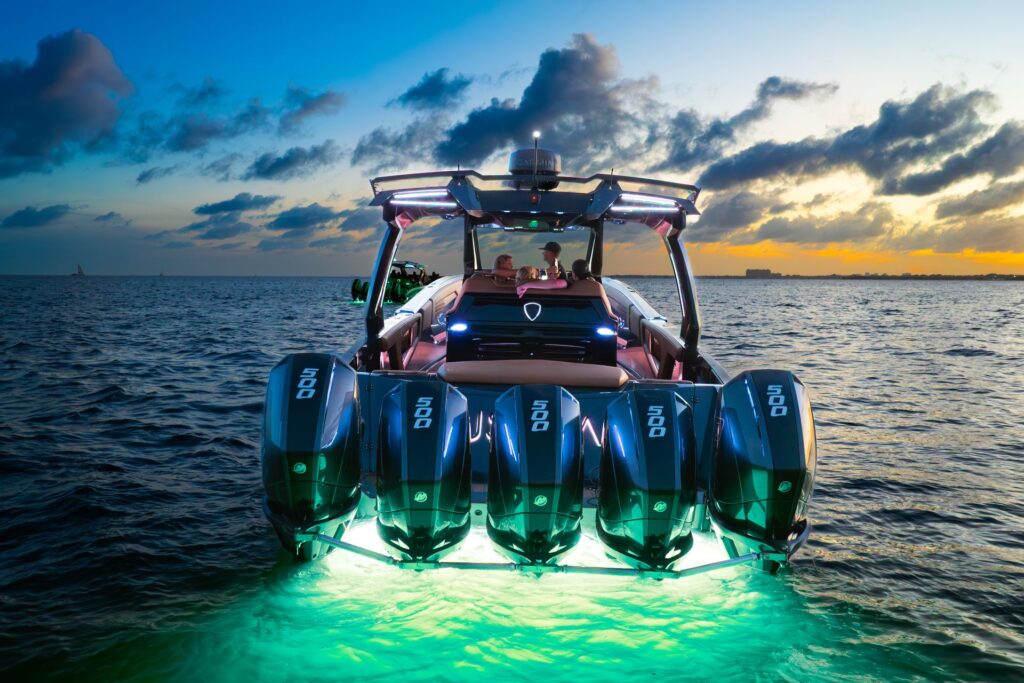
For Adrenaline Powerboats, the relationship between in-house design, custom paint, advanced manufacturing capability, and build-specific rigging provides a clear example. The Reaper platform establishes the foundation, while the custom-building process gives individual boats room to develop a more specific identity.
In an era when premium experiences can be reproduced with extraordinary consistency, that difference becomes more valuable, not less. The future of exclusivity may belong to objects that still require time, judgment, collaboration, and skilled human attention to exist at all.
For owners drawn to that kind of process, begin a custom Reaper inquiry.