Commissioning a custom powerboat begins long before the first component is installed. The most important work often happens in conversation: defining how the boat will be used, what the owner values, which details are non-negotiable, and what kind of presence the finished machine should have. A truly successful build is not simply a standard model with a longer options list. It is the result of turning preferences into a coherent brief and then carrying that brief through design, materials, layout, rigging, finish, and final delivery.
For owners accustomed to custom homes, collector cars, aircraft interiors, or other highly specified objects, the process is familiar in principle. The challenge is not gaining access to more choices. It is making the right choices in the right order. Every decision affects something else, and the strongest projects are the ones in which performance, function, aesthetics, and craftsmanship reinforce one another.
That is what makes commissioning different from shopping. The owner is not simply selecting a finished object. The owner is helping define what the finished object should become.
Start With the Way the Boat Will Actually Be Used
The most productive custom builds begin with use rather than decoration.
Before discussing paint, upholstery, electronics, or visible hardware, the owner and builder need to understand what the boat is expected to do. Will it spend most of its time on day runs between waterfront destinations? Will it carry family and friends regularly? Is the owner especially focused on the driving experience? Are long days aboard common? Will storage, cabin comfort, entertainment, or specific helm equipment matter more than they would for another owner?
These questions create the framework for everything that follows.
A boat designed around frequent social use may place greater emphasis on seating, movement through the cockpit, storage, and convenience. A boat built around an owner who spends most of the day at the helm may prioritize driver ergonomics, instrumentation, visibility, and control placement. Someone who values visual drama may make different finish decisions from an owner who prefers technical restraint.
There is no universally correct specification. The objective is alignment between the boat and the life it will actually lead.
That is why the initial brief deserves more attention than many owners expect. A custom project becomes easier when the priorities are clear. Without that clarity, customization can turn into a sequence of isolated decisions that compete with one another rather than contributing to a unified whole.
Translate Preferences Into a Design Language
Once the purpose of the boat is understood, the next step is turning personal taste into something a design and build team can execute.
Owners often begin with references rather than technical instructions. They may point to a favorite automobile, an architectural interior, a watch, an aircraft cabin, a paint color, or another boat whose proportions or material combinations they admire. These references are useful because they reveal more than a preference for a single color or finish. They communicate an attitude.
A design team then has to interpret that attitude within the reality of a performance powerboat.
A restrained automotive-inspired palette, for example, may need to be adapted to a much larger exterior surface. A color that looks sophisticated on a coupe can behave differently across the length and height of a hull. Interior materials have to work with sunlight, water, heat, movement, and repeated use. Graphics must follow the geometry of the boat rather than simply cover it.
The best custom design therefore involves translation, not imitation. The finished boat should feel connected to the owner’s taste without becoming a collage of references borrowed from other categories.
This is where professional judgment becomes essential. A good design team helps edit the brief. It knows when to emphasize an idea, when to simplify it, and when a detail that appears attractive in isolation may weaken the overall composition.
Materials Are Both Aesthetic and Functional Decisions
Material selection is one of the most satisfying parts of a custom build because it is where abstract ideas become tactile.
Upholstery, flooring, hardware finishes, painted surfaces, carbon-fiber details, and other visible components establish the cockpit’s atmosphere. They determine whether the boat feels technical, warm, restrained, aggressive, modern, or intentionally understated.
But a marine environment imposes discipline. Materials cannot be selected only for how they look under indoor lighting. They must be considered in the context of heat, ultraviolet exposure, spray, wet clothing, repeated contact, cleaning, and movement underway.
This is why commissioning a boat is different from decorating a room. A material decision has to satisfy the eye and the environment at the same time.
The most successful specifications tend to balance contrast carefully. A bold exterior may benefit from a calmer interior. A more monochromatic paint scheme may create room for texture and detail inside the cockpit. Bright accents can be effective when used with restraint, while overuse can make an otherwise sophisticated design feel temporary.
A custom boat should still look convincing years after delivery. That requires resisting the temptation to treat every surface as an opportunity to make a statement.
Layout Should Reflect Priorities, Not Fashion
Customization becomes most valuable when it improves how the boat functions.
Layout decisions determine how easily people move, where they sit, what the operator can reach, how gear is stored, and whether the boat remains comfortable after several hours of real use. These considerations may not attract as much attention as a dramatic paint reveal, but they often become more important over time.
A thoughtful commissioning process asks practical questions early. How many people are usually aboard? Where does the owner prefer to spend time when not driving? What needs to be accessible quickly? Which equipment is essential and which additions would create unnecessary complexity? How should the helm feel when the operator is standing or seated? What kind of visibility is expected from the primary driving position?
The point is not to redesign a proven platform unnecessarily. It is to understand which configurable elements can make that platform better suited to a particular owner.
Adrenaline Powerboats provides a useful example of this philosophy. Its public company information states that all Adrenaline designs are developed in-house and that every boat it builds is rigged in-house, with rigging specified for each build. That combination creates a direct relationship between the design concept and the technical execution of the finished boat.
Performance Objectives Need to Be Defined Clearly
A custom performance boat also requires an honest discussion about performance priorities.
“Performance” can mean different things to different owners. Some place the greatest value on acceleration and outright pace. Others care more about composure, confidence, usability, range, or the ability to spend long periods underway without turning every outing into an endurance exercise.
The commissioning process should make those priorities explicit.
This does not mean an owner should dictate engineering decisions that belong with the builder. It means the builder should understand the intended experience. A well-defined brief gives the technical team context for the choices available within the platform.
On Adrenaline’s current Reaper models, the manufacturer publishes specific construction methods, equipment, engine options, cockpit features, and other configurations for the Reaper 42 and Reaper 47. Those published specifications show why a custom-build conversation has to remain grounded in the capabilities and architecture of the actual model rather than treating customization as limitless.
That boundary is important. Bespoke does not mean arbitrary. The best custom work respects the engineering integrity of the platform while using the available design and configuration choices intelligently.
Paint Is Where the Boat’s Identity Often Becomes Visible
Few stages of a custom powerboat build are as emotionally immediate as paint.
The hull is a large visual object, and color can transform the way its proportions are perceived. Dark tones can emphasize mass and technical aggression. Lighter colors may make surfaces and body lines more apparent. Graphics can stretch the boat visually, divide large surfaces, highlight specific geometry, or create a more restrained identity depending on how they are used.
Because paint has such an immediate effect, it is also one of the easiest areas to overcomplicate.
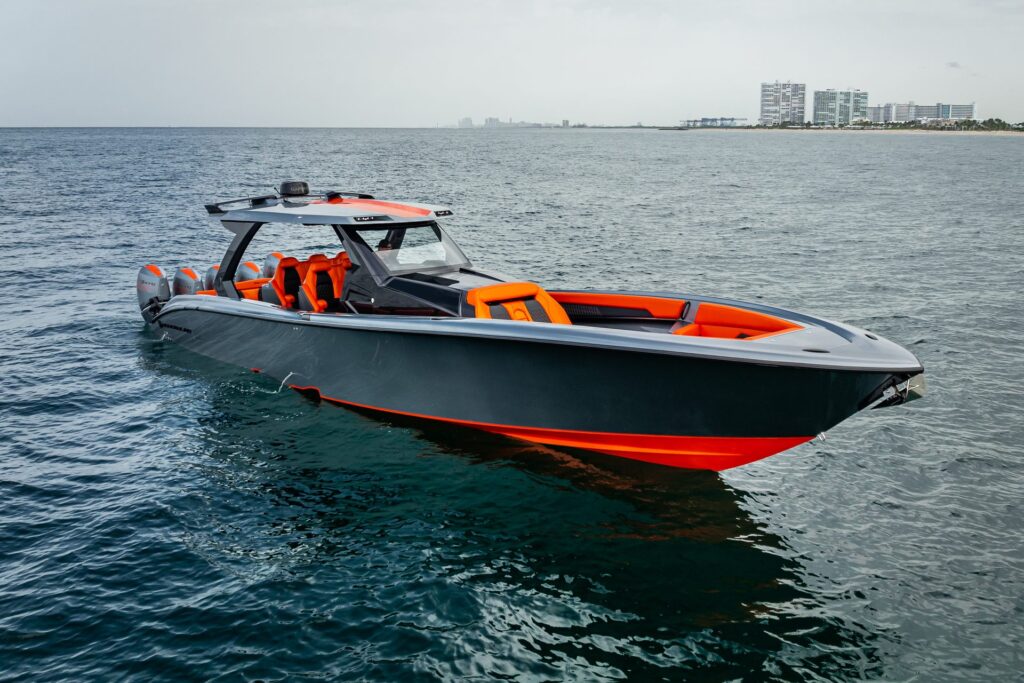
Strong custom paint work should follow the design of the boat rather than fight it. The objective is not to demonstrate how many colors or techniques can be applied. It is to create a visual identity that feels inseparable from the hull beneath it.
Adrenaline says it uses custom paint on every boat and that its design team works closely with the customer to tailor the process to the customer’s specifications. The company explicitly frames this as a way for individual builds to remain unique.
That approach captures one of the pleasures of commissioning: there is a moment when the project stops feeling like a model designation and starts looking like one particular owner’s boat.
Watching the Machine Take Shape Changes the Experience
Commissioning is not only about the finished product. The build itself becomes part of ownership.
Early in the process, the boat exists mostly as a set of ideas. There are conversations, references, design concepts, configurations, and decisions that may still feel abstract. As the project progresses, those ideas become physical.
The owner begins to recognize details that were discussed weeks or months earlier. A color appears on a real surface. Upholstery turns from a sample into a complete seating environment. Hardware, electronics, and rigging transform an unfinished structure into a functioning machine.
That progression gives custom ownership a narrative that an inventory purchase cannot reproduce.
Adrenaline’s published client-process material begins with a one-on-one consultation focused on the customer’s vision, preferences, and requirements, followed by collaboration with the design team. That sequence is significant because it places the owner’s ideas at the beginning of the process rather than introducing personalization only after the major decisions are already fixed.
The build becomes a record of decisions made deliberately over time.
Restraint Is Part of Good Commissioning
One of the hardest parts of a custom project is knowing when enough has been specified.
The availability of choice can create pressure to use all of it. If a special paint treatment is possible, why not add another? If one contrasting material looks good, perhaps three will look better. If technology can be added, there can be a temptation to include it whether or not it improves the owner’s actual use of the boat.
A sophisticated commissioning process resists that impulse.
Every addition should have a reason. The strongest builds usually contain hierarchy: some details are intended to attract attention, while others support them quietly. Visual restraint allows craftsmanship to become more apparent. Functional restraint prevents complexity from overwhelming usability.
This is especially important for owners who expect to keep a boat for years rather than a single season. A coherent specification tends to age better than one built around every fashionable detail available at the moment of delivery.
Custom should mean considered, not crowded.
Delivery Is the End of the Build, Not the End of the Idea
Eventually the project moves from design and construction to delivery. That moment matters because the boat changes categories. It is no longer a project being discussed, designed, painted, rigged, and finished. It becomes a machine that will now be used.
Only then can the specification be judged in its proper environment.
The owner experiences the helm underway rather than during a walkthrough. Materials are seen in direct sun. Seating is evaluated over hours instead of minutes. Storage decisions either make sense or begin to suggest what should be done differently next time. Paint that looked dramatic indoors takes on another personality against open water.
This is where good commissioning proves its value. The decisions made early in the project should continue to make sense after the excitement of delivery.
A successful custom boat does not feel as though the owner simply selected more options. It feels like the major choices share a common logic. Use, performance, layout, materials, paint, and equipment all point toward the same idea of what the boat was meant to be.
That coherence is the real art of commissioning.
For Adrenaline Powerboats, the combination of in-house design, custom paint, and build-specific rigging makes the Reaper platform a natural setting for that kind of owner involvement. The company’s published process reinforces the same principle: begin with the owner’s vision, turn it into design decisions, and carry those decisions through the build.
The reward is more than a boat that looks different from the next one at the marina. It is the satisfaction of knowing why it looks, feels, and functions the way it does.
For owners ready to define those decisions for themselves, begin the process of commissioning a custom Reaper.