For generations, luxury was often described through inherited signals: formality, restraint, old institutions, and objects whose value was reinforced by tradition. That version of luxury still has its place, but it no longer defines the entire category. A distinctly American interpretation has emerged alongside it—one shaped by engineering, performance, customization, confidence, and the belief that a premium object should reflect the person who owns it rather than simply conform to an established idea of refinement.
That shift is especially visible in high-performance machines. Collector cars, custom motorcycles, performance trucks, private aircraft, and serious powerboats all reveal a version of luxury that is less interested in ceremony and more interested in capability. Materials matter, but so does what they are asked to do. Craftsmanship matters, but so does the willingness to innovate. Exclusivity matters, but increasingly it comes through individual specification rather than a recognizable badge alone.
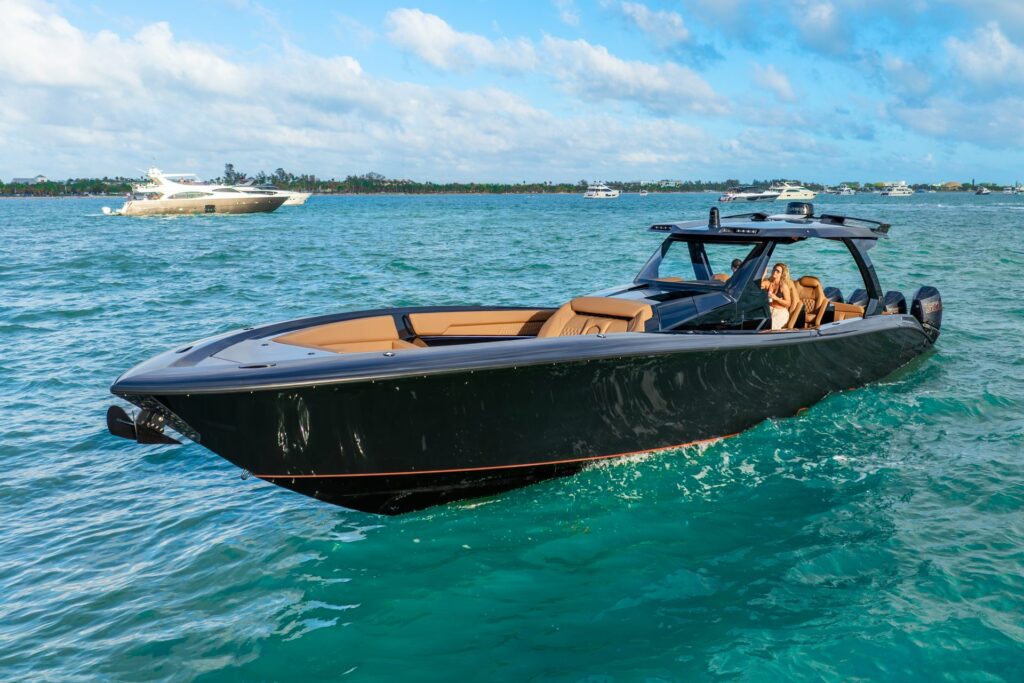
On the water, that combination finds one of its clearest expressions. A modern American performance powerboat can be technically ambitious, visually assertive, highly personalized, and meticulously finished without pretending to be anything other than what it is.
American Luxury Has Always Had a Performance Streak
American luxury has never been entirely quiet. Even in eras associated with chrome, long wheelbases, and formal interiors, there was an underlying fascination with power. Large-displacement engines, dramatic proportions, aviation-inspired design, motorsports, and the ability to cross enormous distances all helped shape the country’s mechanical culture.
The modern version is more sophisticated, but the instinct remains recognizable. Horsepower is not treated as the opposite of refinement. Technical capability can be part of refinement when it is integrated intelligently. A machine can be luxurious precisely because it performs at a level that required unusual engineering, materials, development, and craftsmanship to achieve.
That perspective makes the performance powerboat a natural American luxury object. Its value is not confined to what can be touched at the dock; luxury is expressed through the completeness of the experience underway.
Capability Has Become Part of the Premium Experience
Traditional luxury often emphasized separation from effort. The premium experience was supposed to make complexity disappear. In a performance machine, however, the owner may actively want to participate.
That does not make the experience less luxurious. It changes what luxury means.
A serious driver may value a helm that communicates clearly rather than isolates completely. An enthusiast may want to hear mechanical character rather than eliminate every trace of it. An owner may appreciate the engineering beneath a surface precisely because understanding how the machine works adds another layer of enjoyment.
This is a form of luxury built around access to capability. The pleasure comes from having a machine that can deliver more than basic transportation and from being close enough to that capability to appreciate it.
American performance culture has long understood this idea: technical competence can become part of the object’s personality.
Craftsmanship Gives Performance Credibility
Horsepower alone is easy to discuss because it produces a number. Craftsmanship is more difficult to summarize, yet it is often what separates an impressive specification from a convincing finished product.
A performance boat brings many disciplines together. The design must work as a whole. Tooling has to translate digital surfaces into physical forms. Construction must meet the demands of the platform. Paint has to follow complex geometry. Rigging needs to integrate multiple systems cleanly. Upholstery and hardware have to survive a marine environment while still supporting the visual language of the boat.
When those elements are handled without a common point of view, the result can feel assembled. When they reinforce one another, the boat feels designed.
That distinction is central to Adrenaline Powerboats. Founded in 2000 and based in Lincolnton, Georgia, the company describes a design-to-delivery approach under one roof. Adrenaline states that its designs are developed completely in-house, beginning with 3D CAD work and continuing through CNC milling and the finished product. It also uses in-house 5-axis CNC machining for rapid prototyping and final tooling.
Those capabilities are modern and technical, but Adrenaline pairs them with a deliberately hands-on philosophy. The company describes every boat as handcrafted and handles custom paint and rigging within its own operation. The result is a useful example of contemporary American craftsmanship: sophisticated manufacturing technology without surrendering the ability to make individual decisions around a specific build.
Individuality Has Replaced Uniformity as a Luxury Signal
There was a time when buying into the right luxury category often meant buying into a recognizable look. The object carried the codes of the brand, and the owner’s role was largely to choose among a limited number of approved variations.
That model is changing.
Owners who have spent years around custom automobiles, high-end interiors, architecture, watches, aircraft, or boats tend to develop precise preferences. They notice color differently. They care about how materials interact. They understand that a small specification decision can dramatically change the character of a finished machine.
Modern American luxury increasingly makes room for that point of view. The object does not lose its identity, but it becomes a platform for individual expression.
Adrenaline’s custom-building process reflects this directly. The company says it uses custom paint on every boat, with its design team working closely with customers to tailor the result to their specifications. It also states that every boat is rigged in-house and that rigging is specified for each build.
That matters because individuality becomes part of the build rather than a cosmetic gesture applied after production.
Confidence Does Not Require Excess
American luxury is sometimes caricatured as bigger, louder, and more extravagant. The best contemporary examples are more disciplined than that.
Confidence can be expressed through restraint. A boat does not need the most complicated paint scheme simply because custom paint is available. It does not need every available piece of equipment to prove its value. It does not need to imitate European minimalism or traditional yachting formality in order to feel sophisticated.
The stronger approach is to know what the object is.
A performance powerboat should look like a performance powerboat. Its proportions can communicate purpose. Its cockpit can feel technically focused while remaining comfortable and beautifully finished. Its materials can be premium without becoming delicate. Its sound and movement can remain part of the experience rather than being engineered out in pursuit of an abstract idea of refinement.
The result feels authentic rather than borrowed from another category.
Technology and Handwork Belong Together
One of the most interesting developments in modern American manufacturing is the disappearance of the old boundary between advanced technology and traditional craftsmanship.
Digital design, computer simulation, CNC machining, advanced composites, and precise manufacturing can coexist with hand-finishing, custom paint, individual rigging, and skilled assembly. In fact, the most compelling low-volume products often depend on both.
Adrenaline’s process is representative of that intersection. The company says its designs are first developed through computer simulations and technology before parts reach the build floor. Its in-house 3D design and 5-axis CNC capabilities establish precision early in the process, while custom paint, handcrafted construction, and build-specific rigging preserve room for individual attention.
This is not craftsmanship in the nostalgic sense of rejecting modern tools. It is craftsmanship strengthened by them. Technology provides control and repeatability where those qualities are valuable. Skilled people retain judgment where judgment improves the final object.
That combination feels particularly American because it treats innovation and craft as partners rather than opposing philosophies.
Luxury Becomes More Personal When It Is Built Close to Home
Domestic craftsmanship also carries a different kind of significance when the product itself reflects a strong local engineering culture. American performance has long been shaped by builders, fabricators, racers, designers, machinists, painters, and technicians who approach mechanical objects as things to be improved rather than merely preserved.
A performance powerboat belongs naturally to that tradition.
The appeal is not nationalism for its own sake. A product does not become excellent simply because it is built domestically. The meaningful question is whether local capability allows the builder to maintain control over design, construction, finishing, and the relationship with the customer.
In Adrenaline’s case, its Georgia operation brings design, CNC work, custom paint, and rigging into one broader process. That proximity creates the possibility for an owner’s preferences to remain connected to the people responsible for turning the design into a finished Reaper.
For a luxury customer, that proximity can make the origin of the object part of its story.
The New American Luxury Is Comfortable With Its Identity
The strongest luxury products do not need to explain themselves by comparison. They know what they are meant to deliver and pursue that purpose with unusual depth.
For a modern American performance powerboat, that may mean combining substantial capability with sophisticated design, advanced manufacturing, custom craftsmanship, and a high degree of personal specification. None of those qualities needs to be softened to fit an older definition of luxury.
Horsepower can coexist with refinement. Advanced manufacturing can coexist with handwork. Bold design can coexist with maturity. Customization can coexist with a recognizable brand identity. A boat can be engineered for serious performance and still be approached as a carefully finished luxury object.
That is what makes this version of American luxury compelling. It is confident enough to value function, individual enough to resist uniformity, and sophisticated enough to understand that craftsmanship is not decoration. Craftsmanship is what turns ambition into something tangible.
Adrenaline Powerboats represents that philosophy in a particularly direct way. Its Reaper models emerge from a process the company describes as in-house from design through key manufacturing, paint, and rigging stages, with customization built into the way individual boats are finished. The brand does not need to separate performance from luxury because its approach treats engineering, design, and individual expression as parts of the same object.
The new American luxury is not defined simply by price, size, or horsepower. It is defined by what those resources allow a builder and an owner to create together: a machine with capability, craftsmanship, and a point of view.
For owners who want to shape that combination around their own preferences, explore the process of commissioning a custom Reaper.