
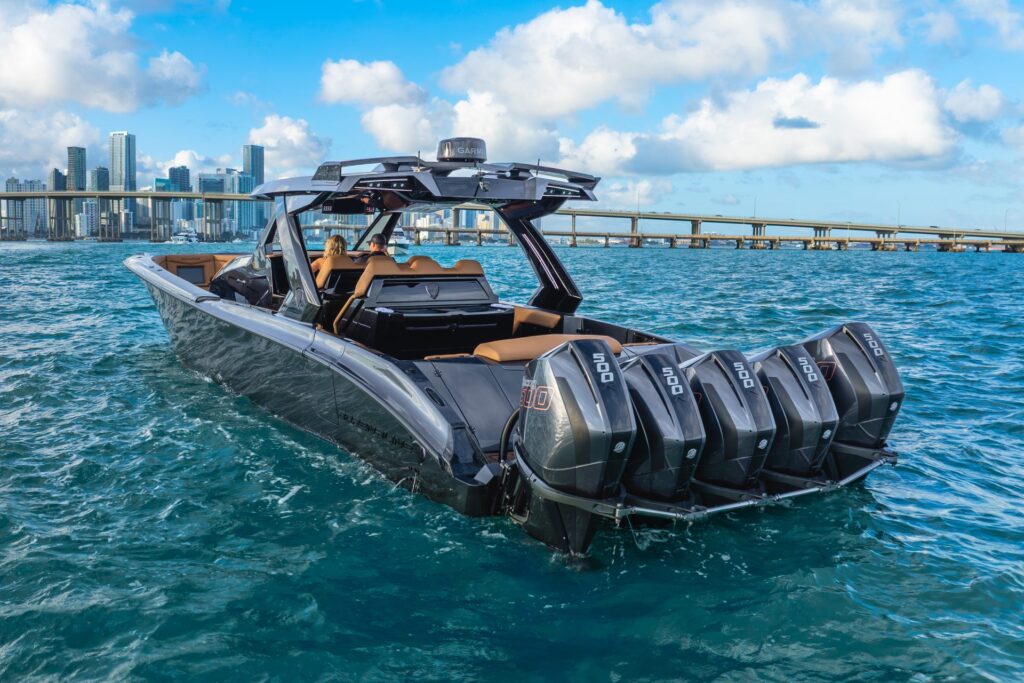
There is a particular kind of arrival that only happens from the water. A car approaches along a road already defined by curbs, traffic, parking spaces, and buildings. A boat arrives across an open surface, visible from a distance and gradually gaining scale as it closes the gap between horizon and dock. Long before anyone steps ashore, the machine has already announced itself through movement, proportion, sound, and the way it occupies the water.
For a serious performance powerboat, that arrival can be one of the most memorable parts of ownership. Not because the boat is trying to demand attention, but because certain machines possess a presence that is difficult to disguise. Their proportions make sense in motion, their stance becomes more dramatic against open water, and their sound reaches the marina before their details can be studied. By the time the boat settles alongside the dock, the entrance has unfolded as a sequence rather than a single moment.
Presence Begins Before the Dock
The visual experience of a performance boat starts at a distance. From shore, the first details are rarely upholstery, instrumentation, or hardware. What registers initially is silhouette. The relationship between the bow, deck, windshield, hardtop, cockpit, and hull creates a recognizable profile before smaller design decisions become visible.
This is why proportion matters so much in marine design. A boat can contain excellent equipment and costly materials yet still lack visual coherence. Another can feel resolved before the observer can identify a single component. Water amplifies that effect because sky, horizon, and open surface create a relatively uncluttered background against which shape becomes more legible.
The arrival begins there, when the boat is still far enough away to be understood primarily as form in motion.
Movement Gives Design Another Dimension
A performance powerboat cannot be fully understood while stationary. At the dock, the hull can be studied closely. Paint, materials, hardware, seating, and individual details become visible. Underway, however, the design acquires another dimension. The boat develops a running attitude, water breaks from the hull, reflections move across painted surfaces, and the relationship between length and height changes as the boat approaches from different angles.
Movement can make a good design more convincing because it reveals why certain lines exist. The bow becomes the leading edge of the experience. The cockpit and hardtop stop functioning only as architectural elements and become part of a single moving profile.
The most memorable designs answer two questions at once: does the boat look resolved while tied up, and does it look equally convincing doing what it was built to do?
Sound Changes the Atmosphere Before the Boat Arrives
The waterfront is a highly sensory environment. Wind moves through rigging, water works against hulls and pilings, and conversations carry across open space. Into that environment, the sound of an approaching performance boat creates a different kind of signal.
Sound can give an arrival scale. It can suggest distance, acceleration, and mechanical character before the boat is close enough to identify. Yet sophistication matters. The appeal is not simply volume, especially in a marina where consideration for others remains part of good seamanship.
The more compelling experience is the transition. A boat can be heard working in open water, then settle into a different character as it approaches a no-wake zone and prepares to dock. The change from performance to precision is part of the arrival. A serious machine should be capable of intensity without requiring intensity at every moment.
The Marina Is a Different Kind of Stage
A marina brings radically different boats into close proximity. Cruisers, center consoles, sportfishing boats, yachts, tenders, and performance machines may occupy neighboring slips, each designed around different priorities. That diversity makes the marina an unusually revealing setting for design.
A performance powerboat does not need to be the largest boat present to have presence. Size alone often says surprisingly little about visual impact. Proportions, stance, paint, cockpit architecture, and the clarity of the design can give a lower, more purposeful machine a distinct identity even beside considerably larger vessels.
This is where the language of performance becomes visible without any demonstration of speed. A long, low profile may communicate purpose. A carefully integrated windshield or hardtop can give the boat architectural tension. Paint can emphasize the hull’s geometry rather than simply decorate it.
The result is not necessarily louder or more extravagant than everything around it. It is simply different enough to be understood immediately.
Paint Becomes Part of the Arrival
Custom paint has an unusual role on a powerboat because the canvas is large and the lighting changes constantly. A color seen inside a build facility is only one version of itself. On the water, sunlight, cloud cover, reflection, spray, and the surrounding environment continually alter its appearance.
For this reason, paint is not merely a finishing decision. It becomes part of how the boat is read from a distance.
Adrenaline Powerboats approaches this element as part of its custom-building philosophy. The company states that it uses custom paint on every boat and that its design team works with the customer to tailor the process to the individual build. It also develops its designs in-house, allowing the visual treatment to relate directly to the underlying form rather than functioning as an unrelated layer applied afterward.
That relationship is important. The strongest paint schemes reveal the boat rather than overwhelm it. They direct the eye toward proportion, shape, and detail already present in the design.
The Final Approach Reveals the Operator
As the boat closes the final distance to the dock, attention shifts from the machine itself to the way it is being handled. This stage of the arrival has very little to do with outright performance. It is about judgment.
Speed comes down. Wake is managed. Traffic, wind, current, dock geometry, passengers, and neighboring boats all enter the operator’s awareness. The helm becomes a place of quiet precision rather than dramatic input.
Experienced boaters recognize this immediately. A smooth approach communicates familiarity with the machine in a way that no high-speed pass can. There is confidence in knowing how much momentum the boat carries, how quickly it responds, and how to position it without unnecessary movement.
That competence gives the arrival a sense of ease. The boat does not need to be forced into place. It is guided.
Arrival Is Also About the People Aboard
A waterfront entrance is not exclusively a driver’s experience. One of the attractions of performance boating is that the journey can be shared.
Passengers experience the gradual transition from open water into the marina. Wind decreases, conversation becomes easier, the destination comes into focus, and people on shore become recognizable. The energy of the run gives way to the social rhythm of arrival.
That change is part of what separates a performance powerboat from many other enthusiast machines. It can deliver an engaging operating experience while also transporting a group directly into a waterfront setting. The run and the destination belong to the same event.
A waterfront restaurant, hotel, private dock, gathering, or afternoon stop becomes part of a larger day that began when the lines were released. The arrival matters because it completes the first half of that story.
Presence Does Not Require Exhibition
There is an important distinction between presence and showing off. Showing off asks for attention. Presence receives it without having to ask.
A thoughtfully designed performance boat can hold attention because the observer senses coherence. The proportions feel deliberate. The sound belongs to the machine. The paint works with the form. The movement looks natural. The final approach is controlled. None of those qualities requires theatrical behavior.
In fact, restraint often makes a stronger impression. This is particularly true in luxury environments, where obvious attempts to communicate status can undermine the sophistication of the object itself. A machine with real character does not need to be explained continuously. Its design and behavior provide enough information.
Some Machines Change the Character of a Destination
The most memorable waterfront arrivals are not memorable because a crowd gathers. They are memorable because the boat momentarily changes the atmosphere of the place.
A distinctive silhouette appears beyond the marina entrance. The sound approaches and then softens. The scale of the boat becomes clear. Paint and surfaces that were unreadable at distance begin to reveal themselves. The operator brings the machine through the final approach, and what had been an object moving across the horizon becomes a physical presence at the dock.
That sequence is unique to boating. It is also one of the reasons design matters so much in a high-performance powerboat. A boat is experienced at multiple scales and in multiple states: from far away and close up, stationary and moving, quiet at the dock and alive on open water. The best designs remain convincing through all of them.
Adrenaline Powerboats builds within that intersection of performance and visual identity. Its in-house design process and custom-paint approach give individual builds the opportunity to develop a presence that belongs not only to the Reaper platform, but to the specific boat commissioned by its owner.
A waterfront arrival should never need to become a performance for the crowd. When the machine has proportion, character, craftsmanship, and a clear design identity, simply arriving is enough.
For those interested in creating a Reaper with a presence of its own, explore a custom Reaper build.