There is a difference between owning an impressive machine and owning one that feels unmistakably yours. The distinction is rarely explained by price alone, and it is not always obvious to someone seeing the boat for the first time. It emerges gradually through use: the color you chose instead of accepting what was available, the helm environment that reflects how you actually operate, the materials that suit your taste, and the details that make sense because they were selected with your priorities in mind.
Customization matters in many luxury categories, but it becomes especially meaningful in a performance powerboat because the owner develops such a direct relationship with the object. A boat is not simply looked at. It is driven, occupied, maintained, shared with friends and family, and experienced repeatedly in changing light, weather, destinations, and water conditions. The more personal the specification, the more those experiences begin to attach themselves to one particular machine rather than merely to a model name.
That is why customization becomes more valuable after delivery, not less. The choices made before ownership eventually become the details that define ownership.
Personal Specification Creates Recognition
One of the first signs that a boat has become truly personal is how quickly the owner recognizes it as his own.
That recognition goes beyond identifying a hull shape or model. It comes from a combination of details that would be difficult to mistake for another example: a particular paint treatment, a restrained interior palette, a certain visual balance at the helm, or a configuration that reflects the way the boat is actually used.
This familiarity changes the relationship with the machine. A standardized product is designed to make sense for a broad range of people. A customized one can feel as though certain decisions were made specifically for the person stepping aboard.
The effect is subtle at first. Over time, however, those details become inseparable from the identity of the boat. The owner stops thinking of them as options and starts thinking of them simply as the way the boat should be.
Ownership Changes the Meaning of the Choices
During specification, a paint color is a sample. A material is a swatch. A layout decision may exist only on a screen or in a conversation. Once the boat enters regular use, those decisions become physical experiences.
Paint is seen under direct sun, reflected water, cloud cover, and marina lighting. Upholstery is judged after hours aboard rather than during a brief inspection. Storage either works naturally or becomes something the owner wishes had been approached differently. The helm is no longer a design concept; it becomes the place from which hundreds of miles may eventually be traveled.
This is where good customization proves itself. The most successful choices do not remain interesting because they are unusual. They remain satisfying because they continue to feel appropriate.
Novelty fades quickly. Relevance lasts.
A specification built around genuine preferences tends to age differently from one built around trends. The owner continues to understand why the decisions were made because the reasons were personal from the beginning.
The Boat Begins to Reflect Habits
People develop habits around machines they use frequently. A driver reaches for the same control without looking. A bag is placed in the same compartment. Passengers gravitate toward familiar seats. The owner develops a preferred routine for leaving the dock, running the boat, arriving, cleaning up, and preparing for the next outing.
Customization can support those habits when the boat has been specified thoughtfully.
This is one reason functional personalization often becomes more important than decorative personalization with time. A dramatic exterior may create the first emotional response, but practical details shape the hundredth day aboard. The owner notices whether the cockpit supports the way people actually move. He notices whether the information at the helm is organized in a way that feels natural. He notices which materials continue to feel right after repeated exposure and use.
A boat that fits those patterns begins to feel less like a product and more like a personal environment.
That does not mean every owner needs a radically different configuration. Often the most meaningful changes are small. Their value comes from the fact that they align the platform more closely with the person using it.
Individuality Becomes More Important With Familiarity
When a boat is new, almost everything about it is stimulating. The scale, sound, acceleration, cockpit, paint, and overall presence create an immediate sense of occasion. As familiarity grows, the owner begins to experience the machine differently.
The broad impressions remain, but attention moves toward detail.
This is where individuality becomes more important. A generic specification may still be attractive, but there is less to discover emotionally once the initial novelty has passed. A highly personal boat carries a different kind of depth because the owner understands the decisions behind it.
A particular color may have been chosen because it connects with another object in a collection. An interior treatment may reflect a preference for restraint rather than contrast. A helm setup may have been selected because the owner values a certain way of organizing information. None of these details needs to be obvious to anyone else.
In fact, their private meaning can make them more valuable.
True personalization is not necessarily about creating a boat that attracts more attention. It is about creating one that rewards the owner’s attention.
A Custom Boat Can Become Harder to Replace
One of the clearest signs of successful customization appears when the owner begins thinking about what could replace the boat.
Replacing a standardized product is relatively simple in theory. A newer version may offer more technology, different styling, or improved capability. The comparison can be made through features and specifications.
A highly personal machine complicates that process.
The next boat may be newer, but will it have the same visual identity? Will the cockpit feel as natural? Will the material combination be as satisfying? Will the overall specification carry the same balance of restraint, performance, and personality? The more successful the original customization, the more difficult it becomes to treat the machine as interchangeable.
Collectors understand this problem well. A particular automobile may remain in a collection not because it is objectively the fastest or most valuable, but because its specification is difficult to reproduce. A watch may remain meaningful because of its history with the owner. A motorcycle may survive repeated opportunities for replacement because its character has become familiar.
A performance boat can reach the same point. Once ownership becomes attached to one particular example, the decision to move on is no longer purely technical.
Customization Gives the Boat a Memory
Objects do not literally remember, but owners attach memories to specific details.
A certain seat becomes associated with a friend who always chooses it. A familiar stretch of deck recalls a particular trip. The helm becomes connected with early mornings, long destination runs, difficult docking conditions handled cleanly, or quiet returns after a full day on the water. Paint that once existed as a design decision becomes the surface seen in hundreds of photographs.
Customization gives those memories a more distinctive physical setting.
The boat is not merely the same model someone else owns. It is the exact boat that was present for those experiences. Its visual and functional details become markers in the owner’s history with it.
This is part of why custom products can acquire emotional value that exceeds the rational importance of their individual features. The specification becomes a framework onto which experience accumulates.
Over years of ownership, the original choices and the later memories become difficult to separate.
Personal Taste Does Not Need an Audience
Customization is sometimes mistaken for display. The assumption is that an unusual specification exists primarily to be noticed by other people.
That can happen, but the most sophisticated customization is often more private than public.
An owner may choose an understated color precisely because it is personally satisfying rather than immediately recognizable. A subtle material contrast may only become apparent from inside the cockpit. A functional decision at the helm may have almost no visual impact from the dock but dramatically improve the owner’s experience.
These decisions represent a mature form of luxury because they do not depend on external validation.
The boat is customized for the person using it, not for the crowd observing it.
That philosophy is particularly well suited to performance boating. The strongest relationship with the boat occurs underway, when most outside observers are irrelevant. At that moment, the owner is interacting with the steering, throttles, displays, seating, hull, and water. Personal choices matter because they influence that private experience.
A Recognizable Model Can Still Become a Singular Boat
Customization works best when it does not erase the integrity of the original design.
A strong platform should have its own identity. The goal is not to disguise the boat until its underlying character disappears. It is to allow the individual example to develop a personality within that framework.
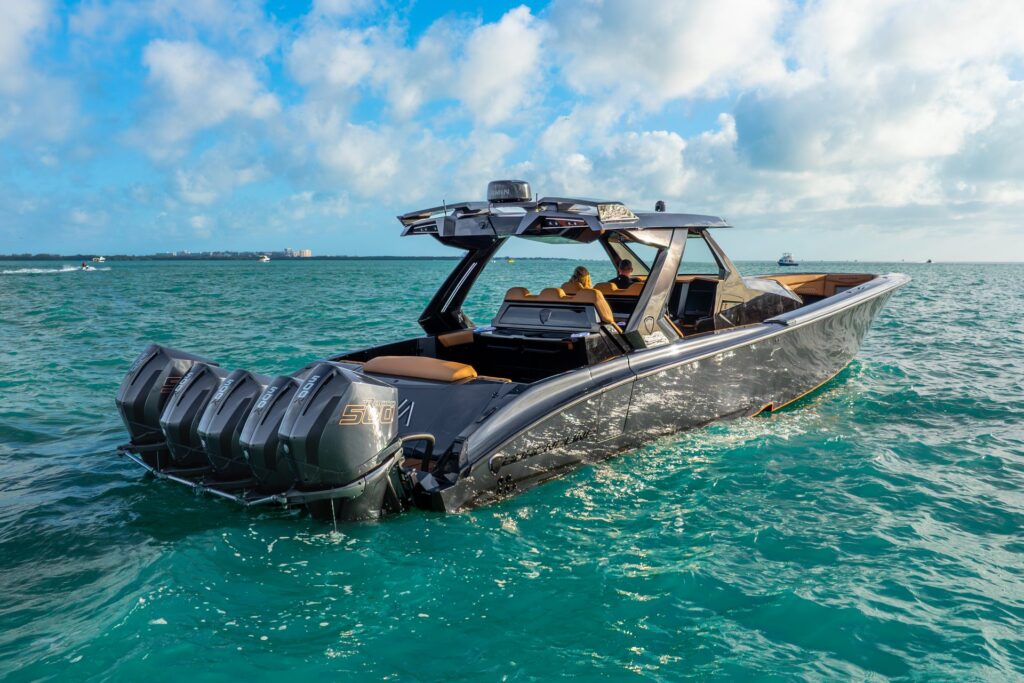
This is where Adrenaline Powerboats provides a natural example. The company states that it uses custom paint on every boat and that its design team works closely with customers to tailor that process to their specifications. Adrenaline also says every boat is rigged in-house and that the rigging is specified for each individual build. Those practices allow a Reaper to remain recognizably part of the model family while giving the finished boat details that belong to a particular owner.
The distinction is important because personalization and brand identity should strengthen one another. A custom boat should not feel anonymous, but neither should it feel like an unrelated collection of choices.
The best examples preserve the architecture of the machine while making the ownership experience more specific.
The Value of Customization Grows After Delivery
Customization is often discussed as part of the sales process, as though its value is concentrated in the excitement of choosing colors, materials, options, and equipment. In reality, those decisions matter far more after the boat leaves the builder.
Delivery is when customization stops being theoretical.
The owner begins living with the choices. Some are appreciated immediately. Others reveal their value slowly. A storage solution may become indispensable only after several long weekends. A particular material may earn appreciation after a season of use. A restrained paint choice may feel more satisfying each year because it continues to look appropriate rather than tied to a brief trend.
This is why thoughtful personalization should be measured by longevity rather than initial impact.
The objective is not simply to make delivery day feel special. It is to make the boat continue feeling correct after the first season, the first hundred hours, and the initial excitement have passed.
Truly Yours Means More Than Different
There is an important difference between a boat that is different and a boat that is yours.
Difference can be created easily. Choose the brightest color, the most unusual contrast, or the most conspicuous available option and the result will stand apart. But individuality requires more discipline. It means understanding what actually matters to the owner and allowing those preferences to influence the final machine without overwhelming the integrity of the design.
That kind of customization creates connection rather than novelty.
Over time, the owner stops seeing a list of selected options and begins seeing one complete object. The colors, materials, equipment, layout, and details form a familiar environment. The boat develops habits around its owner, and the owner develops habits around the boat.
At that point, customization has achieved something much more meaningful than visual distinction. It has made the machine emotionally specific.
For Adrenaline, the emphasis on custom paint and build-specific rigging creates room for that relationship to develop within the Reaper platform. The value is not simply that one boat can look different from another. It is that an owner can live with a set of choices that continue to feel personal every time the boat leaves the dock.
That is why customization matters more when the boat is truly yours. The initial decisions may take place before delivery, but their real value is measured in the years that follow.
For owners ready to create a Reaper that reflects their own preferences from the beginning, start a custom Reaper inquiry.