
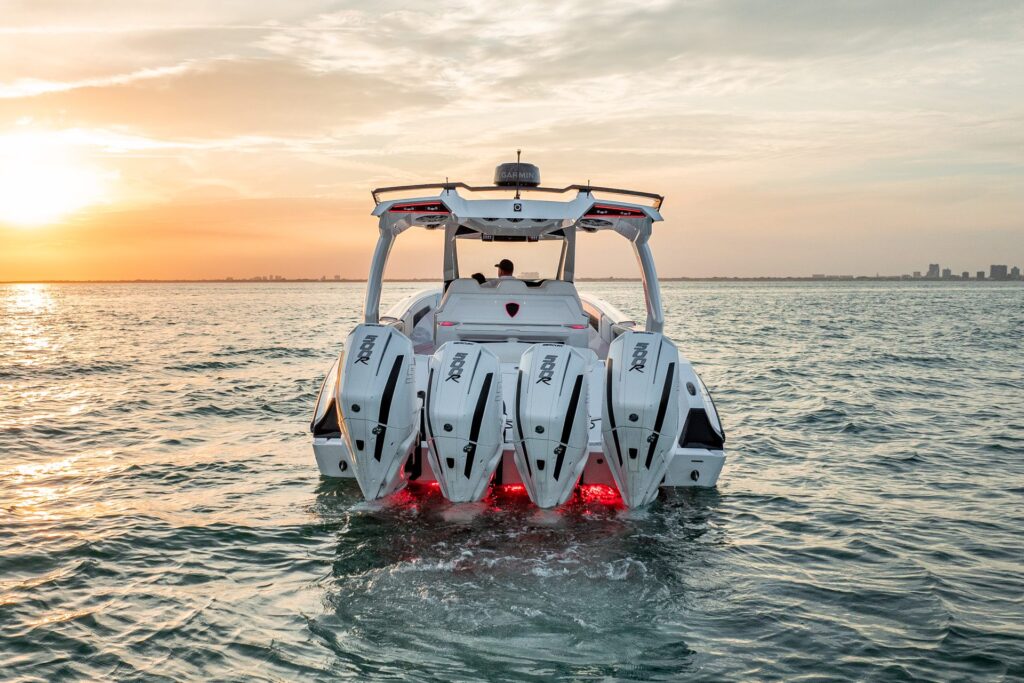
Luxury is easy to recognize when everything is still. It can be seen in the finish of a surface, the quality of a material, the precision of a seam, or the way a cockpit is arranged before anyone turns a key. At rest, refinement is visual and tactile. At speed, however, luxury is asked to prove itself.
A performance powerboat introduces movement, wind, noise, vibration, acceleration, changing water, and constant demands on the driver and passengers. Those forces expose whether comfort has been treated as decoration or engineered into the experience. True luxury at speed is not the absence of intensity. It is the ability to experience intensity without the machine becoming crude, exhausting, or disorganized.
That distinction changes the meaning of refinement. On a serious performance boat, luxury is not simply what surrounds you. It is how the entire boat behaves while delivering the experience it was built to create.
Refinement Is Most Convincing Under Load
Many products can feel luxurious in controlled conditions. Soft materials, polished hardware, dramatic lighting, and carefully composed interiors create an immediate impression. A performance boat has to carry that impression into an environment that is constantly moving.
Once the throttles come forward, every design decision becomes more consequential. Seating has to support the body rather than merely look sculptural. Controls must remain intuitive while attention is divided between speed, water, traffic, and navigation. Visibility matters more. Materials are no longer judged only by appearance, but by how they feel after hours of sun, spray, wind, and use.
This is why genuine luxury in a high-performance environment tends to be holistic. It cannot be added with a few premium finishes. The hull, cockpit, seating, ergonomics, controls, structure, and overall layout must work together so that performance feels deliberate rather than chaotic.
A boat can be fast and impressive while still demanding too much from everyone aboard. A more refined machine delivers pace while preserving a sense of order.
Composure Changes the Perception of Speed
Speed is not experienced only through a number on a display. It is interpreted through the body. The way a boat settles, responds, turns, carries momentum, and communicates with the operator determines whether speed feels controlled or merely dramatic.
This is where composure becomes a form of luxury.
A composed performance boat does not need to isolate the driver from what is happening. Experienced owners often want the opposite. They want feedback and a clear understanding of what the hull is doing. The distinction is that useful information reaches the operator without unnecessary distraction.
On the water, the variables are greater because the surface itself is changing. Refinement therefore feels less like silence and more like confidence. The driver can remain attentive to conditions while the boat’s design supports rather than complicates that task.
The Helm Is Where Luxury Becomes Functional
A luxury performance boat ultimately has to make sense from the helm. This is where styling, ergonomics, technology, visibility, and control converge, and it is where superficial refinement is easiest to expose.
The best helm environments reduce unnecessary friction. Information should be legible. Controls should be logically located. Seating should provide support appropriate to the boat’s capabilities. Sightlines should make it easier to read the water and understand the boat’s position. The driver should not have to fight the layout in order to operate the machine well.
None of this sounds extravagant, yet that is precisely the point. Mature luxury is often defined by the removal of small irritations. The owner notices what does not require conscious effort.
The current Reaper 42 and Reaper 47 from Adrenaline Powerboats provide a useful example. Adrenaline lists dual-row helm seating for six, full wraparound coaming bolsters, substantial cockpit storage, and digital controls among the Reaper models’ equipment. Those details matter less as individual checklist items than as parts of a cockpit intended to support actual time underway.
True luxury at the helm is not measured by the number of screens or switches. It is measured by how naturally the boat allows the operator to focus on driving.
Comfort Does Not Have to Dilute Performance
There has long been a false choice in enthusiast culture between comfort and authenticity. The assumption is that a machine becomes less serious as it becomes more refined. In reality, the highest level of engineering often does the opposite. It makes capability easier to access and more satisfying to live with.
Supportive seating is not a concession to softness when a boat is moving quickly. It helps occupants remain secure and reduces unnecessary physical effort. Thoughtful cockpit design does not diminish the sensation of speed; it can make that sensation sustainable for longer periods. Useful storage, practical boarding arrangements, and protected spaces do not compromise performance identity. They allow the boat to function as a complete object rather than a single-purpose demonstration.
A machine that is exciting for ten minutes can be memorable. A machine that remains rewarding over an entire day reaches a different standard.
Sensory Quality Is About Editing, Not Eliminating
A performance powerboat should not feel anesthetized. Sound, acceleration, wind, and the movement of the hull are central to its appeal. Removing those sensations entirely would erase much of the reason for owning one.
Luxury enters through editing.
The goal is not silence but quality of sound. Not isolation but control of vibration. Not the elimination of motion but the management of how that motion reaches the occupants. Not the removal of wind but a cockpit environment that allows the sensation of speed without turning every mile into a test of endurance.
Refinement does not mean making a high-performance machine behave like something it is not. It means allowing its character to come through cleanly. The best mechanical objects often work this way: they preserve the sensations that create emotional connection while reducing the noise, harshness, and inconvenience that add nothing to the experience.
Luxury at speed is therefore not quieter by definition. It is more resolved.
Materials Must Work as Hard as the Boat
Premium materials are often discussed visually, but movement changes how they are judged. A surface that looks impressive in photographs may feel less convincing when a passenger braces against it. Upholstery is evaluated differently when it must support occupants underway. Flooring matters when people are moving through the cockpit with wet feet. Hardware becomes more important when it is used repeatedly rather than admired from a distance.
Adrenaline’s published Reaper specifications include marine-grade UV-stable upholstery alongside practical cockpit equipment and custom finish options. That combination reinforces the larger principle: refinement has to coexist with exposure, movement, and repeated use.
Confidence May Be the Most Important Luxury
The most valuable feeling a serious machine can create is confidence.
Confidence allows attention to move away from managing unnecessary distractions and toward the reasons the boat is enjoyable in the first place: reading the water, choosing a line, feeling acceleration build, moving efficiently between destinations, and sharing the experience with the people aboard.
This is not the same as making performance effortless. High-speed boating still requires judgment, awareness, and respect for conditions. No amount of luxury should disguise that reality. But a well-resolved boat can support the operator so that skill is applied to the environment rather than spent compensating for poor ergonomics or confusing design.
That may be the most sophisticated definition of luxury in any performance category. The product does not constantly call attention to how luxurious it is. Instead, it makes difficult things feel considered.
The Experience Should Remain Special After the Acceleration Ends
Raw speed creates an immediate reaction. It is visceral, measurable, and easy to understand. Yet ownership is built from everything that happens around those moments as well.
There is the transition from idle into open water. The settling of the boat into its running attitude. The feel of the helm during a long stretch at pace. The quality of the seating after several hours. The ease of moving around the boat after arriving. The visual satisfaction of looking back at the machine tied up at the end of the day.
These moments are where performance and luxury stop being separate categories.
A truly refined performance boat does not ask the owner to choose between excitement and sophistication. It recognizes that the two can strengthen each other. Performance gives the boat emotional intensity. Luxury gives that intensity structure, longevity, and depth.
That is what true luxury feels like at speed. It is not simply polished surfaces moving quickly across the water. It is the sensation that the experience—from feedback through the helm to the support of the seat, the quality of the materials, and the clarity of the cockpit—has been considered in the context of motion.
For Adrenaline, that philosophy is visible in the way its Reaper models combine performance-oriented design with usable cockpit arrangements and custom finishing, while the company’s broader build process emphasizes in-house design, custom paint, and build-specific rigging.
The most convincing luxury does not compete with performance for attention. It makes the performance feel complete.
For owners interested in shaping that balance around their own preferences, begin a custom Reaper inquiry.