
There is a point in every luxury market where price stops being the most meaningful measure of distinction. Two products can occupy the same financial territory and still create completely different ownership experiences. One may be expensive because of scale, technology, materials, or brand positioning. The other may feel exclusive because very few examples exist, because its details were shaped around one owner, and because the process of acquiring it resembles commissioning more than shopping.
On the water, that distinction is especially visible. Marinas are full of costly boats, but cost alone does not determine which ones retain attention after the first glance. The machines that feel genuinely exclusive tend to possess something harder to quantify: a sense of intention. Their proportions, finishes, specifications, craftsmanship, and character work together in a way that makes the individual boat feel difficult to duplicate.
That is the difference between something that is merely expensive and something that feels truly exclusive.
Price Can Buy Quality, but Not Automatically Rarity
There are many legitimate reasons a powerboat can command a high price. Advanced engineering, specialized construction, sophisticated electronics, premium finishes, high-performance propulsion, and labor-intensive manufacturing all carry real cost. In a serious performance boat, those costs may also reflect years of design development and the complexity of integrating multiple systems into one cohesive machine.
But expense and exclusivity are not the same thing.
A product can be extraordinarily costly and still be broadly standardized. If the same model, color palette, trim combinations, layouts, and option structures are repeated across a large production run, the owner may possess something impressive without possessing something especially personal. The purchase may represent quality and status, but it does not necessarily create rarity in the deeper sense.
Exclusivity begins to emerge when the finished object stops feeling interchangeable. It is not simply that fewer people can afford it. It is that fewer people can possess that exact expression of it.
That difference matters in performance boating because the boat is not merely displayed. It is operated, touched, heard, seen in changing light, and experienced in motion. The details that make it distinctive at the dock continue to shape the experience underway. A boat that reflects its owner’s preferences can become more personal with every hour of use.
Exclusivity Begins Where Standardization Ends
Mass production has enormous strengths. It can deliver consistency, predictable quality, efficient serviceability, and refined products that appeal to a broad customer base. But standardization necessarily imposes boundaries. Choices must be organized into packages, predefined combinations, and options that can be repeated reliably across many units.
Bespoke products operate differently. Their value often comes from allowing the customer’s preferences to influence the finished result in ways that would be impractical for mass production.
That does not mean every custom decision needs to be dramatic. In fact, the most convincing expressions of exclusivity are often restrained. A specific paint treatment, a particular material combination, a carefully considered cockpit atmosphere, or a subtle visual theme can make a boat feel individual without making it theatrical. The purpose is not to make every surface unusual. The purpose is to make the entire object feel coherent and personal.
This is where commissioning differs from selecting. The customer is not simply choosing the most desirable version of a standardized product. The customer is participating in the creation of a particular example.
For an enthusiast accustomed to collector cars, watches, aircraft, or bespoke interiors, that distinction is familiar. The object becomes more interesting because its specification reflects judgment. It carries evidence of choices that were made deliberately rather than inherited from a production template.
Craftsmanship Gives Exclusivity Substance
Rarity by itself is not enough. A product can be uncommon for reasons that have nothing to do with quality. Lasting exclusivity requires substance, and craftsmanship is one of the elements that gives rarity meaning.
Craftsmanship reveals itself through details that are difficult to reduce to a specification sheet. It can be seen in how components fit together, how surfaces are finished, how paintwork follows complex forms, how hardware is integrated, and how practical systems are resolved without compromising the visual character of the boat. The result should not feel like a collection of expensive parts. It should feel like one complete machine.
That matters because a premium powerboat lives in a demanding environment. Sun, spray, heat, vibration, movement, passengers, equipment, and repeated use all test the quality of the design and the work behind it. Luxury that impresses only at delivery is superficial. More meaningful craftsmanship continues to make sense after the novelty of ownership has faded.
Limited-production builders can be especially compelling in this context because the distance between design intent and finished product can remain relatively short. When design, fabrication, paint, rigging, and finishing are closely connected, there is greater opportunity for individual decisions to influence the final build.
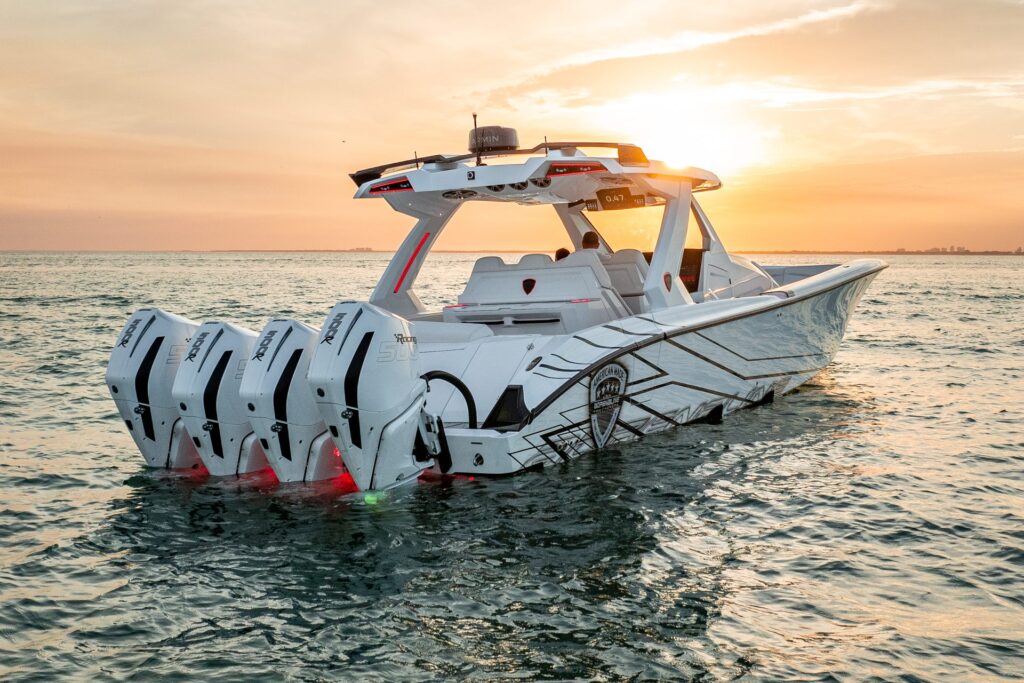
Adrenaline Powerboats describes its own custom boat-building approach in these terms. The company states that its designs are developed in-house, that custom paint is used on every boat, and that its design team works with customers to tailor the paint process to their specifications. Adrenaline also says each boat is rigged in-house and that rigging is specified for the individual build. In practical terms, that means customization is not treated simply as a decorative layer added after the important decisions have already been made. It is part of how the finished boat takes shape.
Individuality Is More Valuable Than Recognition
There is a familiar form of luxury built around recognition. The badge is known, the silhouette is identifiable, and the product communicates its position almost instantly. That kind of recognition has value, but it is not the only form of exclusivity.
For many enthusiasts, a more compelling experience comes from owning something that rewards closer inspection. The boat may still be recognizable as a particular model, yet the color, finish, specification, detailing, and overall attitude of that individual example make it unmistakable.
This is where exclusivity becomes personal rather than performative.
The goal is no longer simply to own something that other people understand to be expensive. The goal is to own a machine that feels difficult to replace because its exact combination of choices belongs to that boat. The satisfaction comes as much from knowing why those decisions were made as from having other people notice them.
Collectors understand this instinct well. Two examples of the same automobile can have dramatically different appeal because of specification, provenance, condition, color, or unusual factory options. Watches within the same reference can inspire different levels of fascination because of subtle production details. Aircraft interiors, motorcycles, and even architecture can work the same way. The underlying platform matters, but individuality is often what gives a particular example its emotional gravity.
Performance powerboats fit naturally into that world because they combine engineering with design in such a visible way. They are functional machines, but they are also highly expressive objects.
Access Becomes Part of the Luxury
Exclusivity also involves access, though not necessarily in the obvious sense of making a product difficult to obtain. A more meaningful form of access is proximity to the people and decisions behind the product.
A standardized purchase is usually transactional. The product exists, the customer selects from the available combinations, and ownership begins at delivery. A commissioned product introduces another layer. Conversations happen earlier. Preferences are discussed before the object is complete. Design decisions become part of the ownership story.
That involvement changes the emotional timeline of the purchase. Anticipation begins before delivery because the boat first exists as an idea, then as a set of choices, and finally as a finished machine. The owner is not simply waiting for inventory to arrive. There is an awareness that something specific is being created.
Adrenaline’s public description of its Reaper client process reflects that philosophy, beginning with a consultation intended to understand the customer’s vision, preferences, and requirements before moving into custom design. The significance of that process extends beyond one builder. It illustrates why access to the people shaping a specialized product can become part of the luxury itself.
The finished boat carries a record of those decisions. Its individuality is not accidental. It is the result of participation.
The Most Exclusive Details Are Not Always the Loudest
It is easy to associate exclusivity with the most visible decisions: dramatic paint, unusual upholstery, distinctive graphics, or bold exterior styling. Those elements can certainly contribute to identity, particularly on a performance boat whose visual presence is part of its appeal. But some of the most satisfying details reveal themselves gradually.
An owner may notice how naturally a cockpit supports a long day on the water. A control may fall exactly where expected. A material may age better than anticipated. A subtle color may look different under morning light than it does at sunset. A paint treatment that first appeared purely aesthetic may reveal how carefully it follows the geometry of the hull.
These details are difficult to appreciate in a quick comparison between competing products. They become visible through use.
That is one of the strongest distinctions between price and exclusivity. Price is obvious at the point of sale. Exclusivity often becomes more apparent with time.
A genuinely individualized boat should continue to reward familiarity. The owner should discover evidence of thought in places that were not immediately obvious. The machine should feel increasingly personal rather than increasingly ordinary.
Distinction Cannot Be Reduced to a Price Tag
The most compelling luxury products resist simple comparison. Their value cannot be summarized by asking which one costs more, has the longest options list, or carries the most recognizable name. They are desirable because design, rarity, craftsmanship, access, and personal specification come together in a way that makes them difficult to substitute.
That is the deeper meaning of exclusivity on the water.
Expensive describes the resources required to acquire something. Exclusive describes the difficulty of reproducing the same experience. One is primarily financial; the other is experiential. One can be measured immediately. The other is revealed through ownership.
For a performance powerboat, that distinction can be profound. Engineering establishes capability. Design creates presence. Craftsmanship gives the object credibility. Individual specification gives it identity. Limited production can protect its rarity, while a thoughtful commissioning process gives the owner a connection to the boat before the first hour is ever logged.
Adrenaline Powerboats operates naturally within that territory by emphasizing in-house design, custom paint, and build-specific rigging as part of its custom-building approach. Those elements matter not because customization is fashionable, but because they give each finished boat more opportunity to carry evidence of individual decisions.
Anyone can compare prices. Genuine exclusivity becomes apparent when comparison itself starts to feel inadequate. When a boat has been shaped around a particular vision, built with enough care to support that vision, and finished in a way that makes the individual example memorable, its value is no longer explained only by what it cost. It is explained by how difficult it would be to create another one exactly like it.
For those interested in taking that idea from concept to specification, explore the process of commissioning a custom Reaper.