
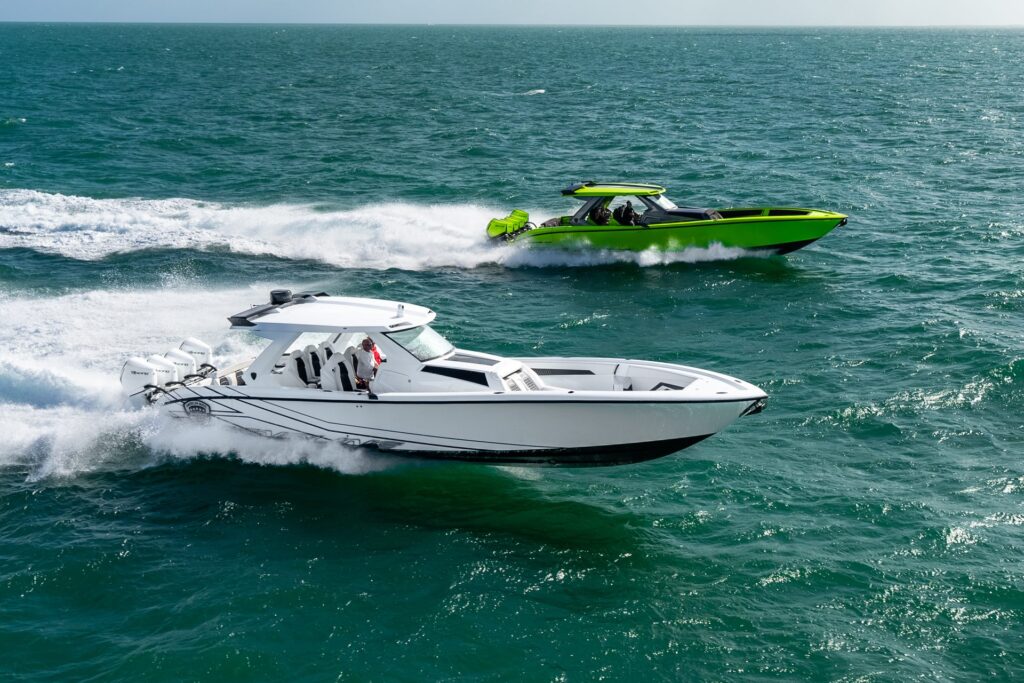
Speed has a way of clarifying things.
At idle, distractions exist. Conversations drift. Attention fragments. The environment feels manageable because it demands very little.
At 100 miles per hour offshore, none of that survives.
There is no spare bandwidth. No room for wandering thought. No tolerance for divided focus. The moment the throttles move forward and the hull rises cleanly onto plane, everything unnecessary disappears.
What remains is awareness.
Speed as a Filter
Most environments allow partial attention. You can operate at eighty percent focus and still function. Offshore at triple-digit speeds does not allow that margin.
Water texture matters.
Wind direction matters.
Boat traffic matters.
Hull response matters.
The faster you move, the more information you must process in real time. Surface changes that seem insignificant at moderate speed become critical at higher velocity. A ripple becomes a lift point. A wake becomes a launch angle. A slight crosswind becomes directional pressure.
Speed filters out everything irrelevant and forces engagement with what is essential.
That is why it feels so sharp.
The Collapse of Distraction
Modern life is structured around interruption. Notifications. Messages. Meetings. Background noise layered over constant expectation.
Offshore at speed eliminates interruption.
You are not scrolling.
You are not multitasking.
You are not negotiating attention.
You are reading water.
That shift is not subtle. It is immediate.
Focus tightens. Peripheral awareness expands. Reaction time shortens. The mind stops jumping and starts tracking.
This is not chaos. It is controlled intensity.
Control Is Measured in Inches
At 100+ MPH offshore, control is not theoretical.
It is measured in inches of steering input. In fractional throttle adjustments. In trim corrections that alter hull attitude by degrees.
Small movements produce significant outcomes.
That sensitivity forces discipline. Overcorrection creates instability. Hesitation creates delay. Smooth, deliberate input keeps the boat settled and predictable.
Control at speed is not about force.
It is about precision.
Loud Power, Clear Mind
There is a misconception that loud engines and aggressive acceleration create chaos. In reality, for those who are accustomed to running hard, the opposite is true.
The louder the engines, the clearer the mind becomes.
The vibration through the hull, the tone of the exhaust, the physical push of acceleration—all of it becomes feedback. That feedback sharpens awareness rather than dulling it.
Sound is information.
The experienced operator hears changes before they are visible. RPM shifts. Load differences. Minor inconsistencies. At speed, listening becomes part of control.
This is not reckless noise.
It is calibrated intensity.
The Flow State Offshore
Psychologists often describe a state called “flow”—a condition where challenge and capability align perfectly. Too little challenge creates boredom. Too much creates anxiety.
Offshore at triple-digit speed sits precisely in that alignment for those who are prepared.
The challenge is real.
The capability is earned.
When both meet, time compresses. Thought simplifies. Reaction becomes instinctive. The boat feels connected rather than separate.
This state is addictive—not because it is dangerous, but because it is pure.
There are no external narratives. Only input and response.
Respecting the Line
There is always a line.
Conditions change. Water builds. Traffic increases. Visibility shifts. The skilled operator understands that control includes knowing when to ease back.
Running hard is not about ignoring limits. It is about understanding them intimately.
At speed, ego becomes obvious quickly. The water does not reward bravado.
It rewards judgment.
The operator who respects that line maintains composure. The one who ignores it introduces instability.
Control includes restraint.
Physical Engagement
Offshore speed is not passive.
It demands posture. Grip. Balance. Subtle weight shifts. It engages the entire body, not just the hands.
You feel acceleration through your spine. You absorb impact through your legs. You brace naturally as conditions change.
This physical involvement deepens focus.
There is no separation between operator and environment. You are part of the motion.
That immersion reinforces awareness.
Why Speed Feels Honest
At high speed offshore, there is no room for illusion.
If your inputs are sloppy, the boat tells you.
If your attention drifts, conditions remind you.
If your judgment falters, the feedback is immediate.
That honesty is part of the appeal.
There are no committees. No filters. No softened outcomes.
Just direct response.
For those accustomed to environments layered with abstraction, this clarity feels grounding.
Composure Under Pressure
Triple-digit offshore performance is not about white-knuckle aggression.
It is about calm intensity.
The most impressive operators appear almost relaxed. Movements are minimal. Corrections are smooth. Speed is maintained without visible strain.
That composure is built through repetition. Through learning how the hull reacts in cross-chop. Through understanding how trim affects stability. Through knowing how throttle transitions influence balance.
Composure turns speed into art rather than spectacle.
The Discipline Behind the Run
What spectators see is acceleration.
What they do not see is the preparation behind it.
System checks. Weather assessment. Familiarity with route. Awareness of traffic patterns. Confidence in the platform.
Running at 100+ MPH offshore is not spontaneous chaos. It is disciplined execution.
The louder and faster the machine, the more important that discipline becomes.
Why This Environment Sharpens Decision-Making
Operating at high speed forces prioritization.
You cannot process everything equally. You must identify what matters most in the moment.
Water ahead.
Boat position.
Engine feedback.
Wind angle.
Everything else drops away.
This sharpening effect carries beyond the water. Decision-making becomes cleaner. Focus becomes more deliberate. Distractions lose influence.
Speed becomes training for clarity.
The Satisfaction of Controlled Aggression
There is undeniable satisfaction in feeling a hull settle confidently at high speed. In hearing engines climb cleanly through RPM. In carving through unsettled water with stability instead of chaos.
For those who enjoy being loud and unapologetic in their presence, offshore speed provides an honest arena.
You can run hard.
But you must run well.
That balance between aggression and control is what makes the experience enduring rather than exhausting.
The Edge of Control
The edge is not where things fall apart.
It is where attention becomes absolute.
Where instinct meets preparation.
Where power meets precision.
Where noise meets clarity.
Offshore at 100+ MPH lives on that edge—not recklessly, but deliberately.
It is not for everyone.
But for those who appreciate loud engines, physical engagement, and the mental sharpness that only real speed provides, it becomes one of the purest environments available.
Not because it is extreme.
But because it is honest.
Begin your private build consultation: https://lp.adrenalinepowerboats.com/reaper-quote
Explore Adrenaline Powerboats: https://adrenalinepowerboats.com/home/