
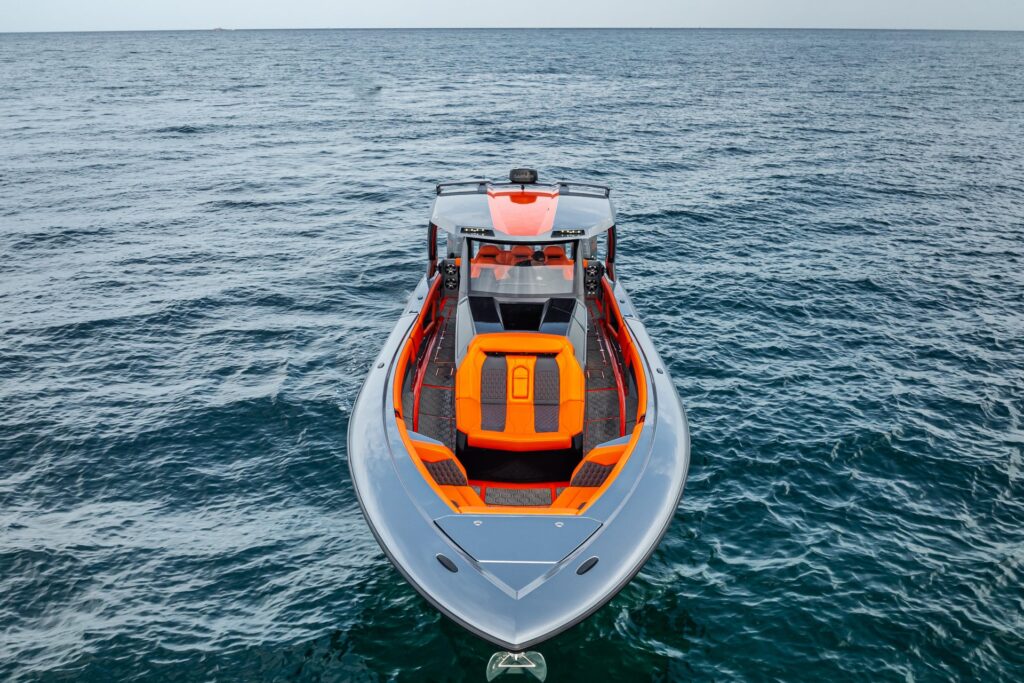
A performance powerboat is usually photographed from the outside. The images emphasize proportion, paint, stance, wake, and the drama of the machine moving across open water. Those views matter because they communicate identity. Yet the owner experiences the boat from somewhere entirely different: behind the helm, looking forward.
That perspective changes everything.
From the driver’s position, the boat is no longer an object to admire. It becomes a moving frame around the water ahead. The horizon, bow, windshield, displays, seating position, and changing surface all combine into one visual field. Performance is interpreted not only through acceleration and sound, but through what the operator sees and how clearly the environment can be read.
This is why perspective deserves to be considered part of the performance experience itself. The best helm positions do more than provide access to controls. They create a relationship between driver, machine, and water that can make even familiar routes feel different every time.
The Horizon Is Part of the Cockpit
Unlike a road car, a powerboat has no fixed lane, centerline, curb, or roadside architecture defining the driver’s field of view. The visual environment is broader and less constrained. Water and sky occupy most of what lies ahead, with the horizon providing the strongest continuous reference.
That openness changes the sense of movement.
In a car, speed is reinforced by objects passing rapidly at the edges of vision. Trees, barriers, signs, buildings, and lane markings make velocity obvious. On open water, the reference points are farther away. The boat may be moving quickly, yet the scene can feel expansive rather than compressed.
The driver begins reading more subtle information: the texture of the surface, the shape of approaching wakes, the position of other vessels, the color changes that can suggest variations in water or weather, and the relationship between the bow and the horizon.
The helm therefore becomes part observation platform and part command environment. The quality of the experience depends on how naturally it allows the driver to interpret what lies ahead.
Seating Position Changes the Meaning of Scale
Where the driver sits or stands influences how large the boat feels.
A lower position can make the bow appear more substantial and the horizon feel farther away. A higher position can increase the sense of command by opening the driver’s view over surrounding structures and traffic. The distance between the operator, windshield, controls, and forward deck also shapes the perception of the machine itself.
This is one reason ergonomics are more than a comfort issue.
The driver should feel integrated with the boat rather than perched above it or buried inside it. Steering, throttles, displays, and sightlines need to relate to the same physical position. If the operator is constantly shifting posture to see ahead or to reach equipment, the visual connection with the water becomes less natural.
Adrenaline Powerboats currently lists dual-row helm seating for six on both the Reaper 42 and Reaper 47. The Reaper 42 also carries multiple Garmin helm displays as part of its published electronics package. Those details show how much of the operating environment is concentrated around the driver’s forward perspective.
Visibility Is a Performance Feature
Visibility is often discussed as a practical requirement, but on a serious performance boat it is more than that. It contributes directly to confidence.
A driver who can clearly read the surface ahead has more time to interpret conditions. A clear view through and around the windshield makes surrounding traffic easier to understand. Good sightlines during low-speed maneuvering can reduce unnecessary corrections. The value is cumulative because every small improvement in visibility reduces the amount of effort required simply to understand where the boat is and what is happening around it.
This is especially important because the marine environment changes continuously. A road remains physically defined even when weather changes. Water does not. Wind can alter the surface in minutes. Boat traffic can create wakes that cross at unpredictable angles. Glare can reduce contrast. Late-day light can make one area of the water easy to read while another appears flat.
The helm needs to support observation across all of those conditions.
Luxury, in this context, can be the absence of visual friction.
The Bow Becomes Part of the Driver’s Reference System
From the dock, the bow is part of the boat’s exterior design. From the helm, it becomes a reference.
Its position relative to the horizon can help the driver understand attitude and movement. The visual relationship changes as the boat accelerates, settles into a run, turns, or responds to the surface. Over time, an experienced owner becomes familiar with these changes without necessarily thinking about them consciously.
This is one of the ways a machine becomes known through use.
The driver does not need to analyze every movement intellectually. Familiarity creates a visual vocabulary. The amount of bow visible, the way the horizon sits in the windshield, and the movement of surrounding water all begin to communicate information intuitively.
That relationship is difficult to appreciate from outside the boat because it belongs almost entirely to the person at the controls.
Changing Light Alters What the Driver Can Read
Light is one of the most important variables at the helm because it changes both the beauty and the legibility of the environment.
Morning light can make the water easier to read in one direction while producing glare in another. Midday may flatten some textures while increasing contrast elsewhere. Late afternoon can turn small surface changes into long highlights and shadows. Cloud cover can make the same route appear completely different from the way it looked a few hours earlier.
This constant variation is part of what keeps the helm experience interesting.
The owner is not driving through a fixed visual environment. The water is continually being redrawn by weather, sun angle, reflections, and traffic. Familiar geography remains familiar, but the surface between destinations rarely looks exactly the same twice.
That is one reason the view from the helm can remain compelling after years of ownership. The machine may be known intimately, while the environment ahead keeps changing.
Displays Should Support the View, Not Compete With It
Modern electronics give the driver access to an enormous amount of information, but the most important visual field remains outside the boat.
Navigation, engine information, digital switching, autopilot, communications, and other systems all have value because they help the operator understand and manage the journey. Problems begin when the helm demands so much attention that the displays compete with the water.
The best integration keeps technology available without allowing it to dominate.
Adrenaline’s current Reaper 42 equipment includes dual 19-inch Garmin helm screens, a single 27-inch Garmin helm screen, digital switching, digital shift and throttle control, and autopilot. The Reaper 47 also offers Garmin navigation and communications equipment within its options list. These systems expand the amount of information available at the helm, but their real value depends on how naturally they support the driver’s awareness rather than replacing it.
A display can tell the operator where the boat is.
The windshield shows what the boat is moving through.
Both matter, but they serve different purposes.
Open Water Creates a Different Psychological Experience
The view from the helm is not only functional. It changes the emotional character of driving.
Open water creates visual distance. The horizon remains far away. Shorelines may recede. The driver can see weather moving in the distance and traffic developing long before it becomes immediate. Compared with driving through a dense urban environment, the visual field contains fewer objects but more space.
That can create a striking combination of concentration and mental openness.
The operator is still responsible for navigation, conditions, speed, passengers, and surrounding vessels. Yet the environment can feel less visually crowded. Attention becomes focused on fewer, larger elements.
This may be one of the reasons performance boating can feel intense without always feeling claustrophobic. The machine asks for involvement, but the view ahead continues to open outward.
The View Changes as the Boat Changes Speed
A performance boat does not present the driver with one fixed perspective.
At idle, the surrounding environment dominates. The boat moves slowly enough that details on shore, nearby vessels, docks, and markers receive more attention. During acceleration, the relationship between bow and horizon changes and the environment begins moving more quickly through the driver’s field of view.
Once the boat settles into a run, another visual rhythm emerges. The horizon stabilizes differently, water begins passing with greater speed, and attention shifts farther ahead.
This transition is part of the experience.
The visual world at the helm changes with the operating state of the boat. A marina approach requires close, precise observation. Open-water running encourages a longer view. Slowing near a destination compresses attention again.
The driver continually adjusts where and how far ahead to look.
That dynamic use of vision is one reason the helm feels active even during a route the owner knows well.
Perspective Makes Familiar Water Feel New
Repeated ownership does not necessarily make a familiar route boring.
The shoreline may remain the same, but tide, light, traffic, weather, and surface conditions alter the journey. A route driven in calm morning water can feel completely different in late-afternoon chop or under an approaching weather system.
The helm gives the owner a front-row view of those changes.
This creates a kind of geographic intimacy. The driver learns not only where places are, but how the water between them tends to behave under different conditions. Certain landmarks become visual references. Familiar approaches develop their own sequence. The owner notices how the same harbor entrance looks under different light or how a coastline changes when seen from farther offshore.
Performance boating therefore creates a relationship with place that is different from simply visiting destinations.
The water between them becomes part of what is remembered.
The Best Helm View Creates Confidence Without Isolation
Some luxury products are designed to separate their occupants from the environment. A serious performance boat often benefits from doing the opposite.
The driver should feel protected enough to remain comfortable and focused, but not so removed that the water becomes abstract. Windshield, seating, structure, controls, and displays should support the operator without eliminating the sense of being on the water.
This balance matters because too much exposure creates fatigue while too much isolation can weaken the connection that makes the experience distinctive.
A strong helm lets the driver remain aware of sound, motion, light, weather, and surface conditions while providing enough structure for those sensations to remain manageable.
That is refinement through connection rather than separation.
The Reaper Experience Is Ultimately Viewed From Inside
Adrenaline Powerboats presents the Reaper 42 and Reaper 47 as performance center consoles designed for serious time underway. Both currently list dual-row helm seating for six, wraparound coaming bolsters, substantial cockpit storage, and other equipment intended to support the people occupying the operating environment. The Reaper 42’s current electronics package places multiple Garmin displays directly at the helm.
Those details matter because owners do not experience a performance boat primarily through the photographs taken of it. They experience it from inside the cockpit, with their attention moving continuously between the machine and the environment ahead.
The paint may be what someone else notices first.
The horizon is what the driver sees.
Perspective Is Part of Performance
Performance is often reduced to numbers because numbers are easy to compare. Horsepower, speed, acceleration, range, weight, and dimensions all provide useful information about a machine.
The view from the helm cannot be summarized so neatly.
It is a combination of position, visibility, scale, information, light, water, and movement. It determines how quickly the driver understands changing conditions and how connected the operator feels to the machine. It shapes confidence at low speed and awareness while running. It can make a familiar route feel different from one day to the next.
Most importantly, it is the perspective from which ownership actually happens.
A performance powerboat may be admired from the marina, photographed from another boat, or remembered through its silhouette moving across open water. For the owner, however, many of the most meaningful hours are spent looking in the opposite direction: forward, through the windshield, toward the next stretch of water.
That view is not scenery surrounding the performance experience.
It is part of the performance experience.
For owners interested in shaping a Reaper around the experience from the helm as much as the impression from the dock, explore a custom Reaper inquiry.