
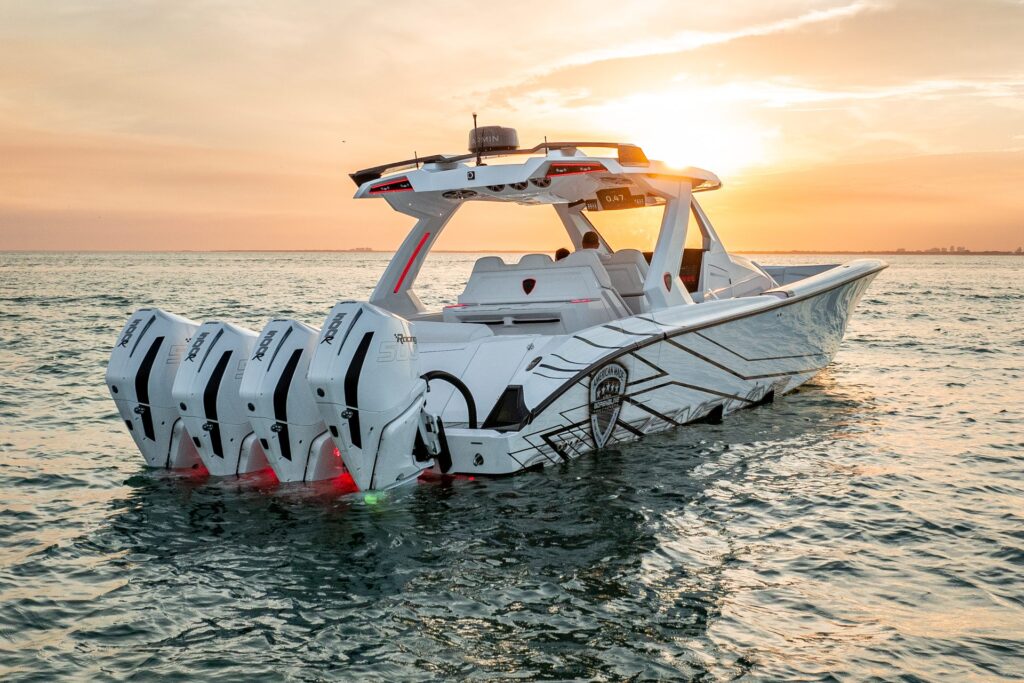
There is a difference between a performance boat that feels substantial and one that simply feels full. Both may carry serious power, advanced electronics, premium materials, extensive equipment, and visually dramatic details. Yet only one can leave the impression that every component exists because the boat genuinely needs it.
That distinction is increasingly important in a market where more is easy to sell. Larger displays, additional systems, greater horsepower, more lighting, more trim, and longer option lists can all create an immediate sense of abundance. But abundance is not the same as resolution. A purpose-built boat has a clearer hierarchy. Its performance, cockpit, materials, technology, and equipment support a specific idea of how the machine should work.
The best performance boats rarely feel deprived of anything important. They simply avoid carrying things that do not strengthen the experience.
Purpose Begins With a Clear Job
Every convincing machine begins with a clear understanding of what it is supposed to do. In performance boating, that sounds obvious, but the answer can become blurred when one platform is expected to communicate speed, luxury, entertainment, technology, status, long-range comfort, and every imaginable convenience at once.
A purpose-built boat does not have to be narrow in capability. It can be fast, comfortable, practical, and highly refined. The difference is that those qualities are organized rather than accumulated.
The designer needs to know which experiences are central. Is the boat expected to reward an owner who spends hours at the helm? Does it need to support full days with passengers? Is destination running part of its personality? How much storage, seating, weather protection, technology, and onboard convenience actually strengthens those uses?
Once those priorities are clear, individual decisions become easier. Equipment has a reason to exist. Space can be assigned intentionally. Visual elements can reinforce the boat’s character instead of competing to prove how much has been added.
Overbuilding Often Begins With Good Intentions
Very few boats become overcomplicated because someone deliberately wanted to make them worse. Overbuilding usually begins with attractive ideas.
Another screen seems useful. Additional lighting creates visual drama. More upholstery looks luxurious. Another system promises convenience. Extra controls, accessories, and decorative details each appear defensible on their own. The problem appears when every good idea is allowed onto the same boat without enough consideration for the whole.
Weight, space, maintenance, attention, and visual clarity are all finite resources. Every added component occupies at least one of them.
This is why restraint is not minimalism for its own sake. It is a design discipline. A builder has to distinguish between equipment that expands the boat’s usefulness and equipment that mainly expands the specification sheet.
A serious performance machine should feel complete, not crowded.
Capability Should Be Integrated, Not Advertised
One of the characteristics of a purpose-built object is that its capability does not need to announce itself constantly.
A well-designed control falls naturally to hand. Useful storage disappears into the architecture. Structural solutions support the boat without becoming decorative theater. Technology provides information when it is needed and then recedes. Seating feels appropriate after several hours rather than merely looking impressive during a walk-through.
This kind of integration can make a sophisticated boat appear simpler than it actually is. Considerable engineering may exist behind the surfaces, but the owner experiences the result rather than the complexity.
That is a mature form of luxury. The machine does not repeatedly remind the owner how much equipment was purchased. It makes the equipment feel inevitable.
Technology Needs a Reason to Be at the Helm
Modern performance boats can accommodate extraordinary electronic capability. Navigation, engine data, digital switching, autopilot functions, communications, cameras, audio, environmental systems, and other information can all be brought into the cockpit.
The challenge is no longer whether technology can be added. It is deciding what deserves the driver’s attention.
A purpose-built helm creates hierarchy. Critical information is easy to find. Frequently used controls occupy valuable positions. Secondary systems remain accessible without competing visually with the tasks involved in operating the boat. The interface should reduce workload rather than create a new category of workload.
Adrenaline Powerboats’ current Reaper 42 specification provides a useful example of substantial technology being organized around a performance helm. The company lists multiple Garmin displays, digital switching, digital shift and throttle control, autopilot, and integrated bow and stern thrusters among the model’s equipment.
More screens do not automatically create more capability. The better question is whether the systems make the owner more informed, more confident, and less distracted.
Power Should Serve the Platform
Performance boating naturally attracts attention to horsepower. It is an understandable focus because engine output is easy to compare and directly connected to the identity of the category.
But a purpose-built performance boat cannot be understood through horsepower alone.
The platform has to carry that power intelligently. Structure, hull design, weight, balance, controls, seating, visibility, and the broader operating environment all influence whether additional output contributes to a better machine. Power without integration can become a number searching for a purpose.
This does not argue for less performance. It argues for coherent performance.
Adrenaline currently publishes several propulsion configurations across the Reaper 42 and Reaper 47, with defined engine arrangements and maximum horsepower for each platform. That is the more useful way to think about serious power: as one element in a larger platform, not as a substitute for one.
Materials Should Earn Their Place
The same discipline applies to materials.
Carbon fiber, premium upholstery, stainless hardware, custom paint, composite structures, and other high-end materials can all be valuable. But the strongest use of an advanced material is not simply making it visible. It is putting it where its physical or aesthetic properties contribute to the boat.
A performance boat should not feel like a material sample board. Too many competing textures and finishes can weaken visual identity even when each individual material is expensive.
Adrenaline Powerboats states that its designs are developed in-house from 3D CAD through CNC milling and that every boat is handcrafted. Its current Reaper pages describe composite construction, vacuum-infused epoxy processes, and carbon-fiber structural elements in specific areas.
These details matter because they connect material choice with the structure and architecture of the boat rather than presenting material alone as the luxury story.
Purpose-built design asks what a material is doing before asking whether it sounds premium.
Usability Is Part of Serious Performance
There is a persistent temptation to treat usability as something separate from performance, as though practical features dilute the purity of a serious machine. Real ownership usually proves the opposite.
A boat that performs impressively for a short demonstration but becomes tiring, disorganized, or awkward over a full day is incomplete. Performance exists inside an ownership experience, and that experience includes boarding, storing gear, moving through the cockpit, sitting for hours, docking, cleaning, and using the boat when the throttles are nowhere near wide open.
The current Reaper specifications reflect this broader reality. Adrenaline lists dual-row helm seating for six, multiple below-deck storage compartments, dual side-door entry, marine-grade upholstery, freshwater systems, and dedicated mechanical rigging compartments among the equipment on the Reaper 42 and Reaper 47.
None of those features exists to make the boat look faster. They help the machine function as a complete boat rather than a performance demonstration.
That is the difference between adding luxury to performance and designing the entire ownership experience around actual use.
Maintenance Belongs in the Design Conversation
Purpose also extends into the hours when the boat is not moving.
Complex systems eventually require inspection, service, troubleshooting, cleaning, and replacement. Adding equipment means adding connections, components, and potential service needs. This does not mean sophisticated systems should be avoided. It means complexity should earn its long-term cost.
A thoughtful boat considers maintenance access as part of design rather than an inconvenience to be addressed later. Technicians need to reach systems. Owners need to understand what is aboard. Rigging should be organized with enough clarity that service does not become an archaeological exercise.
Adrenaline says every boat it builds is rigged in-house and that rigging is specified for each build. Both current Reaper pages also list a dedicated mechanical rigging compartment.
These are relevant details in a discussion about purpose because invisible organization matters just as much as visible equipment.
A machine designed only for delivery day is not truly finished.
Visual Restraint Can Make Performance More Convincing
Overbuilding can be visual as well as mechanical.
Performance boats naturally possess strong forms: a long hull, substantial propulsion, a technical cockpit, a hardtop, a windshield, and numerous functional surfaces. Adding too many visual ideas can make the design less powerful because the eye no longer knows what deserves attention.
A purpose-built specification lets the architecture lead.
Custom paint can emphasize length and surface development rather than obscuring them. Carbon fiber can appear where it supports the technical character without becoming a motif repeated simply because it is fashionable. Interior accents can continue the exterior theme without reproducing it on every surface.
Adrenaline’s company material says custom paint is used on every boat and that its design team works with the customer to tailor the result to individual specifications. That level of freedom makes restraint more important, not less. When almost anything can be personalized, good judgment becomes the scarce ingredient.
A boat should look intentionally designed before it looks heavily customized.
The Best Luxury Removes Friction
Purpose-built luxury is often quiet.
It appears when the seat remains comfortable hours into the day. It appears when a control is located where the hand expects it. It appears when gear has somewhere logical to go, when the helm presents information clearly, when passengers can move through the cockpit naturally, and when the boat can transition from a serious run to a relaxed stop without feeling compromised in either state.
None of these qualities creates the instant spectacle of another engine or a more elaborate graphic. Yet they influence ownership repeatedly.
That repetition is what makes them valuable.
The most convincing premium machines often feel less complicated after extensive use, not more. Familiarity reveals that the apparent simplicity was created through disciplined decisions behind the scenes.
Purpose Is What Makes Capability Feel Complete
A performance boat does not become more serious by refusing comfort, technology, or customization. Nor does it become more luxurious by accumulating every possible feature.
The stronger approach is integration.
The hull, structure, power, cockpit, electronics, materials, storage, seating, systems, and visual treatment should feel as though they were developed around a shared objective. Features should support the way the boat will actually be operated. Technology should reduce friction. Materials should contribute structurally, functionally, or aesthetically. Customization should strengthen identity. Performance should belong to the platform rather than exist as a number added on top of it.
Adrenaline Powerboats describes its custom-building process as design to delivery under one roof, with in-house 3D design, CNC capability, custom paint, and build-specific rigging. Its current Reaper 42 and Reaper 47 also combine performance configurations with practical cockpit, storage, and cabin features. Those published details make the brand a useful example of why a serious powerboat can be highly equipped without needing to feel indiscriminately equipped.
That is ultimately what separates purpose-built from overbuilt.
One tries to contain more.
The other makes every important element matter.
For owners who want to shape a Reaper around a clear set of priorities rather than simply fill an options list, explore a custom Reaper inquiry.