The first serious performance boat teaches an owner what brochures cannot. Before ownership, it is easy to imagine that the next step will simply be more: more horsepower, more screens, more visual drama, more features, more size. After enough time on the water, priorities usually become more selective.
Experience has a way of editing taste. Details that once seemed essential may prove forgettable, while small practical choices begin to matter disproportionately. An owner learns which seats are actually used, which equipment earns its place, which materials remain satisfying after a season, and which parts of the helm shape every hour underway. By the time a second or third boat is considered, the specification often becomes more personal precisely because it becomes less theoretical.
That is why the next boat should not merely be a newer version of the first. It should reflect everything ownership has clarified.
Experience Changes the Meaning of “Better”
Before owning a performance boat, “better” can sound straightforward. Faster, larger, more powerful, more advanced, or more expensive all seem like obvious directions.
Ownership complicates that equation.
After real time aboard, an owner begins distinguishing between capability and relevance. A feature may be technically impressive without contributing much to the way the boat is actually used. A dramatic design choice may have generated excitement at delivery but become less important than a cockpit detail encountered every weekend.
This is where the second boat often becomes more intelligent. The owner is no longer specifying around assumptions. He has evidence.
The question changes from “What else can I add?” to “What do I want to feel every time I use this machine?”
The First Boat Teaches You How You Really Spend Time
Owners often discover that their actual boating habits differ from the plans they had before delivery.
Perhaps destination runs become more important than expected. Perhaps the owner spends more time at the helm and less time entertaining at the dock. Perhaps certain friends become regular passengers. Maybe early morning runs become the defining use case, or the boat becomes the centerpiece of long weekends built around waterfront stops.
These patterns matter because they reveal what the next build should prioritize.
The owner who regularly spends hours underway may place greater weight on seating, sightlines, helm organization, and storage. Someone who uses the boat as part of a social weekend may think differently about cockpit flow, guest comfort, access, and practical conveniences.
The second specification becomes stronger because it is based on lived behavior rather than imagined behavior.
More Experience Usually Creates More Restraint
One of the clearest signs of an experienced owner is often a greater willingness to leave things out.
The first custom build can encourage abundance. Every available feature feels like an opportunity. Extra displays, visual accents, complicated graphics, unusual materials, and optional equipment all promise to make the boat feel more complete.
Time reveals which decisions actually matter.
On the next boat, the owner may choose fewer visual ideas but execute them with greater conviction. The electronics package may become more focused rather than larger. A color palette may become simpler. An unnecessary feature may disappear because the owner already knows it will rarely be used.
Restraint is not a retreat from luxury. It is the result of confidence.
A Personal Specification Becomes Less Performative
Early in ownership, it can be tempting to think about how a boat will be perceived from outside. That is natural. A large custom powerboat has considerable visual presence, and the commissioning process includes decisions that are highly visible.
Experience gradually moves attention inward.
The owner begins valuing the things that matter when nobody else is looking: the atmosphere from the helm, the material under the hand, the view through the windshield, the way equipment is arranged, and how naturally the boat supports a full day.
This can lead to a more personal second boat. Paint may become bolder because the owner genuinely loves it, or quieter because there is no longer any need to prove that the boat is custom. Interior choices may become more specific to comfort and taste rather than to what appears dramatic in photographs.
Personalization becomes more authentic when it stops needing an audience.
The Helm Often Becomes the Center of the Next Build
Repeated time at the controls has a way of sharpening opinions quickly.
After enough hours, owners know what information they reference constantly, where they naturally look, how they prefer to sit or stand, and which controls should be immediately accessible. They also know what cockpit features sounded important during specification but rarely entered their real operating routine.
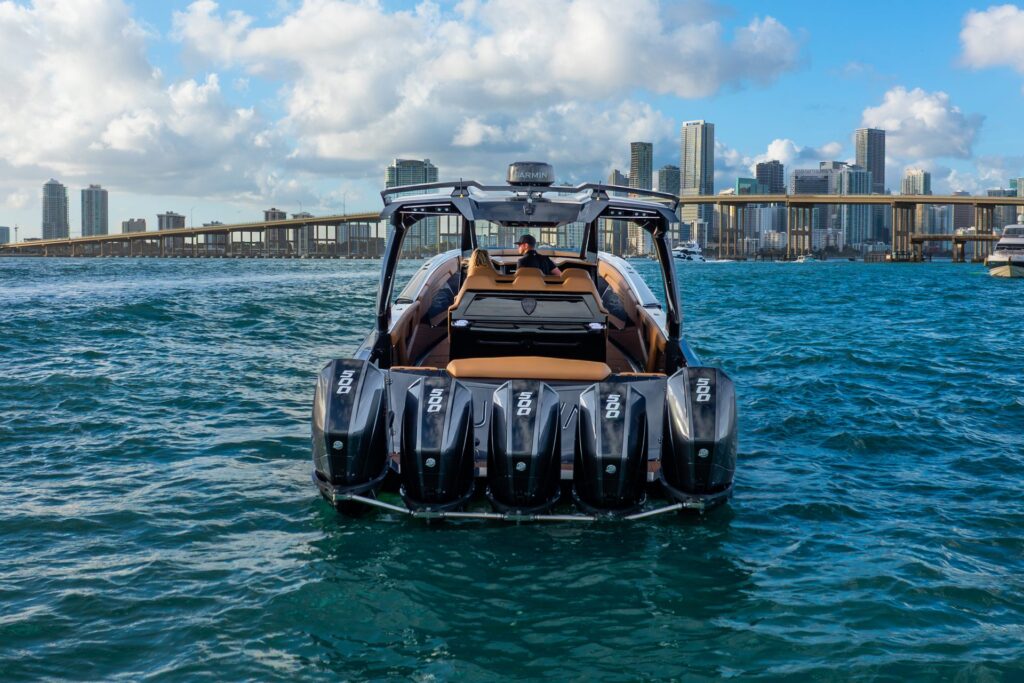
The current Reaper 42, for example, is published with multiple Garmin helm displays, digital switching, digital shift and throttle control, autopilot, and dual-row helm seating for six. Those features illustrate how much can be concentrated around a modern performance helm.
For an experienced owner, the question is not simply how much equipment can be installed. It is how the helm should be organized around actual habits. That distinction can make the next boat feel more personal from the first hour.
Materials Are Judged Differently After a Season
Material decisions also become more disciplined with experience.
A sample viewed during specification does not reveal how a surface will feel after repeated exposure to sunlight, heat, moisture, sunscreen, cleaning, movement, and ordinary wear. Ownership does.
The next time an owner chooses upholstery, flooring, hardware finishes, or painted surfaces, the conversation is no longer purely aesthetic. There is a memory attached to how previous materials behaved.
That does not necessarily lead to conservative choices. It leads to informed ones. The owner can still choose something dramatic, technical, or unconventional, but the decision is made with a clearer understanding of what it will be like to live with.
Luxury becomes less about the first impression and more about the hundredth interaction.
Storage and Access Stop Feeling Like Secondary Topics
Storage rarely carries the emotional excitement of paint or propulsion during a first build. After ownership, its importance can rise substantially.
Real boating produces gear, routines, and repeated movements. Lines, towels, safety equipment, bags, tools, food, cleaning supplies, and personal items all need logical places. The owner quickly learns which compartments are easy to reach and which create unnecessary effort.
Adrenaline’s current Reaper 42 and Reaper 47 specifications both identify multiple below-deck storage compartments and storage beneath the front helm seats. Those published features are relevant because they address exactly the kind of practical detail that often matters more after ownership experience accumulates.
The second-time buyer tends to ask these questions earlier because he already knows how often the answers will matter.
A More Personal Boat Does Not Need to Be More Complicated
There is a misconception that personalization and complexity naturally increase together. They do not.
An experienced owner may become more specific while simultaneously choosing a cleaner boat. A particular paint color may matter greatly, but the graphics may become simpler. The helm may be more carefully configured while containing fewer unnecessary devices. Materials may be more distinctive even though the overall palette is restrained.
Personalization is strongest when the boat reflects priorities, not when it displays the maximum number of decisions.
This is why a second build can feel more bespoke than a first even when it appears quieter. The owner understands which details carry emotional or functional weight and which ones only create noise.
Clarity makes customization more convincing.
The Previous Boat Becomes a Reference Point
The first boat also becomes a benchmark.
Every future seating arrangement is compared with what worked before. Every paint idea is judged against how the previous finish aged visually. Every helm is evaluated through the memory of what felt natural or awkward. Storage, access, lighting, controls, and materials all gain context.
This comparison can be useful, but the next boat should not simply attempt to correct a list of complaints. A mature specification also preserves what was genuinely successful.
That may mean carrying forward a favorite color family, a preferred cockpit atmosphere, or a functional priority that proved indispensable. The next machine becomes an evolution of taste rather than a rejection of the one before it.
In that sense, previous ownership gives the commission a vocabulary.
Custom Builders Become More Valuable as Owners Become More Specific
Experience can also change what an owner expects from a builder.
A first-time buyer may be satisfied with selecting among predefined combinations. A repeat owner is more likely to arrive with precise preferences and stronger opinions about what deserves to remain unchanged.
That makes a collaborative custom-building process increasingly valuable.
Adrenaline Powerboats says its boats are designed in-house, use custom paint on every build, and are rigged in-house according to the specification of each individual boat. That approach is relevant to experienced owners because it creates room for a build to respond to a more developed brief rather than forcing every decision into a standardized package.
The owner brings experience. The builder brings technical and design judgment. The strength of the next boat depends on how well those two forms of knowledge meet.
The Next Boat Should Reflect What You Have Learned About Yourself
The most interesting change between a first and later commission is not always technical. It can be personal.
Owning a performance boat reveals preferences that are difficult to articulate in advance. Some owners discover that they value quiet visual restraint more than expected. Others realize that a bold specification brings them genuine pleasure every time they approach the dock. Some become more focused on long-distance comfort; others become more interested in the purity of the helm experience.
These discoveries are not universal, which is exactly why they matter.
A second boat should not simply follow the accepted progression of the market. It should respond to the owner’s own progression.
That may result in a more powerful boat, a larger one, a more technologically advanced one, or something visually more ambitious. But those outcomes should be consequences of clarified preferences rather than objectives by themselves.
Experience Turns Options Into Priorities
The first time through a custom-build process, an owner is choosing among possibilities.
The next time, those possibilities are easier to rank.
Some features become non-negotiable because they proved valuable every weekend. Others drop away because they added little to the experience. A particular material, seating arrangement, or helm philosophy may become central. Paint and visual design may become more disciplined because the owner now understands what continues to feel satisfying after novelty has faded.
This is where experience creates a better specification. It does not eliminate emotion from the process. It gives emotion a clearer target.
Adrenaline’s current Reaper 42 and Reaper 47 provide established performance platforms, while the company’s stated emphasis on custom paint, individual rigging, and in-house design allows those platforms to be shaped around a more particular vision.
A repeat owner is in the best position to take advantage of that opportunity because he arrives knowing more than what he likes.
He knows what he misses when it is absent.
The Second Boat Should Feel More Like You
There is a temptation to assume that every next purchase should be more dramatic than the last. In enthusiast culture, progress is often described through larger numbers: more speed, more power, more technology, more exclusivity.
Experience offers a different definition of progress.
The next boat can be better because it is more precise. The visual identity can be closer to the owner’s actual taste. The cockpit can support real habits. Equipment can earn its place. Materials can be chosen with a deeper understanding of how they will age. The complete specification can contain less compromise because the owner now knows where compromise will be noticed.
That is why the second performance boat should be more personal than the first.
The first boat teaches the owner how the category works. The next one has the opportunity to express what the owner has learned.
For owners ready to turn those lessons into a more focused Reaper specification, begin a custom Reaper inquiry.