
For many experienced boat owners, the yacht is not the end of a progression so much as the beginning of a more complete understanding of what time on the water can be. A yacht solves a particular set of problems beautifully. It creates space, comfort, privacy, entertaining capacity, and the ability to spend extended periods aboard. It can turn a weekend into a voyage and a coastline into a sequence of destinations rather than a boundary.
A high-performance powerboat offers something very different.
It does not need to compete with the yacht for the same role, and framing the decision that way misses the point. The appeal lies in contrast. Where a yacht excels at duration, space, hospitality, and extended cruising, a performance boat emphasizes immediacy, driver engagement, acceleration, sound, and a more direct physical relationship with the water. One expands the experience of being aboard. The other intensifies the experience of being underway.
For an owner who already understands the value of a capable yacht, adding a performance boat can make the fleet more versatile rather than redundant.
Different Machines for Different Days
A well-developed marine collection works much like a thoughtful automotive collection. A grand touring car, a lightweight sports car, and an off-road vehicle may all be expensive and highly engineered, but their value comes from serving different purposes. Expecting one machine to replace the others would misunderstand why they are interesting.
Boats are no different.
A yacht is often the natural choice when the day revolves around comfort, entertaining, overnight stays, extended cruising, generous interior volume, and the ability to spend long periods aboard without sacrificing the amenities that make time away enjoyable. It creates its own environment.
A performance powerboat creates a different kind of day. The owner may leave with fewer people, a lighter agenda, and a greater interest in the run itself. A destination can still matter, but the experience between departure and arrival becomes central. The helm is not simply a station from which the boat is managed. It becomes one of the principal reasons to be aboard.
Neither experience is more legitimate. They are simply different, and that difference is exactly what makes both worth having.
The Yacht Is About Staying; the Performance Boat Is About Going
One of the clearest distinctions between the two categories is the relationship with time.
A yacht encourages people to settle in. There is room to move, dine, entertain, relax, sleep, and remain aboard for extended periods. The boat becomes a destination in its own right. Time stretches because the owner does not need to leave in order to change activities.
A performance boat has a more kinetic personality. It encourages movement. The question is often not where to stay, but where to go next.
That changes the rhythm of ownership. A spontaneous lunch run, an afternoon departure, a fast trip to meet friends, or a morning spent simply driving can make sense in a way that would feel unnecessary aboard a larger yacht. The boat is ready for a shorter, more focused experience where the journey itself carries much of the emotional weight.
For an owner with access to both, the choice becomes useful. Some days call for staying. Others call for going.
Driver Engagement Changes the Relationship With the Water
Large yachts can be deeply involving to operate, especially for owners who take an active role in navigation and handling. But the physical character of a high-performance powerboat is different.
The operator sits much closer to the experience.
Throttle inputs feel more immediate. Steering decisions are more direct. The movement of the hull is more apparent. Wind, sound, acceleration, and changing water conditions all enter the experience with less separation between machine and operator. The boat feels less like a platform moving through the environment and more like a machine actively interacting with it.
That immediacy is one of the strongest reasons a performance boat can complement an established yacht.
The attraction is not simply speed for its own sake. It is the concentration of sensation. The helm becomes an active place, and the operator feels the consequences of input in real time. The water is no longer scenery surrounding the journey. It becomes part of the mechanism through which the journey is experienced.
For owners who also enjoy collector cars, motorcycles, aircraft, or other machines that reward active participation, that difference can be especially compelling.
Performance Makes Shorter Windows More Valuable
Not every day on the water needs to become a full itinerary.
One of the advantages of a performance boat is that it can make a shorter window of time feel substantial. A few hours can be enough for a meaningful run, a destination lunch, a visit to another marina, or simply time at the helm before returning home.
That flexibility matters for owners whose schedules do not always allow for extended cruising.
A yacht may be at its best when the day or weekend is built around it. A performance powerboat can fit naturally into the spaces between larger plans. It can turn an open afternoon into a memorable outing without requiring the logistical scale of a longer voyage.
This is not about convenience in the ordinary sense. It is about density of experience. The boat can deliver a significant amount of engagement in a relatively short period of time.
That quality gives it a distinct role in the fleet.
The Social Experience Is More Intimate
A yacht can accommodate large groups elegantly. Guests can spread across multiple spaces, move between interior and exterior areas, and create separate conversations and activities. That versatility is one of the category’s defining strengths.
A performance boat brings people together differently.
The group is smaller, the environment is more concentrated, and everyone aboard tends to share the same experience at the same time. The acceleration, sound, view, movement, and arrival are communal. There is less separation between driver and passengers, and less separation among the passengers themselves.
This can make a performance run feel unusually social even when the boat is deeply driver-focused.
The intimacy is not about exclusivity in a social sense. It comes from shared attention. Everyone is in the same moment.
For owners who already have a yacht capable of hosting larger gatherings, this smaller-scale experience can be a valuable counterpoint.
The Performance Boat Can Become the Tender You Actually Want to Drive
It is tempting to describe a smaller performance boat as simply a tender to a larger yacht, but that undersells the point.
A true performance powerboat has its own identity, purpose, and emotional appeal. It may support the broader fleet by providing faster point-to-point movement, easier access to certain waterfront destinations, or a more engaging option for shorter outings. But it earns its place because it is desirable independently.
That distinction matters.
An accessory exists primarily to support the primary object. A compelling performance boat should be worth using even when the yacht is not involved at all. It should create days, routes, and experiences that justify themselves.
In that sense, the relationship is closer to having two different instruments in the same collection. They may occasionally work together, but each has its own reason for being there.
Design and Scale Create a Different Kind of Presence
A yacht carries presence through volume, proportion, architecture, and the lifestyle it supports. A performance powerboat creates presence through tension, movement, low stance, sound, and visible purpose.
The visual languages are not interchangeable.
A larger yacht can dominate a marina through scale. A performance boat can remain comparatively compact and still feel highly resolved because its shape communicates intent so clearly. Its exterior may be more closely tied to speed and hydrodynamics. Its cockpit can appear more technical. Its engines and hull form may remain central to how the machine is understood.
For an owner who appreciates industrial design, this contrast can make the two categories more interesting together.
One object is about creating space. The other is about compressing energy into form.
A Performance Boat Can Extend the Fleet’s Geographic Possibilities
Different boats also change how an owner thinks about waterfront geography.
A yacht may make longer stays, extended coastal travel, and multi-day itineraries practical. A performance powerboat can make shorter destination runs more immediate and add flexibility to the way nearby waterways are used.
A familiar area can feel different when experienced from a faster, more direct platform. Restaurants, marinas, private docks, events, and neighboring waterfront communities may become part of a single day in a different way. The boat can encourage the owner to think less in terms of where to remain and more in terms of how much water can be meaningfully experienced between morning and evening.
Again, the value is not merely faster transportation. It is the change in perspective that comes from using a different machine.
The fleet becomes more capable because the owner gains more than one way to engage with the same body of water.
Custom Specification Matters Even More in a Multi-Boat Collection
When a performance boat joins an established marine collection, specification becomes especially important.
The new boat does not need to imitate the yacht, but it can be designed to coexist with it intelligently. An owner may choose complementary colors, intentionally contrasting aesthetics, or a distinct visual personality that makes the performance boat feel like a separate chapter within the same collection.
Functionally, the owner may also know more clearly what matters because of previous boating experience. There is less need to guess about preferred materials, helm priorities, storage, seating, and the way the boat will actually be used.
That experience can make the specification more disciplined.
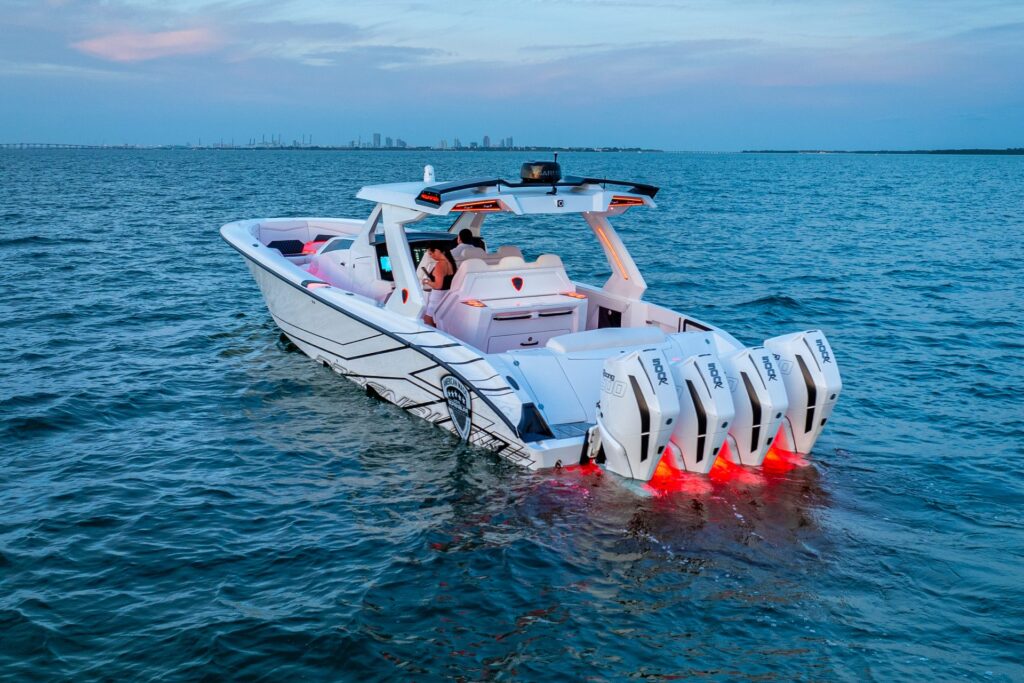
Adrenaline Powerboats is relevant here because its current lineup includes the Reaper 42 and Reaper 47, and the company describes its boats as individually built with custom paint and build-specific rigging. For an owner adding performance to an existing fleet, that level of individualization creates room for the new boat to have its own identity rather than feeling like an off-the-shelf secondary vessel.
The Fleet Becomes More Complete Through Contrast
The most interesting collections are rarely built from objects that all do the same thing.
A collection of automobiles becomes richer when each car offers a different kind of experience. The same logic applies on the water. A yacht may be the right machine for a long weekend with guests, while a performance powerboat may be the one chosen for a focused morning run. One may be ideal for living aboard. The other may be the reason to wake early simply because conditions look right.
Owning both changes the decision from “Which boat is better?” to “Which experience do I want today?”
That is a much more useful question.
The performance boat does not diminish the yacht’s role. If anything, it can make that role clearer. The yacht remains the platform for space, duration, hospitality, and extended comfort. The performance boat takes responsibility for immediacy, engagement, sound, movement, and the pleasure of driving.
A strong fleet does not eliminate overlap entirely, but it gives each machine a reason to exist.
What Comes After the Yacht Is Not Another Yacht Experience
For an experienced yacht owner, adding performance is compelling precisely because it does not attempt to recreate what is already available.
More interior volume is unnecessary if another vessel already provides it. Another variation on the same cruising experience may add capacity without adding much emotional range. A performance powerboat introduces something genuinely different.
It asks the owner to participate more directly. It makes shorter outings feel worthwhile. It changes the meaning of a destination because the run itself becomes part of the attraction. It brings a smaller group together around one shared experience. It adds a different design language and a different mechanical personality to the fleet.
That is why the question “What comes after the yacht?” should not be interpreted as a search for a replacement.
The yacht may remain the centerpiece of the marine collection. The performance boat simply expands the collection’s vocabulary.
Adrenaline’s Reaper models sit naturally within that role because the brand currently positions the 42 Reaper and 47 Reaper as high-performance center-console boats and emphasizes individualization through its custom-building approach. The appeal is not that a Reaper can do what a yacht does. It is that it does something deliberately different.
For an owner who already understands the pleasures of space, comfort, and extended cruising, performance offers another relationship with the same water: faster, more immediate, more physical, and more closely connected to the helm.
That does not replace the yacht.
It gives the fleet another reason to leave the dock.
For owners ready to add that kind of performance to an established marine collection, explore a custom Reaper inquiry.