
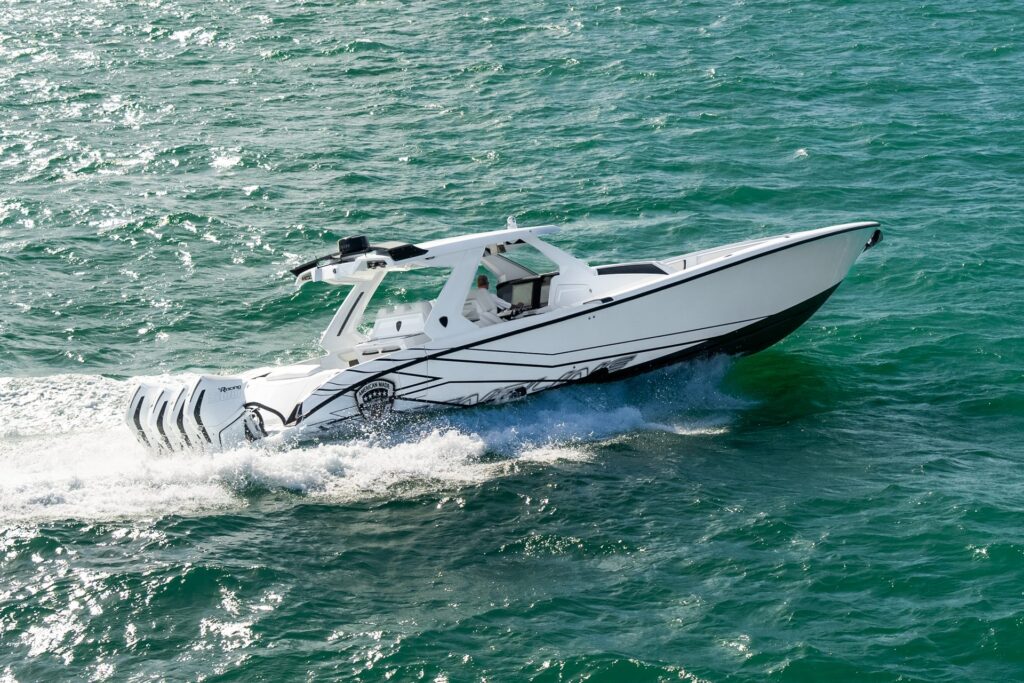
The first hours with a new performance powerboat are dominated by the obvious things. The paint still feels unfamiliar enough to study every time you walk toward the dock. Acceleration carries the excitement of discovery. The cockpit is new territory, and even familiar equipment feels different because it belongs to a machine you have not yet fully learned. During that period, ownership is largely about first impressions.
Time changes the way a boat is judged.
After enough weekends, destination runs, dockings, fuel stops, guests, cleanups, and long days underway, the qualities that matter most begin to shift. The dramatic elements do not lose their appeal, but they are joined by a more practical appreciation for details that were easy to overlook at delivery. Seating geometry matters more. Storage becomes either intuitive or irritating. Materials reveal how well they tolerate real use. Controls become familiar enough that their placement can be judged without conscious thought. Visibility, access, ergonomics, and small design decisions begin influencing whether ownership feels effortless or demanding.
The first hundred hours do not necessarily tell you everything about a boat, but they change what you notice. By then, luxury is no longer measured only by how impressive the machine looked when new. It is measured by how well the boat fits into the life of its owner.
Ergonomics Become More Important Than First Impressions
A helm can look spectacular in photographs and still become frustrating over time if basic ergonomic relationships have not been resolved carefully.
During the first few outings, an owner is still learning the boat. Reaching for a switch twice or adjusting position to see around an obstruction may seem like part of becoming familiar with the machine. After repeated use, however, patterns become obvious. Controls that are naturally located disappear from conscious thought. Awkward ones announce themselves every time they are needed.
This is where ergonomics become one of the quietest expressions of quality.
The relationship between seating position, steering, throttles, displays, switches, sightlines, and physical support determines how much unnecessary work the operator performs over the course of a day. A few inches of reach, the angle of a display, or the position of a frequently used control can seem trivial during a short demonstration. Multiply the same movement across dozens of hours, and the value of thoughtful placement becomes much clearer.
A well-designed cockpit starts feeling familiar surprisingly quickly. That familiarity is not boredom. It is evidence that the environment makes sense.
Seating Is Judged in Hours, Not Minutes
Almost any well-upholstered seat can feel comfortable during a walk-through. The meaningful test begins after several uninterrupted hours aboard.
Support becomes more important as the day develops. The shape of the seat, relationship between the cushion and bolsters, ability to shift position, and material quality all influence fatigue. Passenger seating undergoes the same test. A boat designed for extended days on the water should remain comfortable when the novelty of the first run has been replaced by a realistic weekend routine.
Material durability becomes part of the equation as well. Marine upholstery lives with ultraviolet exposure, moisture, heat, movement, sunscreen, wet clothing, and frequent cleaning. It cannot be treated like a material that spends its life in a climate-controlled interior.
Adrenaline lists heavy-duty, marine-grade UV-stable upholstery on both the Reaper 42 and Reaper 47, alongside full wraparound coaming bolsters and dual-row helm seating for six. Those published details are significant not because they sound impressive on an equipment sheet, but because seating and occupant support are exactly the kinds of features whose value becomes clearer after substantial time aboard.
The best seating eventually becomes something the owner stops thinking about. The day simply ends with less fatigue than it might have otherwise.
Storage Becomes a Daily Quality-of-Life Feature
Storage is rarely the reason someone falls in love with a performance powerboat. After enough ownership hours, it can become one of the reasons the boat remains enjoyable.
Real boating produces gear. Lines, fenders, towels, bags, safety equipment, cleaning supplies, personal items, food, shoes, and countless other necessities have to go somewhere. Without deliberate storage, they migrate into seating areas and walkways, gradually changing the cockpit from an organized performance environment into a collection of loose objects.
Good storage solves this problem quietly.
The important factor is not merely volume. Location matters. Frequently used equipment should be accessible without unloading half a compartment. Items that are wet, awkward, or rarely needed may require different spaces from personal belongings. The most successful arrangements begin to support routines, allowing the owner and regular passengers to know instinctively where things belong.
The current Reaper 42 and Reaper 47 specifications list seven below-deck storage compartments as well as storage beneath the front helm seats. Those are the kinds of practical features that tend to become more important after delivery than they seemed during specification.
A clean cockpit is aesthetically satisfying, but the deeper luxury is not having to think constantly about where everything goes.
Visibility Reveals Its Value in Changing Conditions
The view from the helm is another quality that becomes easier to judge after real use.
Visibility is not experienced in one position under one set of conditions. The boat may be operated in bright sun, changing cloud cover, late-afternoon glare, busy waterways, open water, narrow marina entrances, and situations where surrounding traffic deserves constant attention. The operator may be standing at one moment and seated at another.
Over time, the relationship between helm position, windshield, hardtop structure, displays, bow profile, and surrounding sightlines becomes an important part of the ownership experience.
Good visibility reduces mental workload. The operator spends less time changing posture or searching around obstructions and more time observing what matters beyond the cockpit.
This is difficult to appreciate from a specification sheet because there is no single number that adequately describes it. Yet after enough hours at the helm, visibility can influence the owner’s perception of the entire boat.
The details that reduce effort are often the ones that become most luxurious with time.
Controls Should Become Instinctive
One of the clearest signs of familiarity with any machine is when operation begins to require less conscious thought.
The owner knows where the controls are. Frequently used functions no longer require visual searching. The relationship between steering, throttle, displays, and other systems becomes part of muscle memory. This does not remove the need for attention; it allows attention to be directed toward operating the boat instead of managing its interface.
Modern performance boats present a particular challenge because they can contain considerable technology. Digital switching, multifunction displays, navigation systems, propulsion data, communications, and auxiliary controls all compete for limited helm space.
The quality of the integration becomes clearer with use.
An impressive screen is useful only if information can be accessed efficiently. A control is valuable only if it can be reached naturally. Technology should simplify the operating experience rather than require the owner to continually navigate the technology itself.
After a hundred hours, unnecessary complexity rarely feels luxurious.
Clarity does.
Materials Reveal Whether They Were Chosen for the Real World
Delivery day tends to show materials under unusually favorable conditions. Surfaces are clean. Upholstery is perfect. Hardware has not yet experienced repeated contact. Flooring has not seen hundreds of footsteps. Paint has not accumulated the realities of ownership.
Time provides a more demanding inspection.
The owner begins to understand which materials merely photographed well and which were appropriate for a high-use marine environment. Frequently touched surfaces reveal their durability. Upholstery demonstrates how it responds to heat and cleaning. Flooring shows whether it remains comfortable and practical. Hardware is judged not only by appearance but by the quality of interaction every time it is handled.
This is why marine luxury has to differ from luxury in more protected environments.
A delicate material may appear premium but create anxiety if it is unsuited to regular use. The better solution is a material that looks sophisticated while allowing the owner to use the boat naturally.
Luxury should reduce friction, not create another list of things to worry about.
Thoughtful Access Matters When Ownership Becomes Routine
Some of the least glamorous aspects of a boat become increasingly important as ownership settles into a rhythm.
Systems need inspection. Equipment may require service. Batteries, pumps, rigging, filters, electrical components, and other mechanical elements eventually become part of maintaining the machine properly. The ease with which relevant systems can be accessed can influence the ownership experience considerably.
This does not mean every owner performs every maintenance task personally. Many will rely on qualified technicians for much of the work. Access still matters because technicians also have to reach the systems they inspect and service.
A boat that has been designed with practical system organization in mind can make routine ownership feel more considered.
Adrenaline’s current Reaper specifications identify a dedicated mechanical rigging compartment on both the 42 and 47. Beyond that published feature, it would be inappropriate to claim specific service-access advantages without firsthand inspection. The broader principle remains important, however: good design has to consider the parts of ownership that happen when the boat is not moving.
Performance may define the machine, but maintenance preserves the ability to enjoy it.
Small Conveniences Become Surprisingly Important
The longer someone owns a boat, the more likely it is that seemingly minor features begin to influence the experience.
Where trash goes matters. How easily passengers board matters. The location of a washdown can matter. A refrigerated compartment can change the way a day is organized. Side access may become more appreciated after repeated dockings and social outings than it ever was during the initial walk-through.
The Reaper 42 and Reaper 47 equipment lists include dual side-door entry, tip-out trash receptacles, freshwater systems, and a refrigerated cool box in the aft back bar, among other practical features. None of these elements individually defines a high-performance boat. Together, however, they demonstrate an important ownership principle: usability is built from many small interactions.
The owner does not necessarily talk about these details every time the boat is used. That is often evidence that they are working.
The most effective conveniences eventually become invisible.
Craftsmanship Becomes Easier to Judge With Familiarity
Initial craftsmanship can be impressive because everything is being seen for the first time. Long-term craftsmanship earns respect differently.
After enough use, the owner knows the boat closely enough to recognize consistency. Paint is no longer evaluated from twenty feet away. Material transitions are seen repeatedly. Compartments are opened constantly. Rigging, hardware, and interior details become familiar enough that shortcuts would be difficult to hide.
This is where the difference between surface-level luxury and deeply considered construction begins to appear.
Adrenaline Powerboats says its designs are developed in-house, every boat receives custom paint, and each boat is rigged in-house to the specification of the individual build. Those elements are relevant to long-term ownership because the quality of integration eventually matters more than the novelty of individual features.
The first week encourages an owner to admire the boat.
The following seasons encourage the owner to inspect it.
The Best Specifications Age Into the Background
Customization receives considerable attention during the purchasing process, yet the ultimate measure of a specification is how naturally it becomes part of ownership.
A successful paint scheme still feels appropriate after the owner has seen it hundreds of times. A material combination remains satisfying after fashion has moved elsewhere. Electronics support the way the boat is actually operated. Storage aligns with real habits. Seating fits the people who regularly use it.
Over time, those choices stop feeling like options that were selected. They simply become the boat.
That may be the most convincing sign of successful specification. Nothing feels as though it was included solely because it was available. The major decisions support the owner’s actual use closely enough that reconsidering them becomes unnecessary.
This is also why experienced owners often become more precise when specifying their next machine. Hours on the water clarify priorities. Features that once seemed important may fall down the list, while details that barely received consideration the first time become non-negotiable.
Experience edits the options sheet.
Long-Term Satisfaction Is Built From Repeated Interactions
The performance numbers of a boat may remain constant, but the owner’s relationship with the machine changes continuously.
The first run is memorable because everything is new. The hundredth hour can be satisfying for almost the opposite reason. The controls are familiar. The owner’s movements through the cockpit are instinctive. Regular passengers know where they prefer to sit. Gear has established its place. The machine has become understood.
This is where long-term satisfaction separates itself from initial excitement.
A boat designed primarily to create a dramatic first impression may struggle once novelty fades. A boat that combines performance with thoughtful ergonomics, durable materials, practical storage, supportive seating, accessible systems, and coherent controls has more opportunities to remain rewarding.
These are not glamorous subjects, but they are luxury subjects.
True luxury is partly the absence of recurring irritation. It is the seat that still feels right after a long day, the control found without looking, the compartment that is exactly where it needs to be, and the material that continues to feel appropriate after years of use.
After the first hundred hours, owners begin appreciating the machine less as a collection of features and more as a complete environment.
That is when the smallest details start carrying the greatest weight.
For owners considering how a Reaper might be specified around the way they actually intend to use it, start a custom Reaper inquiry.