
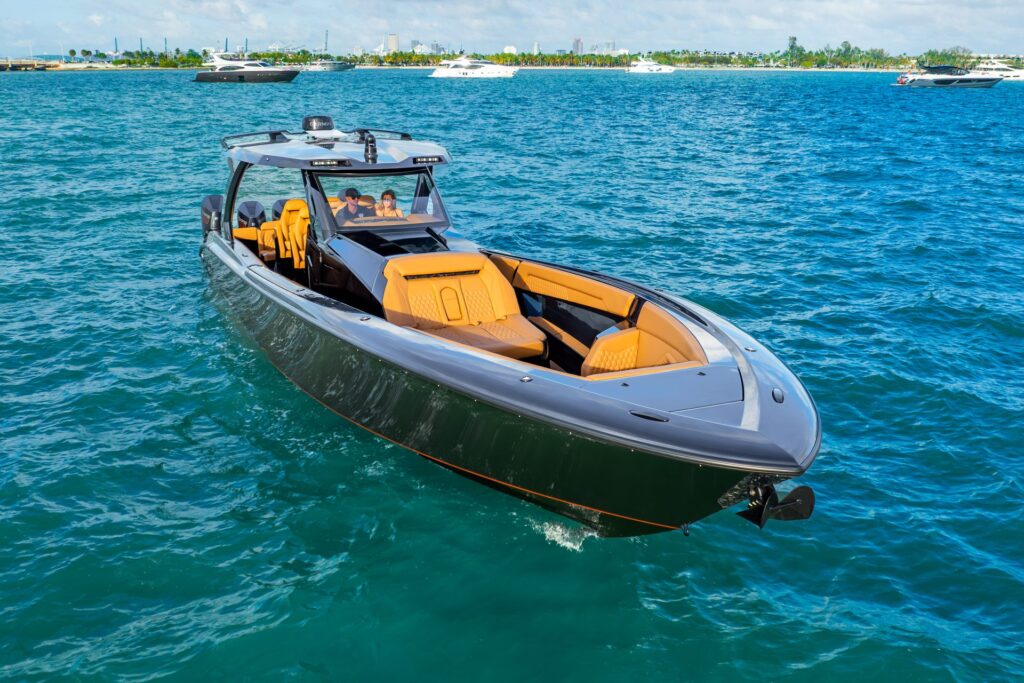
The cockpit of a serious performance powerboat has to satisfy two very different expectations at the same time. It must function as a command environment, giving the operator clear access to information, controls, visibility, and the physical support required to manage the boat confidently. Yet it must also deliver the refinement expected of a premium machine whose owners may spend entire days aboard.
The best modern cockpits do not treat those objectives as competing priorities. Luxury is not added around the helm after the functional work is finished, and performance does not require an austere environment stripped of comfort. Instead, ergonomics, technology, seating, materials, storage, and visual organization are developed around the same objective: creating a space that feels purposeful when the boat is underway and sophisticated when the pace slows.
That is where the modern performance cockpit has evolved most dramatically. It is no longer simply the place where the driver sits. It has become the interface between the operator and everything the boat is capable of doing.
The Helm Has to Organize Complexity
A contemporary performance boat can place an extraordinary amount of information in front of the operator. Navigation, engine data, system status, communications, digital switching, autopilot functions, and other controls may all need to be accessible without turning the helm into a wall of disconnected equipment.
More technology does not automatically create a better cockpit. The real challenge is organization.
Information needs hierarchy. The most frequently referenced data should be easy to locate. Critical controls should not disappear among secondary functions. Displays should be positioned so that the operator can absorb information without constantly shifting attention away from the water. Physical and digital interfaces need to make sense together.
This is where thoughtful design begins to feel luxurious. A sophisticated helm does not impress simply because it contains large displays or advanced equipment. It impresses because the complexity has been edited into something understandable.
The operator should feel that the cockpit is working with him rather than asking him to manage the cockpit itself.
Visibility Is a Luxury Because It Reduces Work
Visibility rarely receives the same attention as upholstery or electronics when people first discuss luxury, yet from the helm it becomes one of the most valuable qualities a boat can possess.
A performance driver needs to read the surface ahead, understand surrounding traffic, monitor the boat’s position, and anticipate changes in the environment. Windshield design, helm height, seating position, hardtop structure, and instrument placement can all influence how naturally that information reaches the operator.
Poor visibility creates constant small corrections. The driver shifts position, looks around obstructions, or changes posture to maintain a clear view. None of those adjustments seems significant individually, but over hours they create fatigue and distraction.
Good visibility has the opposite effect. It allows the operator’s attention to remain outside the boat where it belongs.
This is an important principle of modern luxury: refinement often comes from removing unnecessary effort. A clear sightline may not look extravagant in a photograph, but from behind the wheel it can be more valuable than a decorative feature that never affects the operating experience.
Seating Is Part of the Control System
Performance seating is sometimes discussed primarily as an interior-design element. At the helm, however, seating has a much more demanding responsibility.
The seat establishes the operator’s relationship with the steering, throttles, displays, sightlines, and movement of the boat. It has to provide support without preventing natural movement. The geometry must work during relaxed cruising as well as more active operation. Materials have to remain appropriate in heat, sunlight, spray, and repeated use.
Passenger seating matters for similar reasons. The people aboard should feel integrated into the performance experience rather than treated as cargo surrounding the driver.
The current Reaper 42 and Reaper 47 from Adrenaline Powerboats both list dual-row helm seating for six people as part of their cockpit equipment, along with full wraparound coaming bolsters. Adrenaline also specifies heavy-duty marine-grade UV-stable upholstery. These features illustrate how seating, occupant support, and material durability can be treated as part of the operating environment rather than independent luxury features.
The distinction is important. In a performance cockpit, a seat is not simply somewhere to sit. It influences how effectively people can remain connected to the boat while it is moving.
Digital Displays Should Create Clarity, Not Theater
Large multifunction displays have transformed the modern helm. Navigation, charting, engine information, sonar, communications, and other systems can now be consolidated into interfaces that would have required numerous separate instruments in earlier generations.
The visual effect can be dramatic, but screen size is only part of the equation.
A successful digital helm makes information easier to interpret. Brightness, viewing angle, menu structure, redundancy, and the relationship between touch controls and physical controls all influence usability. The operator should be able to retrieve important information quickly without navigating unnecessary layers during a moment that demands attention elsewhere.
Adrenaline currently lists dual 19-inch Garmin helm screens and a single 27-inch Garmin helm screen among the electronics on the Reaper 42, along with digital switching. Its published equipment also includes digital shift and throttle control and autopilot.
Those specifications are notable because they demonstrate the scale of information management possible in a contemporary performance cockpit. The real luxury, however, lies in how effectively such systems are integrated. Technology should reduce cognitive load, not merely increase the number of available functions.
Controls Need a Natural Physical Logic
Even in an increasingly digital cockpit, the physical relationship between the operator and the boat remains fundamental.
The steering wheel, throttle controls, switches, seating position, and displays create an ergonomic triangle that has to function intuitively. The operator should not need to reach awkwardly for a frequently used control or search visually for something that should be found almost instinctively.
This becomes more important as performance increases because operating conditions can change quickly. The driver may be balancing information from the water, engines, instruments, passengers, and surrounding traffic simultaneously. Every unnecessary movement consumes attention.
A well-designed helm reduces those demands by creating physical logic. Controls are grouped according to function. Important interfaces occupy predictable positions. Less frequently used systems remain accessible without competing for the most valuable space.
That logic is difficult to appreciate from a specification sheet. It becomes obvious after hours at the helm.
Materials Have to Feel Premium Without Becoming Precious
Luxury materials in a marine cockpit face an unusual test. They must look and feel refined while living in an environment that is fundamentally hostile to delicate surfaces.
Sunlight is relentless. Spray and humidity are unavoidable. Passengers board with wet clothing. Hands move constantly between controls, grab points, seating, storage compartments, and equipment. The cockpit may experience heat, salt exposure, repeated cleaning, and substantial physical movement during a single day.
Materials therefore have to communicate quality through more than softness or visual richness. Durability is part of the luxury.
A premium surface that requires excessive caution can become less satisfying than one designed specifically for the environment. The ideal material feels appropriate to the boat’s identity while allowing the owner to use the machine without treating the cockpit like a protected showroom.
That is especially important in a performance boat. The cockpit should invite engagement. Owners should be able to drive, move through the boat, entertain passengers, and spend full days aboard without feeling that normal use is compromising the object.
True refinement survives contact with reality.
Storage Is Part of Cockpit Architecture
Storage may seem mundane compared with instrumentation or custom upholstery, but it has an outsized effect on how a cockpit feels in use.
Loose equipment changes the character of a performance environment quickly. Bags, lines, towels, personal items, safety equipment, and other necessities can turn an otherwise carefully designed cockpit into a cluttered space if there is nowhere logical to put them.
Well-integrated storage allows the visual order of the cockpit to survive actual ownership.
The Reaper 42 and Reaper 47 both currently list seven below-deck storage compartments as well as storage beneath the front helm seats. They also incorporate dual side-door entry and forward lounge areas within their cockpit layouts.
Those are practical considerations, but practical design is a major part of modern luxury. A cockpit becomes more sophisticated when equipment can disappear into spaces intentionally designed to receive it rather than being treated as an afterthought.
The result is not simply tidiness. It is a stronger sense that the boat has been designed around the realities of spending time aboard.
The Cockpit Has to Work at More Than One Speed
A performance cockpit exists in several different modes over the course of a day.
During a serious run, the helm is a focused operating environment. Seating support, visibility, instrumentation, control placement, and communication become dominant considerations. Entering a marina changes the priorities. Low-speed maneuvering demands precision and awareness. Once the boat is secured, the same space becomes social, with passengers moving, talking, relaxing, and accessing storage or entertainment features.
Designing for only one of those states produces an incomplete boat.
This is one reason the modern center-console performance layout has become such an interesting design exercise. The cockpit has to preserve a clear relationship with the driver while still functioning as a space for several people.
The Reaper layouts demonstrate that combination through dual-row helm seating, forward lounge areas, wraparound coaming bolsters, multiple storage compartments, and side-door access. The Reaper 42 also lists integrated bow and stern thrusters with joystick control, showing how systems intended for very different operating speeds can occupy the same broader command environment.
Luxury emerges when the transition between those modes feels natural.
Customization Makes the Helm Personal
The helm is also one of the places where individual specification can matter most.
Owners differ in the information they prioritize, how they use their boats, the technology they consider essential, and the visual atmosphere they want at the controls. One may prefer a highly technical aesthetic with dark materials and visible carbon fiber. Another may want a cleaner visual treatment that integrates the electronics more quietly into the overall cockpit.
The objective should not be customization simply for the sake of being different. A custom helm is most successful when specification reflects actual use.
Adrenaline’s broader custom-build philosophy supports that idea. Its Reaper equipment lists include optional additional Garmin displays and navigation equipment, while the company describes its boats as individually rigged in-house.
That relationship between customization and function is particularly valuable at the helm. Paint may establish identity from across the marina, but the cockpit is where the owner experiences the boat most directly. Decisions made there are encountered every time the engines are started.
Luxury at the Helm Is Ultimately About Confidence
The most sophisticated performance cockpit is not necessarily the one with the most screens, the largest number of controls, or the most elaborate materials.
It is the one that makes the operator feel informed, supported, and connected.
Good seating stabilizes the body. Clear visibility keeps attention outside the boat. Well-organized instrumentation communicates what matters. Thoughtful controls reduce unnecessary movement. Durable materials allow the machine to be used without hesitation. Storage preserves order. Technology manages complexity quietly in the background.
When these elements work together, the cockpit begins to disappear from conscious thought. The operator stops managing an arrangement of components and simply drives the boat.
That may be the highest form of luxury in a performance environment. The refinement is present everywhere, but it does not constantly demand recognition.
For Adrenaline Powerboats, the Reaper cockpit illustrates this intersection particularly well. The published equipment for the Reaper 42 and Reaper 47 combines substantial helm seating, digital systems, practical storage, marine-grade upholstery, and configurable electronics within platforms designed around serious performance.
A modern performance cockpit should make the boat feel more capable without making the experience feel more complicated. When ergonomics, technology, materials, and control are resolved around the person at the helm, luxury no longer feels like an addition to performance.
It becomes part of command.
For owners interested in shaping that command environment around their own preferences, begin a custom Reaper inquiry.