A performance powerboat is one of the rare machines whose appearance cannot be separated from the forces it is designed to manage. The hull must move efficiently through water. The deck has to organize people, controls, structure, and access. The cockpit must protect and support occupants without making the boat feel heavy or visually disconnected. Every major surface is therefore asked to do more than look attractive.
That is why the most convincing offshore designs often feel closer to industrial sculpture than decoration. Their beauty comes from proportion, tension, purpose, and the visible relationship between engineering and form. A strong powerboat does not simply wear an aggressive shape. It looks as though the shape could only have emerged from the job the machine was designed to perform.
In that sense, performance becomes art when function is resolved so completely that the engineering begins to communicate visually.
Proportion Comes Before Detail
Before paint, upholstery, hardware, or graphics are considered, a boat establishes its identity through proportion. Length in relation to beam, the height of the deck, the visual mass of the bow, the position of the cockpit, the scale of the windshield or hardtop, and the relationship between the hull and propulsion all determine how the boat reads from a distance.
These relationships matter because the eye recognizes balance before it recognizes individual features. A boat can contain expensive materials and sophisticated technology but still feel awkward if the fundamental proportions are unresolved. Conversely, a disciplined silhouette can make the machine feel purposeful before the observer understands anything about its specifications.
Performance boats often rely on visual tension. Long horizontal lines suggest speed and direction. A low cockpit can make the hull appear planted and deliberate. The bow may carry enough volume to communicate capability without visually overwhelming the rest of the boat. The best proportions create a sense of stored energy, as if the machine appears ready to move even when it is tied to the dock.
That quality is difficult to create through styling alone. It has to begin with architecture.
Hull Form Is Both Engineering and Visual Language
The hull is first an engineering object. Its form determines how the boat interacts with water, carries load, responds to changing conditions, and supports the performance objectives of the platform. Yet because so much of the hull remains visible, those technical decisions also become part of the boat’s aesthetic identity.
Chines, strakes, steps, flare, deadrise, and the transition from bow to running surface are functional elements, but they also create shadows, edges, planes, and changes in visual tension. A knowledgeable observer may understand these features technically. Even someone without that background can sense when the geometry feels deliberate.
This is where marine design differs from surface styling. The form is not arbitrary. Water imposes consequences. A designer cannot simply draw a dramatic line and expect the engineering to accommodate it later. The exterior has to reconcile appearance with hydrodynamic reality.
That constraint is not a limitation on creativity. It is often what gives the design its authority. Beauty becomes more convincing when the observer understands that the shape exists for a reason.
Stance Communicates Character
Automotive designers speak frequently about stance because the way a car sits on its wheels can communicate performance before the engine starts. Boats have an equivalent relationship with the water.
Freeboard, deck height, bow attitude, cockpit placement, hardtop proportions, and the visual relationship between the hull and engines all influence stance. A serious performance boat often looks low, stretched, and directional, but those qualities have to remain balanced with the practical requirements of the platform.
Too much visual mass in one area can make the boat feel heavy. Too little can make it appear insubstantial. A hardtop that is too dominant can interrupt the horizontal energy of the hull. One that is carefully integrated can become part of the silhouette rather than a structure sitting on top of it.
The strongest designs make these relationships look inevitable. Nothing appears to have been added simply because there was space for it.
Surfaces Create Motion Even at Rest
Large painted surfaces behave differently from small ones. On a powerboat, a subtle change in curvature can alter reflections across several feet of hull. A crease can create a shadow that visually lowers the profile. A changing radius can make a surface appear tighter, softer, more muscular, or more technical depending on how light moves across it.
This is why surface development is so important to high-end design. The boat should remain visually interesting without becoming busy.
A well-resolved hull can communicate motion while stationary because its surfaces guide the eye forward. Lines accelerate toward the stern or converge toward the bow. Tension builds and releases across transitions. The visual language may be dramatic, but the drama comes from geometry rather than ornament.
That distinction matters. Decoration can make a boat noticeable. Form gives it identity.
The Cockpit Must Belong to the Exterior
One of the most difficult challenges in powerboat design is integrating the cockpit into the overall form. The boat needs seating, controls, visibility, protection, storage, access, and technology, yet those functional requirements should not make the upper structure feel disconnected from the hull beneath it.
The windshield and hardtop are especially important because they sit directly in the viewer’s line of sight. Their rake, thickness, height, and relationship with the deck can either continue the boat’s visual movement or interrupt it.
A successful cockpit feels designed from the same idea as the hull. The exterior lines lead naturally toward it. Seating and coamings reinforce the architecture rather than appearing as furniture placed inside a shell. Controls and displays occupy the helm without turning it into a collection of unrelated rectangles.
This is where function and visual discipline meet. The cockpit has to work first, but good industrial design makes that functionality feel intentional.
Engineering Creates Its Own Aesthetic
Many of the most beautiful performance machines are compelling precisely because their engineering remains legible. Cooling openings, structural elements, mechanical interfaces, fasteners, carbon-fiber parts, and controls can all become visually interesting when they are integrated honestly.
The mistake is to confuse exposure with authenticity. Simply making engineering visible does not make a design better. The important question is whether the visible technical elements contribute to the overall composition.
A well-designed performance boat allows function to generate detail. Hardware can feel purposeful rather than decorative. Structural forms can create rhythm. Controls can communicate precision. Material transitions can reveal how the machine is assembled without making it look unfinished.
This approach produces a kind of technical beauty. The observer senses that the boat was designed by people who understood not only what the machine should look like, but what it has to do.
Paint Should Reveal the Form
Custom paint can radically change the personality of a performance boat, but the strongest schemes usually work with the underlying geometry rather than against it.
A well-placed color break can emphasize length. A darker lower section can visually reduce mass. Metallic or pearlescent finishes can reveal changing curvature as sunlight moves across the hull. Graphics can follow a chine, echo a deck line, or create contrast that makes certain surfaces more legible from a distance.
The temptation with a large hull is to treat every square foot as an opportunity for expression. That often weakens the design. When graphics compete with the geometry, the boat can lose the clarity that made the form compelling in the first place.
Adrenaline Powerboats approaches custom paint as part of the individual build rather than a fixed decorative package. The company states that every boat receives custom paint and that its design team works with the customer to tailor the result. That philosophy fits naturally with performance design because paint becomes another tool for interpreting the form rather than hiding it.
The strongest custom finish does not make the viewer forget the hull. It makes the hull easier to see.
Digital Tools Have Changed What Designers Can Resolve
Modern performance-boat design increasingly lives in a digital environment long before a physical hull exists. Three-dimensional CAD, simulation, computer-aided manufacturing, and CNC tooling allow designers to study complex surfaces and transitions with a level of precision that would have been much more difficult to achieve through traditional methods alone.
The important advantage is not simply accuracy. Digital tools allow the designer to understand relationships earlier.
A windshield can be evaluated against the deck surface before tooling begins. A hull line can be studied from multiple viewpoints. A transition that looks attractive in profile can be reconsidered if it feels awkward from above. Tooling can preserve geometry more faithfully as a concept moves toward production.
Adrenaline’s published design process reflects this modern approach. The company says its designs are developed in-house from 3D CAD through CNC milling, and that it uses in-house 5-axis CNC machining for prototyping and final tooling. That continuity gives design and manufacturing a shared language.
For a company that describes its philosophy as “Art in Motion,” the connection is particularly appropriate. The artistry is not separate from the engineering process. It is developed through it.
Beauty Changes Underway
A performance boat cannot be judged fully from a showroom or marina slip because movement changes the composition.
At speed, the amount of hull visible above the water changes. Spray creates a temporary extension of the form. Reflections move rapidly across the surfaces. The running attitude alters the relationship between bow, deck, cockpit, and horizon. Elements that seemed subtle at rest may become more pronounced once the boat is in motion.
A design that works only when stationary is therefore incomplete.
The most successful forms remain coherent across states. They look resolved at the dock, controlled during low-speed maneuvering, and purposeful once the boat is running. The design does not transform into a different object; it reveals another layer of the same one.
This is where the idea of art in motion becomes more than a metaphor. Motion is not simply something happening to the boat. It is one of the conditions under which the design was meant to be experienced.
Timelessness Comes From Resolving the Fundamentals
Performance design is vulnerable to fashion because aggressive styling can quickly become exaggerated. Sharp edges, complex graphics, oversized details, and trendy color combinations may create immediate impact, but immediacy does not guarantee longevity.
Timeless performance machines usually rely on stronger fundamentals. Their proportions remain convincing. Their surfaces are controlled. Their functional elements are integrated. Their visual identity does not depend on one fashionable detail.
This does not require conservative design. Some of the most memorable machines are radical. The difference is that their radicalism comes from a coherent idea rather than a collection of effects.
A boat with a strong underlying form can accept different paint schemes and individual specifications while remaining recognizable. That is an important quality for a bespoke builder because customization should expand identity, not erase it.
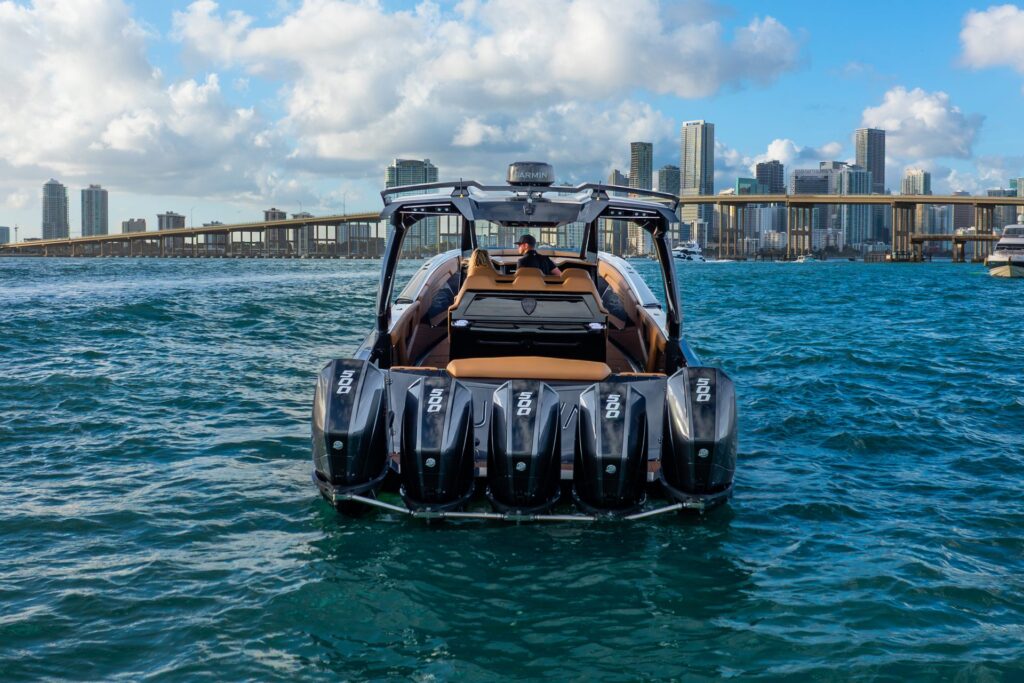
The Reaper 42 and Reaper 47 illustrate that principle particularly well: both are presented by Adrenaline as distinct performance platforms while retaining room for custom treatment within the broader build process.
When Function and Form Become Indistinguishable
The highest level of industrial design is reached when it becomes difficult to identify where engineering ends and aesthetics begin.
A hull line may be beautiful because it manages water effectively. A cockpit may look focused because its controls and seating have been organized around the driver. A hardtop may strengthen the silhouette because it has been integrated with the deck rather than treated as an afterthought. A painted surface may appear dramatic because the finish reveals geometry that was already present.
None of those qualities require decoration for decoration’s sake.
That is what gives a serious performance powerboat visual authority. Its beauty does not feel applied. It feels earned by the way the machine has been conceived.
For Adrenaline Powerboats, in-house design, digital development, CNC tooling, and custom paint create a direct path between the original concept and the final visual object. The Reaper’s appeal is therefore not simply that it looks dramatic. It represents a broader idea of performance design in which proportion, engineering, craftsmanship, and individual specification are expected to work together.
When those elements align, a powerboat becomes more than a technical object and more than a luxury object. It becomes a piece of functional sculpture—one whose final form only makes complete sense when it is moving across the water.
For owners interested in shaping that design language around a personal specification, explore the process of commissioning a custom Reaper.