
For many enthusiasts, the garage is where the obsession begins. A first serious sports car becomes a gateway to more specialized machinery: naturally aspirated engines, forced induction, carbon fiber, hand-finished interiors, limited-production models, unusual specifications, and the subtle differences that separate one chassis from another. Over time, the fascination becomes less about transportation and more about engineering, design, and the emotional quality of a machine built with a clear purpose.
Eventually, however, another question appears. What happens when the garage is no longer enough?
For collectors and performance-minded owners, the answer increasingly leads toward the water. A serious performance powerboat does not replace the experience of an exotic automobile, nor does it need to compete with one. It expands the same enthusiasm into a different environment, where speed is experienced across an open surface, mechanical character is amplified by scale, and the operator interacts with a machine that responds not only to throttle and steering input but also to wind, water, load, and changing conditions.
The crossover from supercars to superboats is therefore less about changing interests than extending them.
The Same Fascination, on a Larger Canvas
People who care deeply about performance cars rarely care about speed alone. If acceleration were the only objective, there would be little reason to debate steering feel, brake response, chassis balance, engine character, seating position, aerodynamics, material selection, or the thousand small decisions that make one vehicle more compelling than another.
The fascination comes from the integration of those elements.
Performance powerboats reward the same kind of attention. Hull design, weight distribution, propulsion, seating, controls, visibility, materials, construction, and cockpit arrangement all influence the way the machine feels. The environment is different, but the enthusiast instinct is familiar: examine how the object is built, understand why it behaves the way it does, and appreciate the details that make one example more resolved than another.
That is why the move from automotive enthusiasm into performance boating can feel surprisingly natural. The enthusiast is not abandoning mechanical culture. He is discovering a larger expression of it.
Engineering Becomes Something You Can Feel
A modern exotic car is an extraordinary exercise in managing forces. Suspension geometry, tire behavior, aerodynamics, braking, cooling, power delivery, and electronic systems all work together to create a particular response at the wheel. The best cars make complex engineering feel immediate.
A performance boat produces a similar sensation, but the surface beneath it is never fixed.
Water changes constantly. Load changes. Wind changes. The hull moves through a medium that can be calm in one stretch and unsettled in the next. That variability gives engineering a different kind of visibility. The shape of the hull, the way weight is carried, the relationship between propulsion and structure, and the driver’s inputs all become part of an experience that cannot be reproduced exactly from one run to the next.
For an automotive enthusiast, that unpredictability can be compelling. A favorite road may change with weather and traffic, but the road itself remains where it was. On the water, the operating environment has a living quality. The machine must work with it.
This makes performance boating highly engaging without requiring the comparison to become a contest over which category is faster or more impressive. A supercar and a powerboat ask different things of their operators. What they share is the pleasure of feeling engineering translate into motion.
Design Has to Work from Every Angle
Exotic automobiles have trained generations of enthusiasts to read design in three dimensions. Proportion matters. Stance matters. The relationship between glass, bodywork, wheels, intakes, surfaces, and aerodynamic elements determines whether a car looks coherent before anyone studies a specification sheet.
Performance boats invite the same kind of scrutiny, but their proportions are expressed differently.
A hull has to communicate purpose while serving hydrodynamic requirements. The sheer line, bow profile, deck treatment, hardtop, windshield, cockpit geometry, and relationship between the hull and propulsion system all contribute to visual identity. A boat must look convincing tied to a dock, viewed from shore, approached from another vessel, and seen at speed.
There is also more visual surface to work with. Paint and graphics can alter the perceived length, height, and aggression of the boat. Upholstery and cockpit materials become part of the exterior composition because so much of the interior is open to view. Hardware cannot simply be hidden behind body panels. Functional elements remain visible and therefore become part of the design language.
This is one reason custom performance boats can appeal so strongly to people already accustomed to specifying unusual automobiles. The finished object becomes a large-scale composition where engineering and aesthetics are difficult to separate.
Mechanical Character Still Matters
The automotive world is increasingly capable of producing astonishing performance with very little drama. That technical progress is impressive, but it has also increased interest in machines with distinct personalities. Enthusiasts still talk about throttle response, exhaust note, steering texture, gearshift feel, engine placement, and the peculiarities that make one car memorable years after the numbers have been surpassed.
Performance boating preserves that appreciation for mechanical character.
Sound has scale on the water. Acceleration is accompanied by the transition of the hull through changing attitudes. Wind becomes part of the sensation. The view from the helm opens rather than narrowing into a road corridor. The operator feels the combination of propulsion, hull behavior, and surface conditions in a way that is both mechanical and environmental.
That does not mean louder is automatically better, or that drama should be confused with quality. As with a serious automobile, the most satisfying machines are often those whose sensations feel connected to their engineering. The sound, movement, response, and feedback should belong to the object rather than seem artificially added.
For someone who already values mechanical authenticity, this can make a performance boat feel immediately understandable even when the medium is completely new.
Specification Is Part of the Pleasure
Collectors know that two examples of the same automobile can feel remarkably different. Color, interior, wheels, seats, trim, options, and small production details can determine whether a car feels generic or perfectly judged. In some corners of the collector market, specification becomes part of the vehicle’s identity.
The same principle has particular force in custom performance boating.
A boat offers an unusually broad range of visible and functional decisions. Exterior paint can be restrained or theatrical. Upholstery can complement the hull or create deliberate contrast. Helm design, electronics, storage, seating, rigging, and equipment choices can influence the owner’s experience long after the novelty of a color scheme has passed.
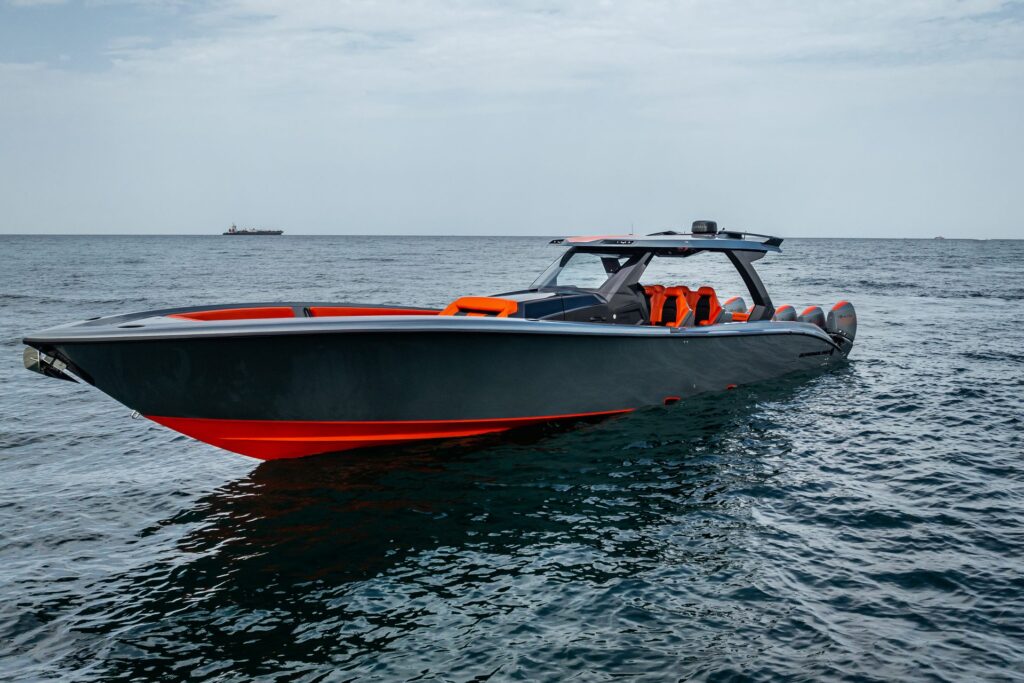
This is where Adrenaline Powerboats fits naturally into the conversation. Adrenaline states that its designs are developed in-house, that it uses custom paint on every boat, and that its design team works with customers to tailor the paint process to their specifications. The company also says every boat it builds is rigged in-house and that rigging is specified for each build.
For an enthusiast accustomed to discussing paint-to-sample colors, interior stitching, carbon packages, wheel finishes, and factory options, that kind of involvement feels familiar. The terminology changes, but the pleasure of specification remains.
The Experience Extends Beyond Ownership
A supercar often reshapes the way its owner thinks about a drive. The destination may matter less than the road chosen to reach it. An early-morning run becomes its own event. A weekend trip is planned around a route that gives the car room to reveal its character.
A performance powerboat can change the shape of a day in much the same way.
The water becomes both route and destination. Leaving the dock is not simply transportation to somewhere else; the run itself can be the central experience. A waterfront lunch, an afternoon gathering, or a trip between coastal destinations acquires another dimension when the journey involves time at the helm.
Yet boating also introduces a social quality that differs from many high-performance cars. The cockpit can accommodate a group, allowing the performance experience to be shared without reducing the driver to a spectator. Passengers can participate in the motion, sound, scenery, and arrival while the operator remains actively engaged with the machine.
For enthusiasts whose automotive collections have traditionally produced solitary or two-person experiences, that wider social dimension can be a meaningful expansion.
A Different Kind of Freedom
Road-going performance is always shaped by infrastructure. Roads have lanes, intersections, speed limits, traffic, surfaces, and destinations determined long before the car arrives. Even on an exceptional driving road, the machine exists within a system designed primarily for transportation.
Open water feels different.
Navigation, weather, traffic rules, and responsible operation still matter, of course. Performance boating is not an escape from judgment or discipline. But the visual and spatial experience is broader. The horizon opens. Routes become less visually prescribed. Distance is perceived differently when there are no lane markings or roadside structures passing beside the cockpit.
That sense of space changes the emotional character of performance. Acceleration feels less confined. Speed is framed by sky and water rather than barriers and buildings. The machine seems to occupy a larger environment, and the owner experiences performance as part of that scale.
For someone accustomed to measuring an enjoyable drive in corners and miles, this can be a fundamentally new sensation without being an unfamiliar one.
Craftsmanship Connects the Two Worlds
The best performance automobiles are compelling even when parked because engineering alone does not explain their appeal. Open a door, examine a carbon structure, study a machined component, or look closely at how leather meets a switch panel, and the pleasure becomes partly about craftsmanship.
High-end performance boats offer the same opportunity on a larger scale.
Adrenaline’s current Reaper 42 and Reaper 47 specifications, for example, describe composite construction, vacuum-infused epoxy construction processes, carbon-fiber structural elements, marine-grade upholstery, and substantial cockpit equipment. The company also emphasizes that design, CNC work, custom paint, and rigging are handled within its own operation. These are not automotive techniques transplanted directly into boating, but they appeal to the same appreciation for materials, process, and purposeful construction.
A collector does not need to be an engineer to appreciate the difference between an object that has simply been assembled and one whose construction tells a coherent story. That instinct crosses categories easily.
The Garage Was Never Really About Cars
For serious enthusiasts, a garage full of interesting machines is rarely about transportation. It is a collection of ideas.
One car may represent a particular era of engine development. Another may be valued for analog controls. Another may be a design object. Another may be important because of rarity, specification, or the memories attached to it. What connects them is not utility but fascination.
A performance powerboat can enter that world without imitating it.
It offers engineering that can be studied, design that can be appreciated, customization that can become deeply personal, and a driving experience that demands active participation. It also opens an environment that no road-going machine can provide. The scale is larger, the sensory experience is different, and the possibilities for using the machine expand beyond the traditional boundaries of a collection.
That is why the progression from supercars to superboats makes sense. It is not a declaration that one form of performance has replaced another. The collector car remains what it has always been: a particular expression of engineering and emotion.
The boat simply adds another dimension.
For enthusiasts who have spent years refining what belongs in the garage, the next compelling machine may be the one that cannot fit inside it. Those interested in translating their taste for performance, engineering, and individual specification to the water can explore a custom Reaper build.