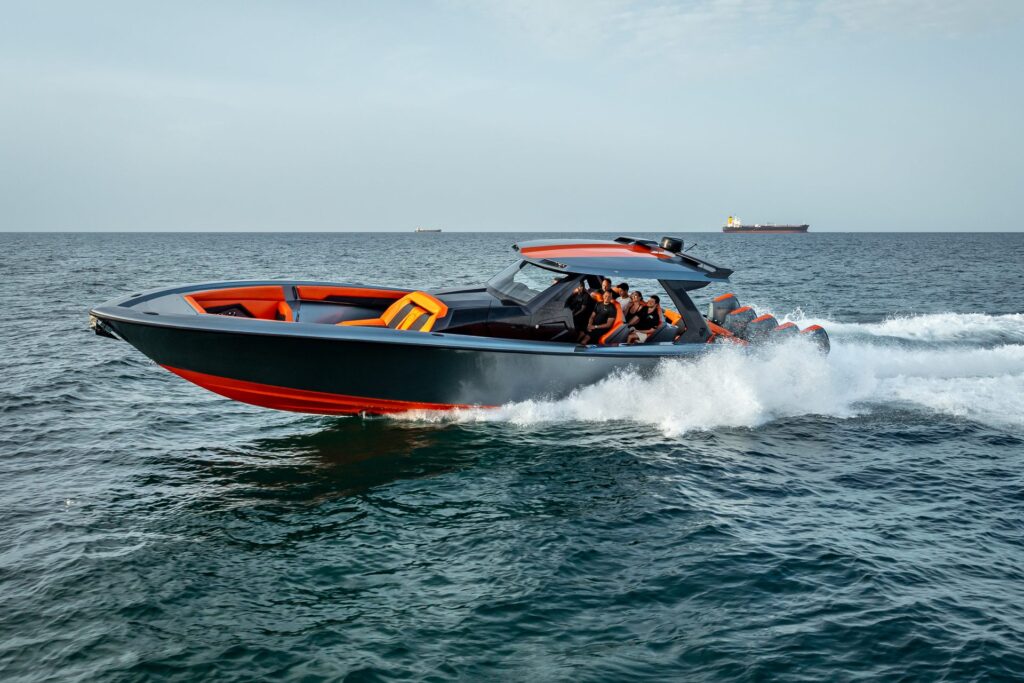
A performance powerboat is never visually static. Even tied perfectly still at the dock, its appearance changes as the sun moves, reflections shift, and the surrounding water alters the way color and surface are perceived. Morning can make a hull feel clean and architectural. Midday reveals every edge with hard clarity. Late afternoon softens the same machine, stretching highlights across the paint and deepening shadows until familiar surfaces begin to look entirely different.
That transformation is one of the overlooked pleasures of owning a highly designed boat. Unlike an automobile viewed mostly against roads, buildings, and garages, a powerboat exists inside a constantly changing field of sky and water. Light does not simply illuminate the design. It participates in it.
For a custom builder, that means color, graphics, surface development, and material selection have to be considered beyond the controlled environment of a design studio or build floor. The boat must continue to make sense when reflections are moving across the hull, when the sun is low, and when evening light reduces the entire machine to silhouette.
The Water Is Part of the Paint
Color on a boat behaves differently because the environment is always contributing to what the eye sees. Water reflects sky, surrounding structures, neighboring boats, and the hull itself. A finish that appears deep and solid indoors can become more dimensional outside because color is constantly receiving moving information from the surface around it.
The result is that paint is not simply a fixed color value. It becomes an interaction between pigment, surface shape, light, and environment. Metallic and pearlescent effects can become especially active as the boat changes angle relative to the sun.
This is one reason a large performance hull can reward long observation. A color that looks almost monochromatic from one angle may reveal multiple tones as the viewer walks the dock. A graphic that appeared subtle under overhead lighting may become more pronounced as sunlight travels across it. Even while the boat is stationary, the finish can feel animated.
Morning Light Rewards Clean Form
Early morning tends to be unusually revealing in a quiet way. The light is lower and softer than at midday, so long shadows exaggerate curvature while broad surfaces receive gentler transitions between highlight and shade.
This can be particularly flattering to disciplined design. A strong sheer line becomes easier to follow from bow to stern. The relationship between hardtop, windshield, cockpit, and hull becomes more obvious. Surface transitions appear gradual rather than abruptly lit, and a well-proportioned boat can feel more sculptural.
Morning also tends to make restrained specifications feel sophisticated. Dark paint can retain depth without becoming visually heavy. Lighter finishes can pick up the color of the sky. Subtle metallic content can become visible without overwhelming the form.
The visual lesson is simple: a boat with strong fundamentals does not need theatrical graphics or hard light to create presence.
Midday Is the Most Honest Light
If morning is flattering, midday is demanding. When the sun sits high, shadows shorten and reflections become stronger. Surface imperfections are more difficult to hide. Color becomes brighter and more direct, while graphics and material transitions are exposed clearly.
For custom paint, this makes midday an important test. A complicated scheme may look exciting in a rendering but become crowded under direct sun. Contrasts that seemed balanced indoors can feel far stronger outside. A poorly placed graphic can interrupt the geometry of the hull because hard light makes every boundary more legible.
Conversely, a well-resolved paint concept often becomes more convincing. Clean masking, disciplined color breaks, and controlled transitions remain legible without becoming chaotic. Craftsmanship behind the finish becomes part of the design.
Midday light is not always the most romantic, but it may be the most honest.
Golden Hour Changes the Boat Again
Late afternoon produces another version of the same machine. As the sun drops, light begins traveling across the hull rather than falling mainly from above. Surfaces facing the sun become warmer and more reflective, while opposite surfaces deepen into shadow.
This is what gives golden hour its particular power around performance boats. Low-angle light reveals curvature. A subtle crown in a hull surface may suddenly become obvious. A chine can cast a longer shadow that sharpens the profile. Metallic paint may develop greater depth because the finish is being struck from a more revealing angle.
The boat can also appear lower and longer. Highlights emphasize horizontal movement while shadow removes some visual mass. A design that already contains tension begins to look more dynamic without a single physical element changing.
Golden hour does not improve weak architecture. It reveals strong architecture differently.
Metallic, Dark, and Light Finishes Behave Differently
Metallic and pearlescent paints are especially dependent on viewing angle and illumination. On a large marine surface, different sections of the hull can catch the same light in different ways. One area may appear bright and reflective while another remains deep and saturated, allowing a single color to create several visual effects at once.
Dark finishes create a different experience. Blacks, charcoals, deep blues, and other saturated colors can visually lower a boat and make technical details stand out. Under low light, they can feel almost monolithic. In bright sun, however, reflections and transitions become more obvious, which means a dark specification demands precision.
Lighter colors reveal geometry more through shadow. Whites, silvers, and pale grays allow small changes in curvature to become visible because one surface catches more sky while another falls slightly into shade. They can also absorb the colors of their surroundings, taking on blue, warm gold, or green depending on the water and sky.
None of these approaches is inherently superior. The more important question is whether the finish supports the architecture of the boat and behaves in a way the owner will continue to enjoy under changing conditions.
Custom Paint Has to Work Outside the Studio
The strongest paint decisions recognize that the boat will spend its life outdoors.
Adrenaline Powerboats states that custom paint is used on every boat and that its design team works closely with customers to tailor the process to individual specifications. That approach is particularly relevant here because the finished scheme will ultimately be seen under conditions far more varied than any design screen can reproduce.
A successful scheme should remain coherent from multiple distances and under different light. The broad composition needs to work from across the marina, while finer transitions should reward close inspection. Colors should make sense in direct sun as well as softer evening light, and graphics should follow the hull geometry strongly enough that moving reflections do not make the design feel accidental.
This is where custom paint becomes more than decoration. It becomes an interpretation of the boat’s form.
Materials Add Another Layer to the Light
Paint is only one part of the visual experience. Glass, carbon fiber, polished hardware, matte finishes, upholstery, and painted engine surfaces all react differently as the sun moves.
Glass can appear nearly black from one direction and highly reflective from another. Carbon fiber may reveal its weave more strongly when the light reaches it at a particular angle. Polished metal can create sharp highlights, while matte materials absorb light and make neighboring glossy surfaces appear more pronounced.
The current Reaper 47 lists visual carbon legs and windshield frame as an available option, while the Reaper 42 and Reaper 47 product pages list hull-paint upgrades and custom-painted engine options. These published choices create opportunities to develop contrast not only through color, but through the way different materials respond to the same environment.
When handled carefully, those differences give the boat depth without requiring every element to become a visual statement.
Sunset Reduces the Boat to Identity
As daylight fades, fine detail begins to disappear. Paint loses some of its importance. Upholstery recedes. Smaller hardware becomes difficult to read. The boat is increasingly judged through the relationship between bow, hull, windshield, hardtop, engines, and overall stance.
This is one of the purest tests of design.
If a boat remains recognizable when most decorative information is gone, the underlying architecture is carrying the identity. A strong profile does not rely entirely on graphics or color to be memorable.
Adrenaline describes its broader design philosophy as “Art in Motion” and says its designs are developed in-house from 3D CAD through CNC work and the finished product. That emphasis on form and function is relevant because custom paint can strengthen an identity, but the identity has to exist in the shape first.
The final minutes of daylight therefore reveal something important. When the finish becomes almost invisible, the boat still has to look like itself.
A Great Finish Rewards Time
The most satisfying luxury objects often reveal more with familiarity rather than exhausting their appeal at the first viewing. A performance boat can do this through the relationship between shape, material, and light.
An owner begins noticing how a particular color looks after a storm has cleared, how the hull catches the last light after an afternoon run, or how certain surfaces become more dramatic when viewed from the water rather than the dock. The same boat can look technical in hard daylight and almost cinematic at sunset.
These changes contribute to long-term attachment because the specification is not experienced only during the initial reveal. It is encountered repeatedly under different skies, seasons, marinas, and destinations.
Adrenaline’s emphasis on custom paint gives individual Reaper builds room to explore that relationship directly. The company’s own materials state that every boat receives custom paint and that the process is tailored with the customer, making finish part of the individual identity rather than a fixed production formula.
Designed for More Than One Moment
A great performance powerboat should not have a single best angle or one lighting condition in which it works. It should hold together in hard midday sun, under overcast skies, in warm late-afternoon light, and as a dark silhouette returning toward the marina.
Its paint should reveal the hull rather than rescue it. Its materials should create depth without overwhelming the larger form. Its graphics should remain connected to the geometry even as reflections move across them.
That is why light belongs in the conversation about performance-boat design. A boat is never experienced under laboratory conditions. It exists outside, surrounded by reflective water and an enormous changing sky. The environment continuously edits the appearance of the machine.
For a custom performance boat, that variability is an opportunity. A thoughtful specification can reveal different sides of the same identity: precise in the morning, uncompromising at midday, dramatic at golden hour, and unmistakable in silhouette after the sun has nearly gone.
The boat has not changed. The world around it has.
When the design is strong enough, every version still feels intentional.
For owners interested in shaping a Reaper whose paint and material specification develops its own character across changing light, explore a custom Reaper inquiry.