There is a subtle but important difference between owning a premium product and owning something that seems to have been considered with you in mind. One asks you to enter a finished system and choose the closest available version to your preferences. The other begins with the idea that your preferences deserve to influence the finished object.
That difference is one of the defining pleasures of bespoke ownership.
In mass-market luxury, the buyer is usually presented with a carefully developed range of choices. The manufacturer has already decided the dimensions, materials, configurations, packages, and combinations that make sense for the largest possible group of customers. The result may be beautifully engineered and exceptionally refined, but the relationship still moves in one direction: the product is fixed first, and the owner adapts afterward.
A custom performance powerboat can reverse that relationship. The platform still has an engineering identity and boundaries that deserve respect, but there is more room for the final machine to reflect the owner’s priorities, habits, aesthetic preferences, and intended use. Instead of asking how to fit yourself into a standardized product, the more interesting question becomes how the product can be shaped to fit you.
Standardization Is Designed Around the Average
Standardization is not inherently a compromise. It is one of the reasons modern premium products can achieve remarkable consistency. When manufacturers know exactly which combinations they will build, they can optimize production, simplify quality control, and engineer around predictable use cases.
The limitation is that standardized products are necessarily designed around an imagined customer rather than one specific person.
That imagined customer may be sophisticated and demanding, but the product still has to accommodate a wide range of needs. Seating positions, storage priorities, colors, materials, layouts, and interfaces are selected because they make sense for many people at once.
For most products, that is entirely reasonable. The tension appears when the buyer has enough experience to know precisely what matters.
An experienced boat owner may already understand which cockpit details become important after several hours underway. A collector may know which colors and materials continue to feel satisfying years later. Someone who spends weekends moving between waterfront destinations may prioritize different elements from an owner who is most interested in time at the helm.
At that level, “good for most people” can begin to feel less compelling than “right for me.”
Bespoke Luxury Begins With Relevance
The word bespoke is often associated with ornament, rarity, or an abundance of choices. Its more meaningful quality is relevance.
A feature becomes valuable when it matters to the person using it. A material feels luxurious when it suits the environment and the owner’s taste. A cockpit feels considered when its priorities align with the way the boat is actually used. A color becomes personal when it is chosen because the owner wants to live with it, not because it happens to be the fashionable selection that year.
This is what separates customization from mere variation.
More options do not automatically create a more personal product. A long menu can still require the customer to choose among decisions already made by somebody else. Bespoke ownership becomes more meaningful when the owner’s preferences are treated as context for the finished machine rather than simply as boxes to check.
The luxury is not unlimited choice. It is having the choices that matter taken seriously.
A Boat Is an Especially Personal Environment
A performance powerboat makes this philosophy particularly relevant because ownership is so physical.
The owner does not simply observe the boat. He moves through it, drives it, reaches for controls, spends hours in the seating, organizes equipment, brings guests aboard, sees the paint under changing light, and experiences the layout in conditions that can never be reproduced completely in a showroom.
Those repeated interactions make fit unusually important.
A cockpit whose configurable details reflect the owner’s priorities can become more satisfying as familiarity grows. The same is true of storage, materials, technology, and visual specification. What appeared to be a small decision during specification may become something encountered on every outing.
The boat becomes an environment rather than merely an object.
This is why details can acquire disproportionate importance. A color may seem like an aesthetic choice at first, but the owner will see it every time he approaches the dock. A material selected for restraint rather than novelty can shape the atmosphere of the cockpit for years. A functional choice that receives little attention at delivery may become one of the most appreciated elements after a season of use.
The closer the object sits to daily experience, the more valuable personal relevance becomes.
You Should Not Have to Perform Someone Else’s Idea of Luxury
Standardized luxury often comes with an implied script.
A particular interior is supposed to communicate sophistication. A certain package is presented as the desirable specification. A combination of colors or features becomes the accepted expression of the model. The owner can choose among those options, but the product still defines the boundaries of good taste in advance.
Bespoke ownership allows more independence.
Someone who dislikes theatrical interiors does not need to accept visual excess simply because the product occupies a premium category. An owner who prefers technical simplicity does not need to add equipment merely because it is available. Someone who values a bold exterior can pursue that direction without requiring every other surface to compete for attention.
Luxury becomes more convincing when it stops asking the owner to perform someone else’s version of it.
The result may be quieter or more dramatic than the standard expectation. What matters is that it feels coherent with the person who commissioned it.
Personal Fit Can Be Emotional as Well as Functional
Not everything that makes a bespoke object feel right can be justified through utility.
Some choices matter because they create pleasure.
A certain color may connect with an automobile already in the collection. A material may recall another object the owner values. A restrained visual theme may simply produce a stronger emotional response than something more elaborate. These preferences may have no effect on objective performance, yet they can dramatically influence satisfaction with the finished machine.
That emotional dimension is not frivolous. Luxury products are rarely purchased on utility alone.
A performance powerboat already exceeds the basic requirement of moving across the water. Its appeal includes design, sound, craftsmanship, movement, social experience, and the pleasure of ownership itself. Within that context, personal aesthetic decisions are part of the experience because enjoyment is one of the reasons the object exists.
When those decisions come from the owner rather than from a generic market profile, the finished boat can feel more intimate.
The Best Customization Eventually Feels Natural
A successful bespoke product does not necessarily remind the owner of its customization every day.
In fact, the opposite may be true.
Over time, the choices begin to feel so natural that they disappear into the experience. The owner no longer thinks about why a particular finish was selected or why one cockpit detail mattered during specification. Those decisions have become normal because they fit.
This is similar to a well-tailored garment. Its value is not that the wearer constantly notices the tailoring. The value is that the garment does not demand adjustment. It simply feels correct.
A custom boat can achieve the same effect at a much larger scale.
The paint feels like the paint the boat always should have had. The cockpit atmosphere feels appropriate rather than decorated. The equipment reflects actual priorities. The machine stops feeling like a standardized product that was modified and starts feeling like one complete object.
That is a more mature expression of personalization than customization designed primarily to be noticed.
Adrenaline’s Approach Reflects the Principle
Adrenaline Powerboats publicly describes a client process that begins with a one-on-one consultation focused on the customer’s vision, preferences, and requirements before moving into custom design. The company also states that its builds are intended to be unique, that custom paint is tailored to customer specifications, and that rigging is specified for each individual build.
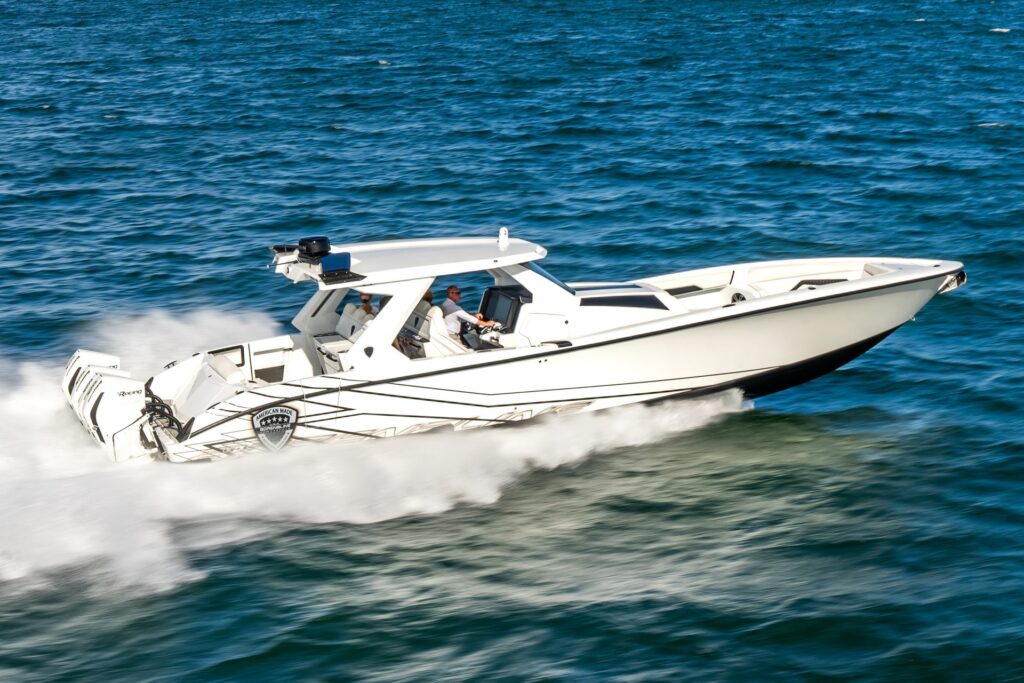
For the Reaper line, that creates a useful balance. The underlying platform provides the recognizable performance and design identity, while the individual build can reflect a more specific point of view. Adrenaline currently presents the Reaper 42 and Reaper 47 as its center-console performance models.
That distinction matters. Having something built around you does not mean demanding arbitrary changes or erasing the integrity of the original machine. It means working within a strong design and engineering framework while giving personal priorities meaningful influence over the finished result.
A Strong Platform Should Still Be Able to Say No
True bespoke luxury requires boundaries.
A builder should not agree to every request simply because customization is available. Some decisions may compromise usability, engineering, safety, durability, or the coherence of the design. Expertise has value precisely because the customer is not expected to solve every technical problem alone.
The ideal relationship is collaborative.
The owner brings preferences, experience, habits, and taste. The builder brings knowledge of the platform, materials, engineering, and the marine environment. The finished product becomes stronger when those perspectives meet rather than when one blindly replaces the other.
This is another reason bespoke ownership differs from simply having more options. A dropdown menu cannot explain why two attractive choices may conflict. It cannot challenge a decision that will age poorly or suggest a more coherent way to achieve the same intent.
Personalization works best when individual preference is supported by professional judgment.
The Luxury Is Being Understood
At its highest level, bespoke ownership is not really about paint, upholstery, electronics, or equipment. Those are expressions of something more fundamental.
The luxury is being understood.
It is the difference between entering a market and finding the product closest to what you want and entering a process where what you want is relevant from the beginning. One experience asks how well you can adapt to the object. The other asks how intelligently the object can respond to you.
For an experienced owner, that difference becomes increasingly meaningful. Familiarity with premium products often makes standardized abundance less impressive. More features do not necessarily create more satisfaction. More recognizable branding does not automatically create more connection.
What becomes valuable is precision of fit.
A performance powerboat is unusually capable of delivering that feeling because it combines a strong mechanical platform with a deeply personal environment. The owner sees, touches, operates, and lives with the specification in a way that allows thoughtful decisions to reveal themselves over time.
The ultimate expression of luxury may therefore be less about having more than everyone else and more about having less need to compromise. The machine does not have to be universally ideal. It only has to make exceptional sense for the person who owns it.
That is the luxury of having something built around you.
For owners who want to explore how a Reaper can be shaped around their own vision and preferences, begin a custom Reaper inquiry.