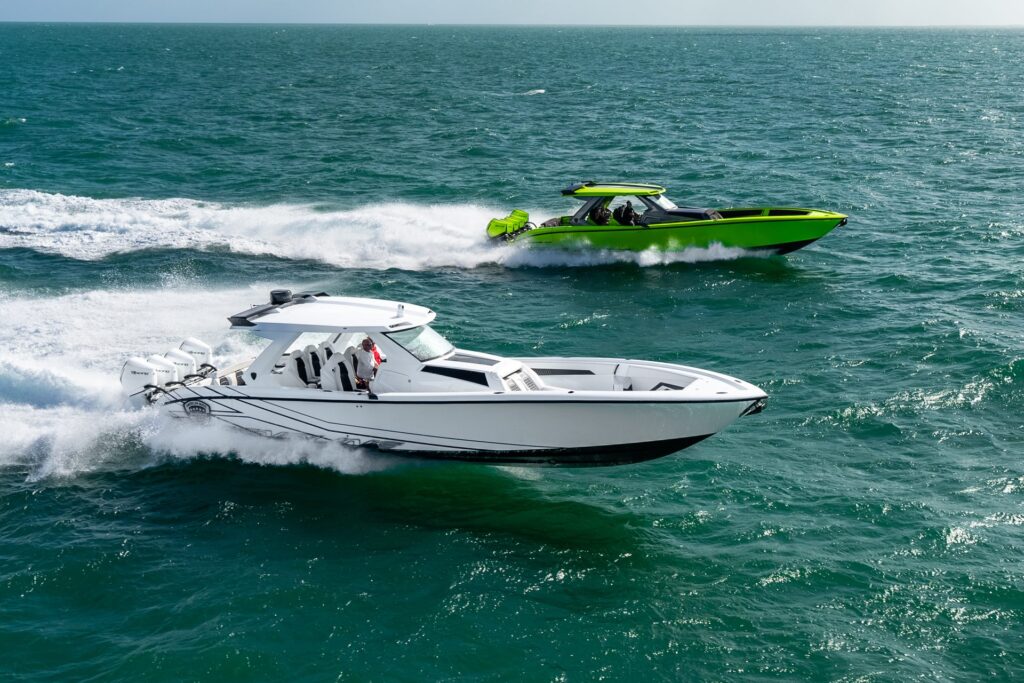
Acceleration is where offshore performance becomes real.
Not at the dock. Not on a spec sheet. Not in conversation.
But in the moment when throttles move forward, engines respond, and the hull transitions from displacement to plane.
That transition reveals everything.
It exposes build quality. It exposes balance. It exposes whether power is being translated into control—or wasted in instability.
For those who understand offshore performance, a perfect acceleration is not just fast.
It is clean.
The First Movement Forward
At idle, everything is quiet in comparison.
Engines rumble steadily. The boat sits level. Water moves gently around the hull.
The moment the throttles advance, that calm disappears.
The bow begins to rise.
The engines load.
The hull starts to break free from displacement and transition into speed.
This is where poor design becomes obvious.
A sloppy platform hesitates. It lifts unevenly. It feels disconnected.
A refined platform responds immediately.
The Rise Onto Plane
The transition onto plane is one of the most critical phases of performance.
Too abrupt, and the boat feels unstable.
Too slow, and it feels underpowered or inefficient.
A well-engineered offshore boat rises smoothly.
The bow lifts with purpose, not hesitation.
The hull settles quickly.
The engines climb cleanly without strain.
There is no confusion in the movement.
Everything feels aligned.
Clean Versus Chaotic Acceleration
Acceleration can either feel controlled or chaotic.
In a chaotic system, throttle input produces inconsistent results. The hull may bounce. Steering may require correction. The boat may feel like it is searching for stability.
In a clean system, acceleration feels linear.
Throttle input produces predictable response.
The hull tracks straight.
The transition is smooth, even at aggressive throttle.
This difference defines the entire experience.
The Sound of Proper Load
Engine tone tells a story during acceleration.
A clean build produces a consistent, rising note.
RPM increases smoothly. Load is applied evenly. There are no gaps or irregularities.
For those who appreciate loud performance, this is part of the satisfaction.
The sound is not random.
It is controlled power being applied correctly.
Experienced operators listen closely.
They can hear when a system is working efficiently—and when it is not.
The Feeling Through the Hull
Acceleration is not just heard. It is felt.
Through the seat.
Through the deck.
Through the steering wheel.
A properly designed offshore hull absorbs load and transfers it evenly. The push back into the seat feels strong but controlled. There is no unnecessary vibration. No harsh transition.
The boat feels connected to the water rather than fighting it.
That connection builds confidence immediately.
Steering Response Under Power
As acceleration builds, steering becomes critical.
A poorly balanced or poorly designed boat may require constant correction. It may pull slightly. It may feel loose.
A refined platform tracks cleanly.
Minimal input is required.
The boat goes where it is pointed—without hesitation.
This is where engineering shows itself most clearly.
Trim and Timing
Trim plays a subtle but important role in acceleration.
Applied correctly, it allows the hull to rise efficiently and settle into its optimal running attitude.
Applied incorrectly, it can create instability or delay the transition onto plane.
In a well-balanced offshore boat, trim becomes a refinement tool—not a necessity for correction.
The timing of these adjustments separates experienced operators from inexperienced ones.
Why Balance Shows Up Immediately
Acceleration reveals balance faster than any other phase.
If weight distribution is off, the boat will lean, hesitate, or struggle to settle.
If balance is correct, the transition feels effortless.
The hull rises evenly.
The boat stabilizes quickly.
Speed builds without disruption.
Balance is not theoretical in this moment.
It is undeniable.
The Role of Build Quality
Acceleration puts immediate stress on every system.
Hull structure.
Engine mounts.
Propulsion components.
Steering systems.
If any part of the build is compromised, it shows up here.
A properly built offshore platform—like those produced by Adrenaline Powerboats—handles this load without hesitation.
The structure holds.
The response remains consistent.
The transition feels intentional.
That consistency is what allows aggressive acceleration to feel controlled instead of risky.
Aggression With Control
For those who enjoy running loud and fast, acceleration is one of the most satisfying parts of offshore performance.
But the satisfaction does not come from raw force alone.
It comes from control.
From knowing the boat will respond exactly as expected.
From feeling the hull settle instead of fight.
From hearing the engines climb without strain.
Aggression without control feels unstable.
Aggression with control feels authoritative.
Sustaining the Run
Acceleration is only the beginning.
What matters is what happens immediately after.
A well-designed boat transitions from acceleration into sustained speed seamlessly. There is no sudden instability. No need to back off unexpectedly.
The boat settles into its running attitude and holds it.
This is where clean acceleration pays off.
It sets the tone for the entire run.
The Difference You Remember
People remember how a boat accelerates.
Not just how fast it goes.
But how it feels getting there.
Whether it felt smooth or unstable.
Whether it felt controlled or chaotic.
Whether it inspired confidence—or hesitation.
These impressions last.
They define the experience more than peak numbers ever will.
Why This Matters
Acceleration is the most honest moment in offshore performance.
There is no time to compensate.
No time to adjust for flaws.
Everything happens immediately.
That is why serious operators pay attention to it.
It reveals the truth about the boat.
Final Thought
From idle to plane, everything is exposed.
Design.
Balance.
Build quality.
Operator input.
When all of these align, acceleration feels effortless—even when it is aggressive.
It feels loud, fast, and controlled.
And that combination is what defines real offshore performance.
Begin your private build consultation: https://lp.adrenalinepowerboats.com/reaper-quote
Explore Adrenaline Powerboats: https://adrenalinepowerboats.com/home/