
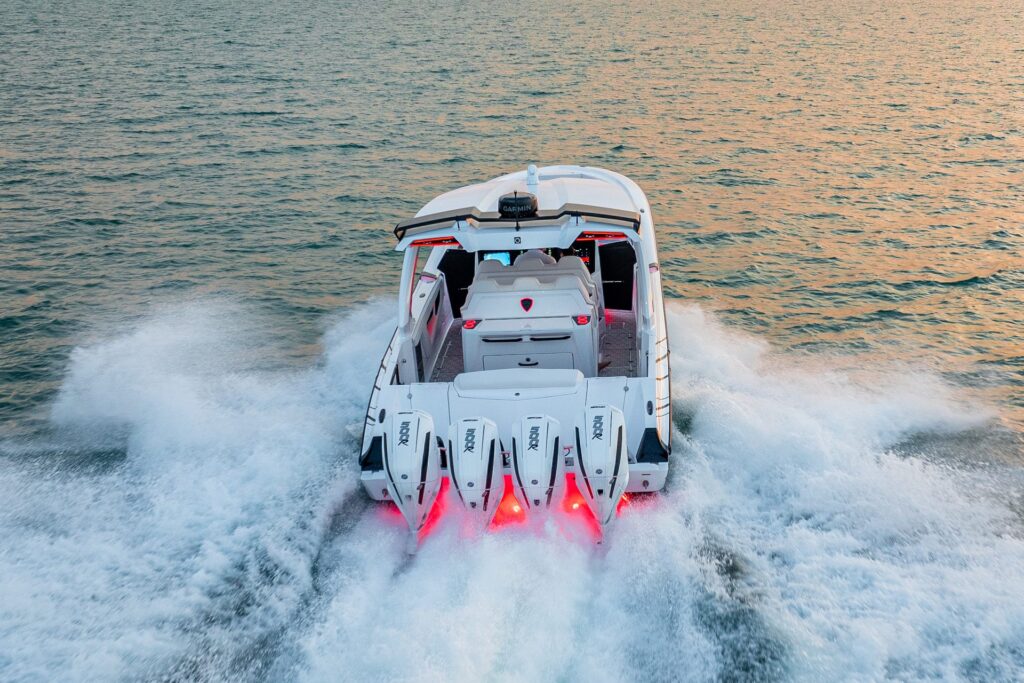
Power moves the boat.
Balance controls it.
In offshore performance, balance is one of the least visible—but most critical—factors influencing how a boat runs. It does not show up on spec sheets. It is not easily marketed. But every experienced operator feels it immediately.
A well-balanced boat feels planted, predictable, and composed.
A poorly balanced one feels unsettled, reactive, and inconsistent.
The difference is not subtle.
What Balance Really Means Offshore
Balance is not just about weight.
It is about how weight is distributed across the hull—fore to aft, side to side, and even vertically.
Fuel load, engine placement, battery positioning, seating layout, and structural design all contribute to how a boat sits in the water and responds at speed.
When balance is correct, the hull runs efficiently.
When it is not, the operator is forced to compensate constantly.
Why Balance Matters More at Speed
At low speeds, imbalance can go unnoticed.
At high speeds, it becomes obvious.
A boat that is too stern-heavy may struggle to stay planted, requiring constant trim adjustment. A boat that is too bow-heavy may feel sluggish and resistant to acceleration. Uneven lateral balance can create subtle lean that forces steering correction.
These small inefficiencies compound.
They reduce speed, increase fatigue, and limit confidence.
The Feeling of a Balanced Hull
When balance is correct, the experience changes completely.
Acceleration feels smooth.
The hull rises cleanly onto plane.
Steering inputs feel minimal and precise.
The boat tracks straight without constant correction.
Crossing wake or chop feels controlled instead of disruptive.
Operators often describe this as the boat feeling “locked in.”
That feeling comes from balance.
Fuel Load and Changing Conditions
Balance is not static.
Fuel burn alone can change the way a boat behaves over the course of a run. As weight shifts, the center of gravity moves. A well-designed offshore platform accounts for this and remains predictable throughout the range.
Less refined designs become inconsistent as weight changes.
That inconsistency forces the operator to adapt constantly.
Predictability is what allows sustained performance.
Passenger Placement Matters
Where people sit matters more than most realize.
Adding weight to one side or shifting passengers forward or aft can alter how the boat runs at speed. In high-performance offshore boats, these changes are noticeable.
Experienced operators instinctively manage this.
They understand that balance is dynamic, not fixed.
They adjust accordingly.
Engineering for Balance
True offshore performance platforms are engineered with balance in mind from the beginning.
Component placement is intentional.
Hull geometry supports even load distribution.
Structural design reinforces stability across varying conditions.
Adrenaline Powerboats approaches build philosophy with this level of intention—ensuring that performance is not just powerful, but controlled and repeatable across real-world scenarios.
Balance is built in, not corrected later.
Trim as a Tool, Not a Fix
Trim adjustment plays a role in maintaining balance, but it should not be used to compensate for poor design.
In a well-balanced boat, trim fine-tunes performance.
In a poorly balanced one, trim becomes a constant correction.
That difference defines how hard and how long a boat can run efficiently.
Fatigue and Imbalance
An unbalanced boat is physically demanding.
Constant steering correction, throttle adjustment, and body compensation create fatigue quickly. Over time, this reduces performance and increases the likelihood of mistakes.
A balanced boat reduces that strain.
It allows the operator to stay focused longer.
Endurance is part of performance.
Why Balance Creates Confidence
Confidence offshore comes from predictability.
When a boat behaves consistently, the operator trusts it.
That trust allows more controlled aggression. It allows speed to be maintained rather than chased in bursts. It allows smoother decisions.
Balance supports that consistency.
Without it, confidence never fully develops.
The Difference Between Fast and Efficient
Some boats can achieve high speeds briefly.
Fewer can maintain those speeds efficiently.
Efficiency comes from minimizing wasted motion—unnecessary correction, instability, and inconsistent tracking.
Balance is what eliminates that waste.
It turns raw speed into usable performance.
Real-World Offshore Conditions
Open water is never perfectly uniform.
Wind, swell, and traffic constantly change the surface.
A balanced hull adapts naturally to these variations. It remains composed. It absorbs change without forcing the operator into constant adjustment.
This adaptability is what defines serious offshore capability.
Subtle, But Defining
Balance is rarely noticed by inexperienced observers.
They see speed. They hear engines. They notice presence.
But experienced operators feel balance immediately.
They know when a boat is working with them instead of against them.
That feeling defines the entire experience.
Built for Those Who Run Hard
For those who enjoy pushing offshore performance—running loud, running fast, and running with authority—balance is not optional.
It is foundational.
It determines whether power can be used fully or only partially.
It determines whether speed feels controlled or unstable.
It determines whether the experience is sustainable or exhausting.
Final Thought
Horsepower may define potential.
Balance defines execution.
Because offshore, where conditions shift and performance is tested continuously, the boats that run best are not just powerful.
They are composed.
And composure begins with balance.
Begin your private build consultation: https://lp.adrenalinepowerboats.com/reaper-quote
Explore Adrenaline Powerboats: https://adrenalinepowerboats.com/home/