Horsepower gets attention.
It’s easy to understand. Easy to compare. Easy to market. Bigger numbers feel better, sound more impressive, and look stronger on paper.
But offshore, horsepower alone doesn’t define performance.
Hull design does.
Because speed without control is temporary.
And control begins with the hull.
The Misconception Around Speed
Most people assume speed is created by engines.
More power equals more speed.
While that is partially true, it ignores the reality of offshore conditions. Open water is not a controlled surface. It is constantly shifting—wind, swell, boat traffic, and current all introduce variables that raw horsepower cannot solve.
A boat with excessive power and poor hull design becomes unstable at speed.
A properly designed hull, even with less power, will run faster in real conditions because it maintains composure.
That difference separates theoretical speed from usable speed.
What a Hull Actually Does
The hull is not just the bottom of the boat.
It is the foundation of everything.
It determines how the boat:
- Cuts through water
- Absorbs impact
- Maintains directional stability
- Responds to throttle input
- Handles cross-chop and wake
Engines provide force.
The hull determines how that force is translated into motion.
Without the right hull, power becomes inefficient.
Stability at Speed
At high speeds offshore, stability matters more than peak numbers.
A hull that tracks cleanly allows the operator to maintain throttle longer. It reduces the need for constant correction. It keeps the boat planted instead of unpredictable.
This is where inferior designs reveal themselves.
They may achieve impressive speeds briefly in flat water, but once conditions change, instability forces the operator to lift.
Lifting reduces real-world speed.
A well-designed hull allows sustained speed.
And sustained speed is what actually matters.
The Difference You Can Feel
Hull design is not just visible—it is physical.
A properly engineered offshore hull feels:
- Planted during acceleration
- Predictable in steering response
- Controlled when crossing wakes
- Balanced under varying load
A poorly designed hull feels:
- Loose at speed
- Reactive instead of stable
- Harsh in impact
- Demanding constant correction
Operators who have experienced both recognize the difference immediately.
It is not subtle.
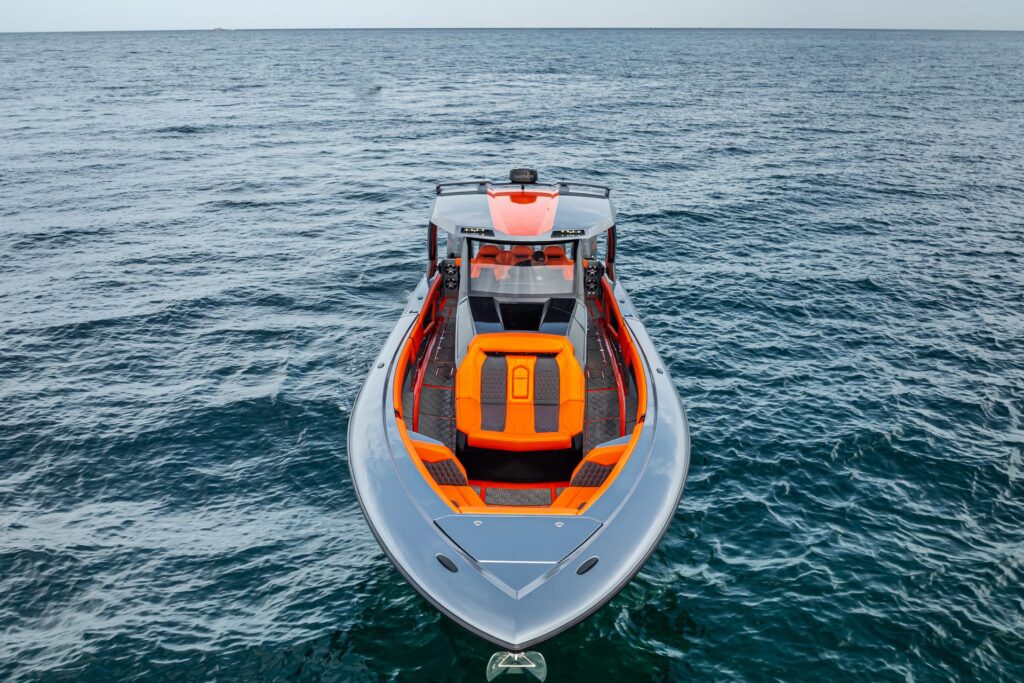
Deep-V and Real Offshore Performance
Serious offshore boats rely on deep-V hull designs for a reason.
A deep-V hull slices through water rather than riding on top of it. It reduces impact in chop, maintains directional stability, and improves ride quality at speed.
But not all deep-V hulls are equal.
Subtle differences in deadrise, strake placement, weight distribution, and overall geometry dramatically affect performance.
This is where true engineering separates itself from imitation.
Power Is Only Useful When It Can Be Applied
There is no shortage of powerful engines available today.
The challenge is applying that power effectively.
If a hull cannot stay stable, the operator cannot stay in the throttle.
If the operator cannot stay in the throttle, horsepower becomes irrelevant.
The best offshore platforms allow you to use more of the power available to you.
Not just in perfect conditions—but in real ones.
Ride Quality Is Performance
Many people separate ride quality from performance.
Offshore, they are the same.
A smoother ride allows the operator to maintain speed longer. It reduces fatigue. It increases confidence. It keeps the boat composed under pressure.
A harsh ride forces constant adjustment.
Adjustment slows you down.
Comfort is not softness.
It is control.
The Role of Structural Integrity
Hull design is not just about shape—it is about construction.
Reinforcement, layup schedule, and material quality determine how the hull behaves under stress.
A hull that flexes excessively loses efficiency.
A hull that is overbuilt maintains integrity under load.
That integrity translates directly into performance.
Adrenaline Powerboats, for example, builds with structural margin in mind—ensuring that the hull maintains composure not just during one aggressive run, but over years of repeated use.
That consistency matters more than a single top-speed number.
Balance and Weight Distribution
Even the best hull design can be compromised by poor balance.
Fuel load, passenger placement, and component positioning all influence how the boat rides.
A well-designed hull accounts for these variables.
It remains predictable even as conditions and load shift.
That predictability allows the operator to stay confident at speed.
Confidence keeps the boat moving efficiently.
Why Experienced Operators Focus on the Hull First
Ask someone with real offshore experience what matters most, and the answer is rarely horsepower.
It is how the boat runs.
How it feels.
How it responds.
How it handles imperfect water.
These qualities all come from hull design.
Power is added after the foundation is correct.
Not before.
The Illusion of Spec Sheets
Specifications can be misleading.
Horsepower numbers are easy to compare.
Hull performance is not.
Two boats with identical power can perform completely differently depending on hull design.
One may feel stable and confident.
The other may feel unpredictable and demanding.
On paper, they look the same.
On the water, they are not even close.
Performance That Lasts
True offshore performance is not about one impressive pass.
It is about repeatability.
The ability to run hard, consistently, across varying conditions, without fatigue or instability.
That level of performance comes from design.
Not just power.
Why This Matters for Serious Buyers
For those considering a high-performance offshore boat, focusing solely on horsepower is a mistake.
Power can be added.
Design cannot be corrected after the fact.
The hull determines the ceiling of performance.
Everything else operates within it.
Choosing the right platform means choosing a hull that can handle real water, sustained speed, and long-term use.
Built From the Bottom Up
The best offshore boats are built from the hull up.
Everything else—engines, controls, finishes—is layered onto that foundation.
When the foundation is correct, the entire experience improves.
Acceleration feels cleaner.
Speed feels more stable.
Control feels more natural.
Confidence builds quickly.
That is what separates serious performance from surface-level specification.
Final Thought
Horsepower may get attention.
But hull design earns respect.
Because offshore, where conditions are real and performance cannot be faked, the boat that runs best is not the one with the biggest number.
It is the one with the strongest foundation.
Begin your private build consultation: https://lp.adrenalinepowerboats.com/reaper-quote
Explore Adrenaline Powerboats: https://adrenalinepowerboats.com/home/